
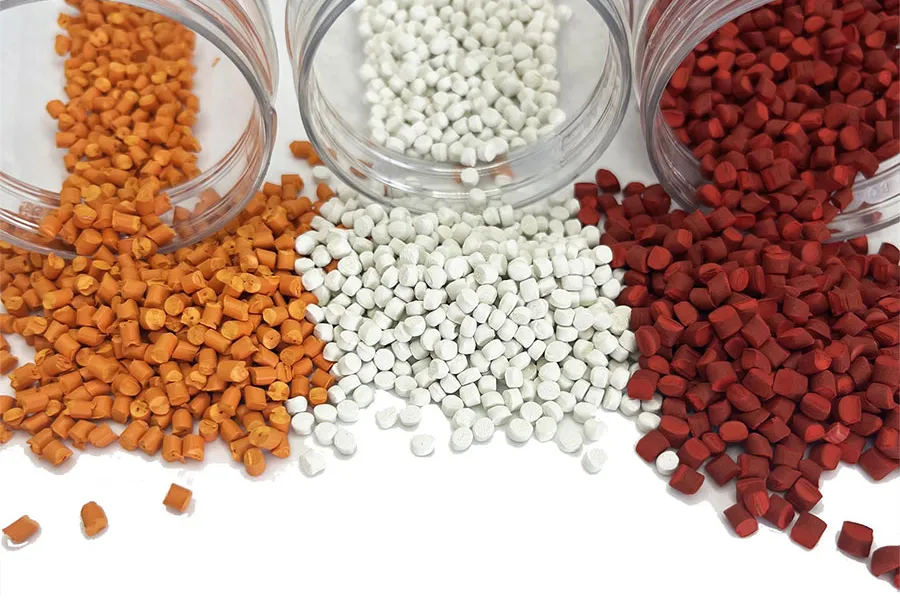
Choosing the right polymer masterbatch is not only about shade, additive package, or price. In real production, the carrier resin determines whether pigments disperse well, whether melt flow stays stable, and whether the finished part meets its intended clarity, strength, and surface quality. On the Nuoxin website, the polymer masterbatch line is organized around resin-specific solutions such as PC, PET, PA, PLA, ABS, and PP grades, which reflects a practical market truth: compatibility must come before color or function.
Carrier resin compatibility affects three critical areas. First, it influences dispersion. When the carrier and base resin melt and mix in a similar way, pigments and additives distribute more evenly. Second, it affects process stability. A compatible polymer masterbatch reduces streaks, haze, flow mismatch, and feeding inconsistency that can create visible defects or higher scrap rates. Third, it protects end-use performance, including gloss, transparency, toughness, light transmission, and dimensional accuracy.
MOCOM’s engineering-plastics guidance makes this principle clear: whenever possible, the masterbatch should use the same carrier polymer as the base polymer, because that improves compatibility, molding behavior, and final-part quality. The same logic also helps processors select dosage windows more safely, especially when they are running injection molding, extrusion, or bottle-preform applications where heat history and residence time matter.
How to choose polymer masterbatch by resin family
For general polyolefin applications, PE- or EVA-based systems are often widely used because they are compatible with PE, PP, and several TPE families. This is why packaging films, bags, caps, and many extrusion products can often use flexible broad-application carrier systems without sacrificing baseline process stability.
Nuoxin’s resin-specific product structure shows this clearly. Its PC masterbatch is designed with a PC carrier for polycarbonate applications and is listed for processing around 260–320°C with a recommended dosage of 0.5%–3%. Its PET masterbatch uses a PET carrier for preforms, bottles, and sheet extrusion and is listed for processing around 240–300°C. These temperature windows, carrier selections, and dosage recommendations are strong signals that matching carrier behavior is the safer route during melting, residence time, and cooling.
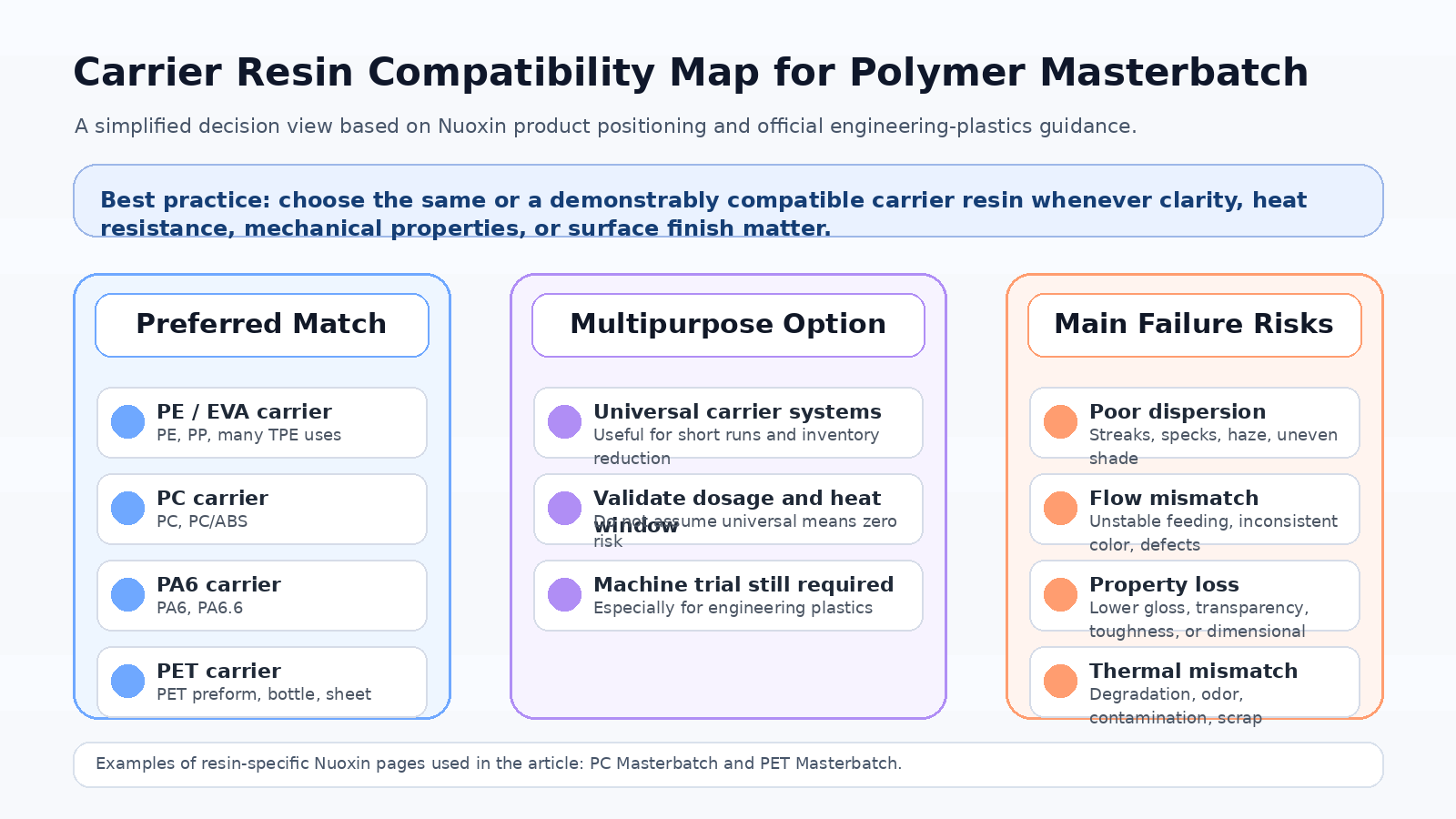
In practice, a processor choosing polymer masterbatch should ask four questions before ordering: Is the carrier identical or demonstrably compatible with the base polymer? Does the thermal stability of the pigment and additive package exceed the actual processing temperature? Is the melt-flow range close enough to support good mixing without over-shearing? Will the formulation preserve key end-use requirements such as clarity, gloss, impact strength, or surface finish?
Compatibility logic by carrier resin family
| Carrier resin | Typical match | What it helps protect | Reference basis |
| PE or EVA | PE, PP, many TPE uses | Broad use across common polyolefin systems | MOCOM guideline |
| PC | PC, PC/ABS | Best fit for transparent, high-heat PC uses | MOCOM guideline + Nuoxin PC page |
| PA6 | PA6, PA6.6 | Supports nylon processing and thermal profile | MOCOM guideline |
| PET | PET preform, bottle, sheet | Supports clarity, thermal stability, and polyester compatibility | DuPont PET guide + Nuoxin PET page |
| Universal compatible carrier | Wide range of common polymers | Useful for short runs; still confirm with plant trials | Avient / Ampacet |
Universal systems vs resin-specific systems
The biggest mistake in polymer masterbatch sourcing is assuming that a “universal” color concentrate will always deliver the same result across all resin families. Universal systems have real value, especially for short runs, inventory reduction, or broad plant usage. Avient’s Omnicolor line, for example, is positioned as a multipurpose compatible carrier system, and Ampacet’s RediBatch also markets a universal carrier concept for common polymer families. These solutions can be effective when the application window is broad and performance requirements are moderate.
But universal does not mean unlimited. For high-clarity PET, high-heat PC, or other engineering plastics, processors still need to confirm chemical compatibility, dosage, and thermal behavior under actual machine conditions. Buyers should avoid treating polymer masterbatch as a plug-and-play ingredient; it is a process material that must fit the full resin-processing temperature, shear, and cooling profile. That warning is especially relevant for bottle preforms, transparent packaging, technical molded parts, and applications where optical balance or dimensional stability are strict commercial requirements.
How polymer masterbatch influences end-use performance
The right polymer masterbatch does more than add color. It contributes to production efficiency and product consistency. On the Nuoxin site, polymer masterbatch benefits are framed around superior color consistency, excellent dispersion, enhanced processing efficiency, wide polymer compatibility, and improved final-product performance. Those claims align with what processors typically measure on the floor: lower variation, faster color change control, more stable dosing, and fewer cosmetic defects.
For PC applications, performance priorities often include heat resistance, dimensional accuracy, and optical balance. Covestro notes that Makrolon polycarbonate combines glass-like transparency, impact resistance, and high dimensional stability, which means the color system used in that matrix must also respect those targets. In PET systems, material guides emphasize clarity, acetaldehyde control, thermal stability, and preform consistency. In both cases, the best polymer masterbatch is the one that preserves the base resin’s intended performance envelope rather than forcing the processor to compensate for poor compatibility later in the line.
Why this topic matches Nuoxin’s site architecture
From an SEO and product-positioning perspective, Nuoxin is not trying to sell a vague colorant. It is presenting a polymer masterbatch portfolio that maps directly to application-specific needs. The polymer masterbatch category page emphasizes polymer compatibility, improved processing efficiency, and applications in packaging, automotive, household goods, agriculture, and construction. More importantly, that category is backed by resin-specific product pages such as PC Masterbatch and PET Masterbatch. That structure is useful for both search engines and industrial buyers because it connects broad keyword demand to concrete formulation logic.
For buyers comparing options, the PC Masterbatch page is the stronger internal destination for engineering-plastics applications, while the PET Masterbatch page is the better entry point for preform, bottle, and sheet projects. Those internal paths reduce friction and help the site rank for both category-level and resin-level search intent.
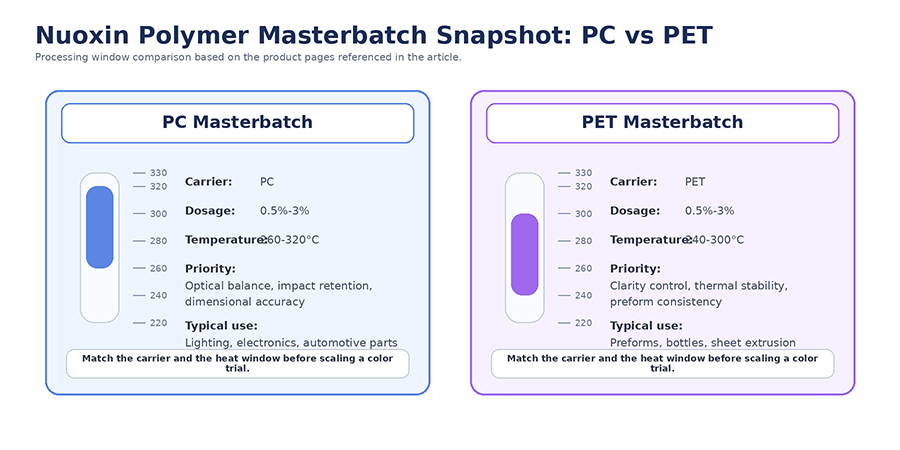
Nuoxin product snapshot: PC vs PET processing window.
| Product page | Carrier | Dosage | Temp. window | Typical use | Direct link |
| PC Masterbatch | Polycarbonate (PC) | 0.5%–3% | 260–320°C | Lighting, electronics, automotive parts | PC product page |
| PET Masterbatch | PET | 0.5%–3% | 240–300°C | Preforms, bottles, sheet extrusion | PET product page |
Practical sourcing checklist
- Confirm whether the carrier is identical to the base polymer or validated as compatible.
- Verify that pigment and additive heat stability exceeds the real processing temperature.
- Check whether melt-flow behavior is aligned with injection molding or extrusion needs.
- Run a plant trial if clarity, gloss, toughness, or dimensional stability are critical.
- Use resin-specific pages and technical sheets instead of relying only on a generic color name.
Recommended Nuoxin product
For internal linking within the article, the most relevant product destinations are PC Masterbatch and PET Masterbatch. Both pages support the carrier-resin argument with clearer dosage and processing context than a generic category page alone.
Conclusion
The best polymer masterbatch is not the one with the strongest marketing claim. It is the one whose carrier resin, thermal profile, and dosage window are aligned with the base polymer and the real process. For commodity polyolefins, broad-compatibility systems may be acceptable. For PET, PC, PA, and other demanding systems, resin-specific design is usually the safer and more profitable route. That is why carrier resin compatibility should sit at the center of every polymer masterbatch selection decision.