
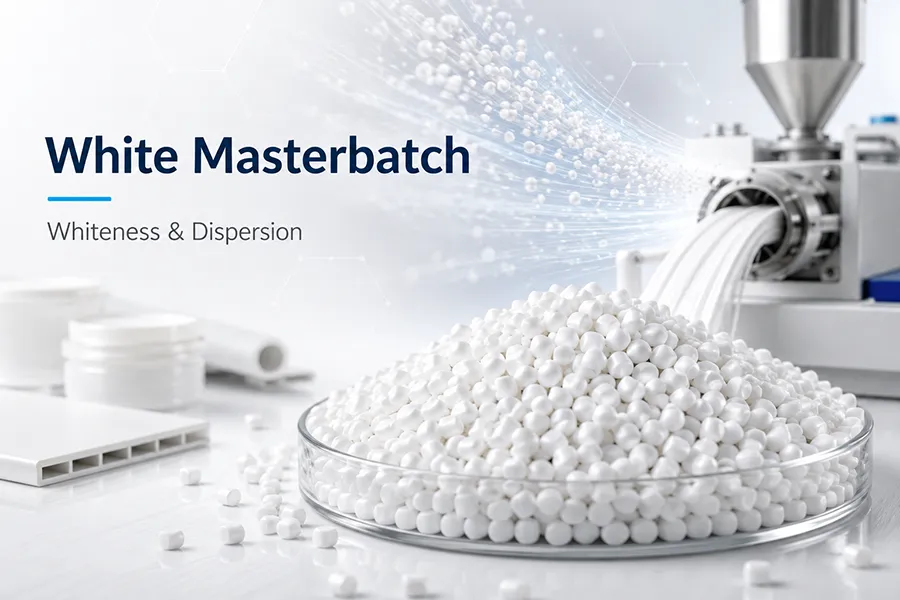
In the production of plastic products, white masterbatch serves not only as a fundamental coloring agent but also directly influences the finished product’s whiteness, opacity, surface gloss, and overall aesthetic texture. This article provides a systematic analysis of the key factors affecting its whiteness and dispersibility, aiming to assist plastic processing enterprises in making more informed decisions when procuring and utilizing white masterbatch.
1. What is White Masterbatch?
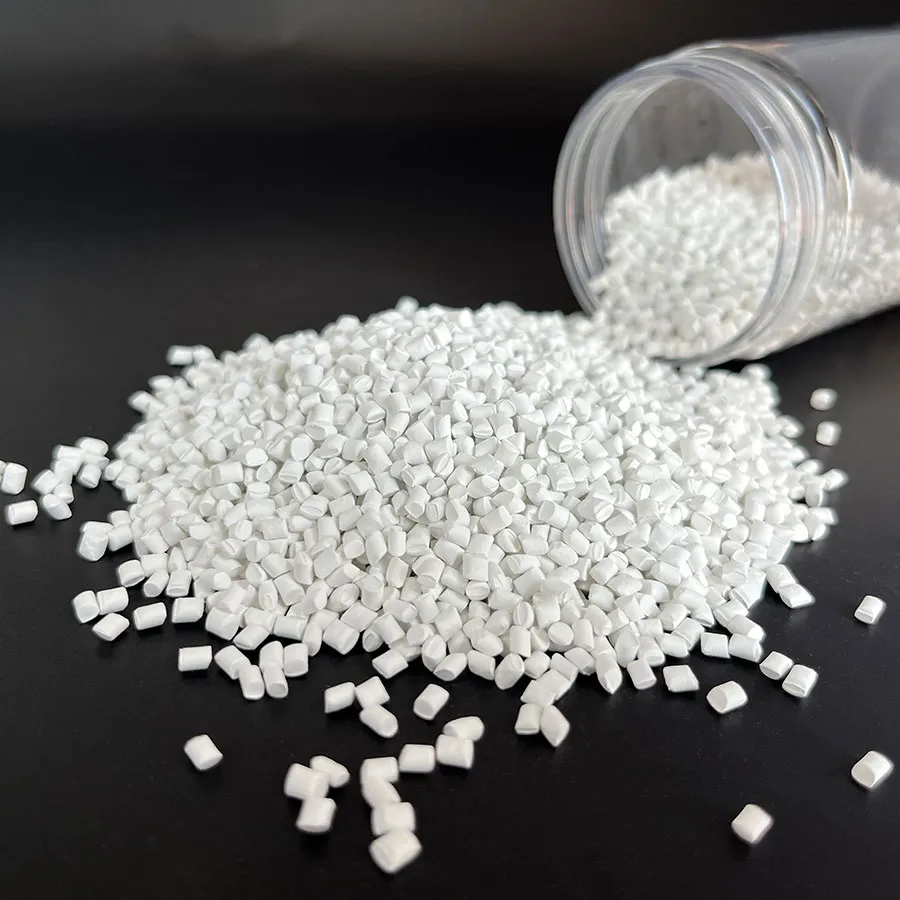
White masterbatch is a functional masterbatch used for coloring plastics. It is produced by pre-dispersing pigments and additives within a carrier resin to form cylindrical white granules, which can be mixed directly with virgin plastic materials. Its primary function is to provide a uniform and stable white base for plastic products while simultaneously enhancing weather resistance and processing performance through the addition of specialized additives. Widely utilized in sectors such as sheets, pipes, food containers, toys, and automotive components, it supports a diverse range of molding processes, including blow molding, extrusion, injection molding, and film blowing.
Technical Principles and Core Components of White Masterbatch
White masterbatch relies primarily on titanium dioxide as its main pigment. Through the application of high shear forces, the pigment particles are refined to a micron scale and encapsulated within a low-melting-point polyethylene or polypropylene carrier resin. This structural design facilitates rapid dispersion of the pigment during processing, thereby preventing issues such as color spots caused by pigment agglomeration. Its lightfastness rating ranges from Grade 6 to 9 (according to international standards), enabling it to withstand prolonged exposure to ultraviolet radiation. Furthermore, its weather resistance is characterized by a color difference control range of 2–4 cm (under xenon lamp aging test conditions), ensuring that outdoor plastic products exhibit no significant fading for a period of up to three years.
2. Why is Whiteness Crucial for White Masterbatch?
The whiteness of white masterbatch is primarily derived from the titanium dioxide contained within it. However, numerous factors influence the whiteness of titanium dioxide; these include, most notably, the size, shape, and particle size distribution of the titanium dioxide particles, the type and content of impurities present, and the presence of crystal lattice defects within the particles.
Generally speaking, titanium dioxide produced via the chloride process exhibits superior whiteness compared to that produced via the sulfate process. This is because the chloride process demands higher purity in raw materials and introduces fewer impurities during the manufacturing stage. In the actual market for white masterbatches, many manufacturers of functional white masterbatches attempt to pass off their products as containing titanium dioxide by incorporating inorganic fillers—such as calcium carbonate, barium sulfate, or zinc sulfide—that possess equivalent ash content. In reality, however, the whiteness of these inorganic powders is simply incomparable to that of titanium dioxide.
3. How to Control the Whiteness of White Masterbatches?
First and foremost, the whiteness of a white masterbatch is primarily determined by the color of its primary colorant—titanium dioxide; it is subsequently influenced by the choice of carrier resin and additives. Therefore, our approach must begin with these three components: titanium dioxide, the carrier, and the additives.
3.1 Selection of Titanium Dioxide
Aim for a Clean, Brilliant White. Titanium dioxide produced via the chloride process typically exhibits a uniform molecular weight distribution and a fine particle size, resulting in a bluish undertone. Conversely, if the titanium dioxide particles are excessively large or the molecular weight distribution is uneven—leading to a yellowish undertone—it becomes impossible to achieve a bright, pure white effect.
3.2 Addressing Insufficient Whiteness
If the titanium dioxide used in the white masterbatch fails to provide adequate whiteness, one must turn to auxiliary agents. Optical Brighteners (Fluorescent Whitening Agents) can be employed to enhance whiteness. These agents are highly effective, albeit expensive. Additionally, a “green-toning” technique—utilizing specific green pigments to neutralize yellow undertones—can be applied to achieve a brighter white; this resulting shade is often referred to as “magnetic white.” Naturally, one may also incorporate small quantities of other pigments to achieve the desired level of whiteness.
3.3 Beyond the Colorant and Additives
The Carrier Resin. In addition to the two aspects mentioned above, the color of the carrier resin—a factor often overlooked—also exerts a certain influence on the whiteness of the masterbatch. Generally, it is advisable to select a virgin (non-recycled), transparent, or naturally white carrier resin. This choice enhances whiteness but may also result in relatively higher production costs. Conversely, if a green-tinted or dark-colored carrier resin is selected, the resulting masterbatch will exhibit lower whiteness, and the final plastic product will fail to achieve a sufficiently bright white appearance.
4. Key Factors Influencing the Dispersibility of White Masterbatches
Dispersibility plays a critical role in the application of titanium dioxide within plastic matrices. Generally speaking, the finer the titanium dioxide particles, the better their dispersion and the higher their tinting strength (coloring power). Furthermore, in applications requiring high-precision printing—such as plastic films—the use of white functional masterbatches with excellent dispersibility results in printed patterns with superior clarity, tonal depth, and color vibrancy. This is because the microscopic surface smoothness of the base film material is one of the decisive factors determining the overall quality of the printed pattern.
4.1 The Impact of Pigment Characteristics
White masterbatch is, in essence, a highly concentrated aggregate of pigments. Since a large volume of pigment powder is compacted together within the masterbatch, the tendency for these particles to agglomerate can easily compromise the effectiveness of their dispersion throughout the plastic matrix. In particular, color pigments such as titanium dioxide and carbon black exhibit strong agglomeration tendencies and are prone to clumping. Therefore, selecting the appropriate pigment type and particle size—based on the client’s specific product requirements and manufacturing processes—is crucial for enhancing the dispersibility of the masterbatch.
4.2 Issues Related to Static Electricity Interference
Some masterbatches lack anti-static additives; consequently, during the manufacturing process, static electricity is easily generated as the masterbatch is mixed and agitated with the plastic raw materials. This leads to uneven distribution of the masterbatch within the raw material matrix, ultimately resulting in color inconsistencies across the finished products.
4.3 The Impact of Melt Flow Rate (MFR)
In an effort to optimize processing performance, some masterbatch suppliers select resins with a high MFR to serve as carrier materials. However, a higher MFR is not always preferable; rather, it requires a comprehensive assessment that balances product performance, surface quality, and processing requirements. If the MFR is too low, the masterbatch struggles to disperse fully within the finished product; conversely, an excessively high MFR may compromise other critical product properties. Therefore, designing the masterbatch’s MFR appropriately—based on the specific characteristics of both the carrier and the pigments—is vital for improving dispersibility.

4.4 The Impact of Addition Ratio
To manage costs or ensure specific product performance standards, some masterbatches are designed with a relatively low recommended addition ratio. However, if the addition ratio is too low, the masterbatch becomes difficult to disperse uniformly throughout the plastic matrix, frequently leading to issues of uneven coloration.
4.5 The Impact of the Dispersion System
During the white masterbatch manufacturing process, dispersants and lubricants are typically incorporated to facilitate the uniform distribution of the pigments. If the dispersant is selected inappropriately, it fails to effectively break down the pigment agglomerates within the masterbatch, thereby resulting in poor dispersibility.
4.6 The Impact of Density Differences
To enhance opacity or covering power, white masterbatches often incorporate high-density pigments—such as titanium dioxide (with a density of approximately 4.0 g/cm³). This disparity in density can easily cause the masterbatch to settle at the bottom during the mixing process, preventing it from blending fully with the plastic raw materials and ultimately leading to color inconsistencies in the finished product.
4.7 The Impact of Carrier Selection
The white masterbatch carrier serves as the medium for conveying the pigments and other additives; consequently, its specific type, grade, model, MFR, and physical form directly influence both the processing performance and the dispersion effectiveness of the masterbatch. Taking polyolefin-based products as an example, the choice of carrier—whether PP, PE, or EVA—as well as the decision to use a single carrier versus a mixed system, and even the specific grade, melt flow index (MFI), and physical form (powder or granule) of the carrier, all exert a significant influence on the quality of the final product.
4.8 Impact of Production and Processing
The manufacturing of white masterbatches involves a multitude of processes. From the selection of mixing equipment and mixing protocols to the choice of granulation machinery, screw configurations, granulation techniques, and even cooling procedures—any variation in a single stage can ultimately affect the final performance characteristics of the masterbatch.
Impact of Molding Processes
Plastic molding processes also play a critical role in determining the dispersibility of the white masterbatch. In the case of injection molding, for instance, improper parameter settings—such as temperature, pressure, or holding time—can lead to insufficient dispersion of the masterbatch.
Impact of Equipment and Molds
The condition of the processing equipment is equally crucial; for example, a severely worn screw results in reduced shear force, thereby diminishing the effectiveness of the white masterbatch’s dispersion. Mold design is of similar importance; factors such as the gate location in injection molds, or the runner structure, slope, and extrusion temperature settings in extrusion molds, all influence both the dispersibility of the masterbatch and the overall molding quality of the product.
5. Varying Requirements for White Masterbatches Across Different Applications
When utilized in base resins such as PE, PP, PVC, PPR, or ABS, a recommended addition ratio of 1–5% (by weight) is suggested. For instance, in the production of food containers, blending the masterbatch with polypropylene raw material and subsequently molding the mixture via an injection molding machine at temperatures between 180°C and 220°C yields a product characterized by a smooth surface and uniform whiteness. It is essential to avoid co-processing with recycled materials to prevent impurities from compromising dispersion effectiveness; furthermore, the processing temperature should be maintained at 10–20°C above the melting point of the carrier resin to ensure the complete melting of the masterbatch granules.
6. Technical Advantages and Performance Profile of Nuoxin White Masterbatches
Compared to traditional color pigments, Nuoxin white masterbatches offer three key improvements: First, dispersibility is enhanced by 30%, thereby reducing the frequency with which filter screens must be replaced during production. Second, the whiteness value is increased by 15–20%, effectively meeting the stringent color purity requirements of high-end toy manufacturing. Third, compatibility with base resins has been optimized, enabling the achievement of uniform coloration—even at a wall thickness of just 0.3 mm—in components such as automotive bumpers. Laboratory testing has confirmed that its migration resistance meets national standards; specifically, no color bleeding was observed after 168 hours of exposure to an oil- and grease-rich environment.
Nuoxin masterbatches have successfully passed heavy metal content testing in accordance with the GB/T 18883-2002 *Standard for Indoor Air Quality*; harmful substances such as lead and cadmium were not detected. The manufacturing process utilizes twin-screw extruders for melt compounding, equipped with laser particle size analyzers to monitor pigment dispersion in real-time, thereby ensuring that the color difference (ΔE) for every batch remains within ≤1.5 (based on the CIE 1976 standard). The product is packaged in moisture-proof aluminum foil bags and can be stored in a dry environment at temperatures below 30°C for up to 12 months without clumping.
Summary
For manufacturers of plastic products, the selection of a white masterbatch should not focus solely on unit price, but rather prioritize actual usage costs and the quality of the finished product. High-quality white masterbatches enable superior whiteness, more stable dispersion, and fewer production defects—even at reasonable additive ratios—thereby helping enterprises enhance product aesthetics, reduce rework rates, and maintain a stable, long-term supply chain.