
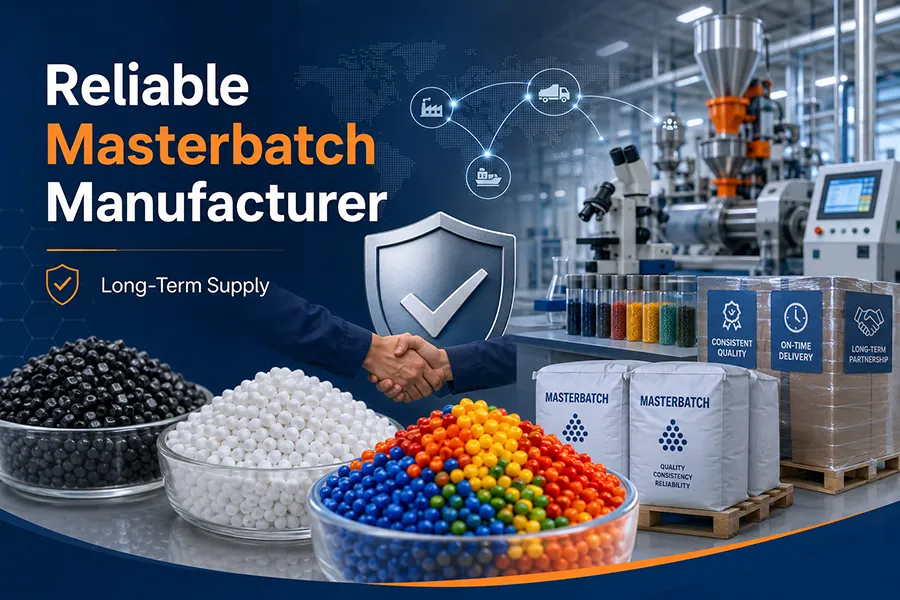
China began developing masterbatches in the mid-1970s. Currently, driven by economic growth and increasingly stringent environmental protection requirements, the advantages of masterbatch coloring technology have become increasingly evident. The sector is experiencing strong growth momentum domestically, with applications becoming ever more widespread. This article offers guidance on how enterprises can select a reliable masterbatch manufacturer.
1. The Growing Importance of the Masterbatch Industry
Polymer composite coloring materials—exemplified by masterbatches—are composite materials produced by processing pigments, resins, and additives according to specific formulas and ratios to meet client requirements. They occupy a vital role and status within the fiber and plastics manufacturing industries.
In terms of the industrial chain structure, the upstream segment of the masterbatch industry encompasses the supply of various raw materials. Pigments constitute the fundamental component of color masterbatches, typically accounting for 20% to 80% of the content; white masterbatches typically utilize titanium dioxide as the pigment, while black masterbatches employ carbon black. Resins serve as the matrix (base material) for masterbatches; through processes such as melting and shearing, the resin facilitates the uniform dispersion of the pigments.
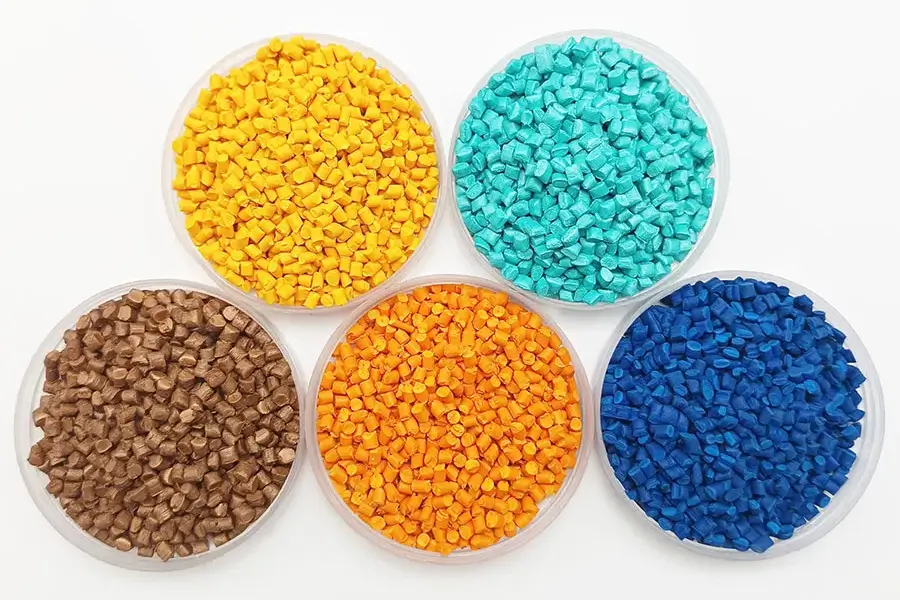
The midstream segment involves the production and processing of masterbatch products. Currently, masterbatch products in my country can be broadly categorized into white masterbatches, black masterbatches, color masterbatches, and functional masterbatches.
Regarding the downstream application market, current trends indicate that Chinese masterbatch products are widely utilized in resins such as polyethylene (PE), polypropylene (PP), polystyrene (PS), ABS, nylon, PC, PMMA, and PET. These applications result in the production of a diverse array of colorful products, including fibers, apparel, daily-use plastics, wires and cables, home appliances, agricultural films, automotive components, and medical devices.
As downstream markets continue to raise their standards regarding product aesthetics, environmental performance, and functional capabilities, the demands placed by enterprises upon their masterbatch suppliers are also becoming increasingly rigorous. Today, masterbatches are no longer merely simple coloring agents; they have evolved into critical components that significantly influence both product quality and brand competitiveness.
Consequently, for enterprises, the question of how to select a reliable masterbatch manufacturer—one capable of ensuring a stable, long-term supply—has emerged as a pivotal issue within the realm of supply chain management.
2. Defining Your Specific Requirements: The First Step in Supplier Selection
Before choosing a masterbatch manufacturer, companies should first clarify their actual application requirements. Different plastic products, processing methods, and end-use applications require different masterbatch performance characteristics.
If a company only compares prices without clear purchasing standards, problems may occur during production, such as color deviation, poor dispersion, unstable processing, surface defects, or inconsistent product quality.
First, companies should confirm the resin material used. Common materials include PE, PP, PS, ABS, PA, PC, PMMA, and PET. Different resins have different compatibility requirements. A qualified masterbatch manufacturer should select suitable carrier resin and additive systems according to the base material to ensure full compatibility.
Second, companies should confirm the processing method. Injection molding, extrusion, blown film, blow molding, drawing, sheet production, pipe production, and fiber spinning all have different requirements for dispersion, heat resistance, fluidity, moisture content, and dosage ratio.
For example, the blown film industry focuses more on dispersion, gel point control, and film surface quality. The injection molding industry focuses on color uniformity, flowability, and surface appearance. The fiber industry has higher requirements for filtration performance, uniform dispersion, and batch-to-batch color consistency.
Third, companies should clarify the final product application. Food packaging, outdoor products, automotive parts, home appliance housings, agricultural films, and wires and cables all have different requirements for environmental compliance, weather resistance, heat resistance, migration resistance, and functional performance. For export products, companies may also need documents such as RoHS, REACH, FDA, and MSDS.
| Requirement Type | Details to Confirm |
| Resin Material | PE, PP, PS, ABS, PA, PC, PMMA, PET, etc. |
| Processing Method | Injection molding, extrusion, blown film, blow molding, drawing, sheet, pipe, fiber spinning, etc. |
| End Use | Food packaging, outdoor products, automotive parts, appliance housings, agricultural films, wires and cables, etc. |
| Compliance Requirements | RoHS, REACH, FDA, MSDS, heavy metal testing, etc. |
3. Evaluate the Manufacturer’s Formulation R&D Capability
Masterbatch is not simply a mixture of pigments, resin, and additives. It requires precise formulation design based on material type, processing method, and application environment. A reliable masterbatch manufacturer should have strong formulation development capabilities and be able to provide suitable product solutions according to customer needs.
A professional manufacturer can usually offer multiple masterbatch types, including white masterbatch, black masterbatch, color masterbatch, filler masterbatch, functional masterbatch, desiccant masterbatch, and customized masterbatch.
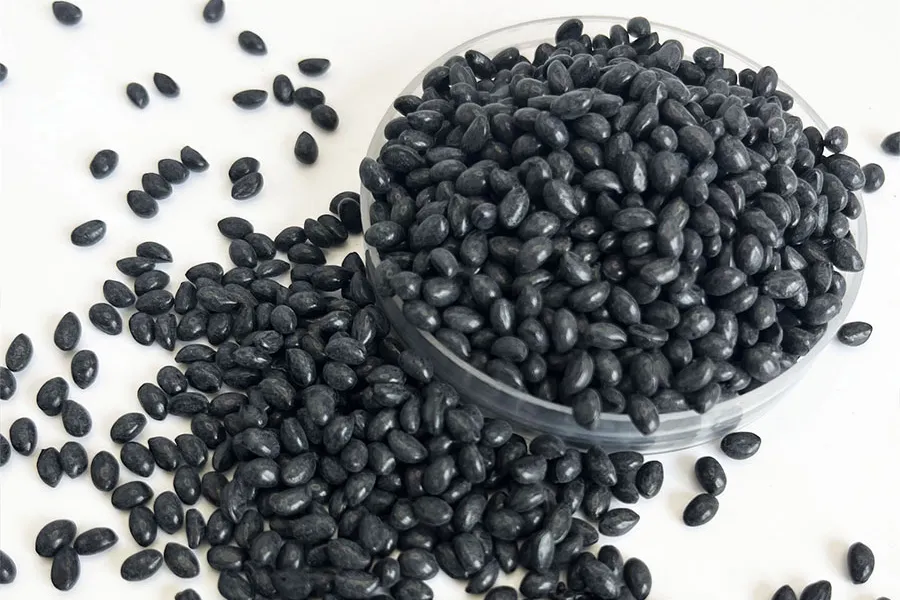
Different masterbatch products have different technical priorities. White masterbatch usually uses titanium dioxide as the main pigment and requires attention to whiteness, opacity, dispersion, and heat resistance. Black masterbatch commonly uses carbon black and requires good blackness, brightness, dispersion, tinting strength, and weather resistance. Color masterbatch focuses more on accurate shade, color stability, migration resistance, and batch consistency.
For customers with special application requirements, standard products may not fully meet production needs. Some customers may require higher opacity, deeper blackness, lower addition ratio, better heat resistance, stronger dispersion, or support for specific environmental standards. A reliable manufacturer should not only provide fixed standard models but also adjust formulations according to the customer’s material, process, product thickness, processing temperature, and application environment.
4. Quality Control Determines Long-Term Supply Stability
For long-term cooperation, quality stability is more important than a single low purchase price. If masterbatch quality fluctuates between batches, it may directly affect downstream product quality. Common problems include color differences, colored spots, gel points in films, flow marks in injection molded parts, uneven gloss, and even product rework or scrapping.
A reliable masterbatch manufacturer should begin quality control from the raw material stage. Major raw materials include pigments, carrier resins, dispersants, and functional additives. If a supplier frequently changes pigment or resin sources, the final product may show color or performance variation even when the formulation ratio remains the same.
Stable raw material supply channels and incoming inspection systems are the foundation of long-term quality consistency.
During production, the manufacturer should strictly control material weighing accuracy, mixing uniformity, extrusion temperature, screw shearing, melt dispersion, cooling, pelletizing, and final packaging. Pigment dispersion is one of the key factors affecting masterbatch quality. If dispersion is insufficient, customers may experience colored spots, streaks, graininess, or uneven color during production.
For finished product testing, companies should pay attention to whether the supplier has testing capabilities for color difference, dispersion, melt flow index, moisture content, heat resistance, migration resistance, and sample plate performance. A high-quality supplier should not only test masterbatch pellets but also conduct application testing based on the customer’s actual resin and processing method.
| Testing Item | Main Purpose |
| Color Difference Test | Checks whether color remains stable. |
| Dispersion Test | Checks whether pigments are evenly distributed. |
| Melt Flow Index Test | Evaluates processing flowability. |
| Moisture Content Test | Helps reduce bubbles and processing defects. |
| Heat Resistance Test | Evaluates stability during high-temperature processing. |
| Migration Resistance Test | Avoids color migration or contamination. |
| Sample Plate Test | Simulates the actual appearance of finished products. |
5. Pay Attention to Sampling and Color Matching Capability
Color performance is the most visible quality indicator of color masterbatch. For packaging, home appliances, automotive parts, daily-use products, toys, and fibers, color stability directly affects product appearance and brand image.
When selecting a masterbatch manufacturer, companies should carefully evaluate its sampling and color matching capabilities.
A reliable manufacturer can usually match colors according to Pantone color codes, RAL color codes, customer samples, plastic parts, color plates, or brand-specified colors. The supplier should also be equipped with professional color matching technicians, standard light boxes, color difference meters, and sampling equipment.
It is important to note that the color of masterbatch pellets is not equal to the final product color. Final color can be affected by resin type, addition ratio, product thickness, processing temperature, surface gloss, mold condition, and processing method.
Therefore, a professional manufacturer will usually recommend that customers test samples under real production conditions instead of judging only by the pellet color.
6. Do Not Only Compare Unit Price; Compare Total Cost
Many companies tend to choose low-priced masterbatch products first. However, from a long-term production perspective, the lowest unit price does not necessarily mean the lowest cost. Companies should focus more on the cost per finished product and production stability.
Low-cost masterbatch may have risks such as insufficient tinting strength, higher addition ratio, poor dispersion, large batch color differences, unstable processing, increased defect rate, and slow after-sales response.
For example, a masterbatch may have a lower price per kilogram, but if it requires a higher addition ratio to achieve the target color, the actual usage cost may be higher.
When comparing suppliers, companies should evaluate unit price, addition ratio, tinting strength, defect rate, processing stability, after-sales support, and repeat-order consistency. A truly suitable long-term supplier should help customers reduce comprehensive production costs, not only provide a lower purchase price.
| Evaluation Item | Key Focus |
| Unit Price | Purchase price per kilogram. |
| Addition Ratio | Actual usage per ton of finished product. |
| Tinting Strength | Whether target color can be reached at a low dosage. |
| Defect Rate | Whether rework and scrap can be reduced. |
| Stability | Whether downtime and quality fluctuation can be reduced. |
| After-Sales Support | Whether production issues can be solved quickly. |
| Repeat-Order Consistency | Whether long-term repeat orders remain stable. |
7. Delivery Capability Affects Supply Chain Security
Although masterbatch is an auxiliary material in plastic processing, supply interruption can affect the entire production line. This is especially true for customized colors, special formulations, and functional masterbatch products, which are difficult to replace with identical alternatives in a short time.
Therefore, delivery capability is also an important standard for judging whether a supplier is reliable.
Companies should understand the supplier’s factory capacity, number of production lines, regular product inventory, raw material stock, order scheduling cycle, emergency order response ability, export packaging capability, and logistics experience.
For long-term customers, excellent suppliers usually establish formulation records, batch traceability records, and safety stock mechanisms to ensure stable supply for future orders.
A reliable masterbatch manufacturer does not only produce according to orders. It should also establish fixed formulation management, batch tracking, regular product stock, advance raw material preparation, delivery communication, and rapid quality issue response mechanisms. These systems can effectively reduce supply chain risks and protect continuous production.
8. Technical Service and After-Sales Response Reflect Professionalism
In actual production, masterbatch performance may be affected by equipment, temperature, raw materials, molds, addition ratio, and mixing method. Therefore, even when the masterbatch itself is qualified, processing problems may still occur at the customer’s production site.
This makes technical service capability very important.
Customers may encounter problems such as light color, obvious color difference, colored spots on product surfaces, gel points in films, flow marks in injection molded parts, insufficient black brightness, poor white opacity, bubbles during processing, or unstable surface gloss.
A professional manufacturer will analyze the causes from multiple angles, including compatibility between masterbatch and resin, addition ratio, processing temperature, raw material moisture, mixing uniformity, equipment shearing capacity, and whether the formulation needs adjustment.
Suppliers that can provide technical analysis and practical after-sales support are more suitable for long-term cooperation.
Conclusion
Choosing a reliable masterbatch manufacturer is not only about selecting a product supplier. It is about selecting a long-term supply chain partner.
For plastic product companies, stable masterbatch supply can help achieve consistent color, stable processing, controllable product quality, higher production efficiency, lower purchasing risk, and safer long-term supply.
A masterbatch manufacturer suitable for long-term cooperation should have stable production capacity, mature formulation R&D capability, strict quality control systems, accurate color matching ability, reliable delivery capacity, complete technical service, and environmental compliance support.