
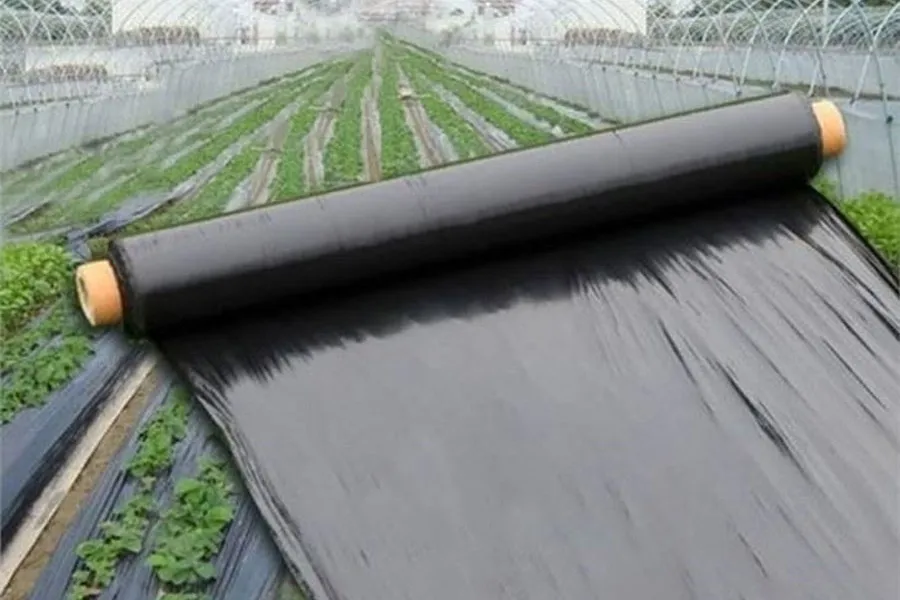
LLDPE vs HDPE is not only a resin comparison for packaging converters. It is a decision framework that affects film toughness, bottle rigidity, sealing behavior, downgauging potential, recyclability, and overall formulation cost. For manufacturers working with masterbatch systems, the choice between LLDPE and HDPE also changes how pigments, fillers, and functional additives disperse during processing.
Nuoxin’s product aligns well with this topic because packaging lines rarely ask which polyethylene is better in absolute terms. They ask which material can run smoothly, accept the right additive package, and maintain stable performance in real production. That is why the LLDPE vs HDPE discussion remains highly relevant for blown film, rigid packaging, extrusion, and cost-sensitive conversion projects.
LLDPE vs HDPE in flexible and rigid packaging
The current packaging market is pushing processors to make narrower choices with less room for trial and error. The European Commission’s packaging rules keep design for recycling high on the agenda, while CEFLEX continues to promote mono-material PE structures for flexible packaging. In that environment, LLDPE vs HDPE becomes a structural decision: it affects downgauging, recyclability, sealing behavior, stiffness, and the amount of formulation correction needed through additives or masterbatch.
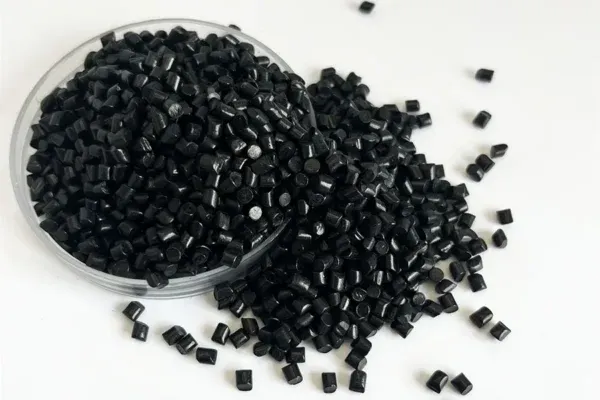
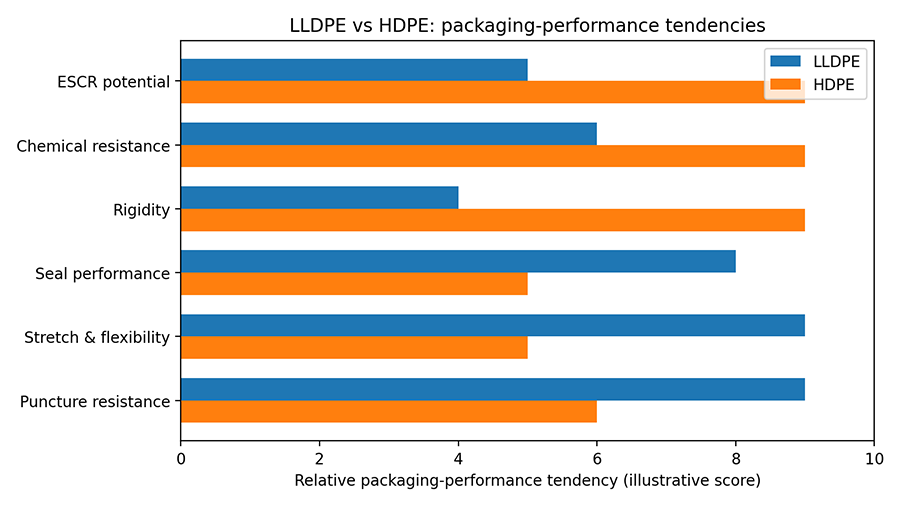
Dow describes LLDPE as a material family with high tensile strength, strong impact performance, puncture resistance, and enough flexibility to support thinner yet durable films. Those traits make LLDPE a natural fit for courier bags, stretch films, liners, agricultural film, and many flexible food or industrial packaging formats. When processors want toughness, stretch, puncture resistance, and good film toughness in a light structure, LLDPE is usually the first direction.
HDPE serves a different purpose. Public Dow, ExxonMobil, and SABIC sources point toward stress-crack resistance, rigidity, and blow-molded packaging performance. In practical terms, the LLDPE vs HDPE decision often separates flexible packaging from rigid packaging: LLDPE favors film toughness and seal-related performance, while HDPE favors bottle strength, container stiffness, and chemical-pack compatibility.
| Item | LLDPE (DOWLEX™ 2607G) | HDPE (DOW™ HDPE 6200 / ExxonMobil™ HD 5705) | Packaging and masterbatch implication |
| Density | 0.918 g/cm³ | 0.953–0.957 g/cm³ | HDPE suits higher-stiffness container structures; LLDPE better supports light flexible film. |
| Typical strength focus | Puncture, stretch, tear, film toughness | Rigidity, chemical resistance, ESCR, blow-molded lightweighting | Masterbatch choice should protect structure, not only color. |
| Typical processing route | Blown film / cast film / coextrusion | Blow-molded containers / thin-wall parts / profiles | LLDPE needs strong dispersion and seal retention; HDPE needs rigidity and crack-resistance retention. |
| Representative public note | High-performance blown film with mechanics, processability, and sealability | High-performance packaging applications with stiffness and ESCR emphasis | Performance targets differ sharply between flexible and rigid packaging. |
| Typical packaging use | Courier bags, liners, agricultural film, stretch film | Bottles, drums, caps, chemical containers, rigid packs | One article can capture both flexible and rigid packaging search intent. |
How LLDPE vs HDPE changes masterbatch matching
This is where material selection becomes commercially important. In many packaging projects, weak performance does not come from the base resin alone, but from poor compatibility between resin choice and masterbatch design. In LLDPE film structures, processors usually care about dispersion, low plate-out risk, seal integrity, puncture retention, and surface appearance. A poorly dispersed black or color system can create gels, streaks, or visual defects that quickly reduce film yield.
In HDPE packaging, the priorities shift. The masterbatch package must protect rigidity, appearance consistency, and crack-resistance margins while remaining compatible with the processing window of blow molding or rigid extrusion. That is why LLDPE vs HDPE should not be discussed without rheology, dispersion, loading rate, and end-use stress. The same additive strategy can behave very differently in a soft blown film versus a rigid bottle wall.
Nuoxin product matching opportunities
Nuoxin’s Color Masterbatch page is a practical product reference because color consistency and dispersion matter in both film and rigid PE applications. The Filler Masterbatch page is also relevant for cost-sensitive packaging lines where stiffness, opacity, and unit economics must be balanced carefully. For recycled or moisture-sensitive PE streams, desiccant masterbatch can also play an important role because moisture often becomes the hidden reason a line runs inconsistently.
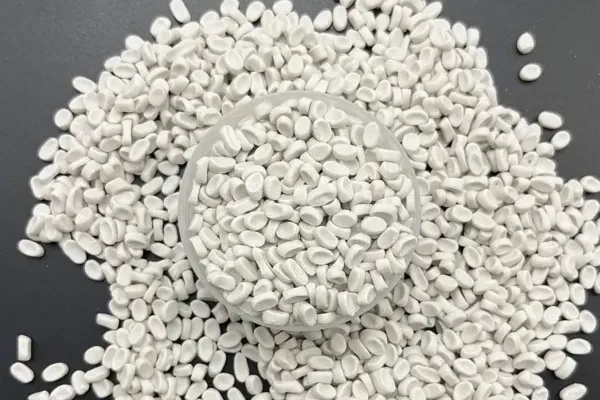
On flexible LLDPE packaging, filler use must be controlled so that puncture resistance, seal strength, and haze do not deteriorate too far. On HDPE bottles or rigid packs, filler can support cost control, but excessive loading may reduce crack resistance or drop performance. Meanwhile, Nuoxin’s current desiccant page highlights moisture absorption above 20% of its own weight, making it especially relevant where recycled material, humid storage, or unstable drying conditions are involved.
Nuoxin also emphasizes quality control, broad application compatibility, and packaging-oriented use cases. That supports a practical selection path: choose the resin family first, then match the masterbatch system to the process route, target loading, and end-use function. In day-to-day production, this approach helps processors reduce waste, stabilize output, and maintain more predictable package performance.
Current trends are rewriting the LLDPE vs HDPE conversation
A recent ScienceDirect study noted that PE remained the most used packaging polymer in the European market, with annual sales volume around 4.85 million metric tons in 2023. That matters because it shows PE is not disappearing from packaging strategy. Instead, the market is refining how PE structures are designed, downgauged, recycled, and reformulated. As recycled content increases, moisture control, odor management, color masking, and process stabilization become more important, which raises the value of functional masterbatch.
This is why LLDPE vs HDPE remains an important topic for Nuoxin’s audience. It captures a real industrial question at the intersection of material choice, circular design, packaging performance, and formulation stability. It is relevant to buyers comparing flexible-film optimization, rigid-container selection, and masterbatch compatibility within the same sourcing decision.
| Packaging scenario | Resin tendency | Recommended product | Public current-site cue | Matching logic |
| Color-focused PE packaging | LLDPE or HDPE depending format | Color Masterbatch | Site highlights color consistency, high dispersion, and wide use in packaging and films. | Best where brand appearance, shade stability, and low streak risk are critical. |
| Cost-sensitive blown film | Mainly LLDPE film structures | Filler Masterbatch | Site emphasizes cost efficiency, stiffness support, and processing optimization. | Useful for shopping bags, liners, and economy films where balance between cost and toughness is managed carefully. |
| Moist or recycled PE processing | Recycled LLDPE / HDPE | Desiccant Masterbatch | Site states moisture absorption can exceed 20% of its own weight. | Supports bubble stability, fewer moisture defects, and better processing consistency in recycled streams. |
| Blown-film output positioning | LLDPE-led film conversion | Blown Film application page | Nuoxin frames film as a core application route across product pages. | Helps connect resin choice to a real converting scenario rather than a purely descriptive product list. |
Conclusion: Choosing the right PE route for packaging and masterbatch performance
Nuoxin is well positioned to discuss packaging-oriented masterbatch solutions because its product presentation already connects material modification with practical production needs. The most useful takeaway is simple: LLDPE is typically favored when flexibility, impact resistance, and seal performance matter most, while HDPE is often preferred when stiffness, dimensional stability, and crack resistance are higher priorities. Once that material direction is clear, the masterbatch package can be matched more precisely to the process and the final packaging target.