
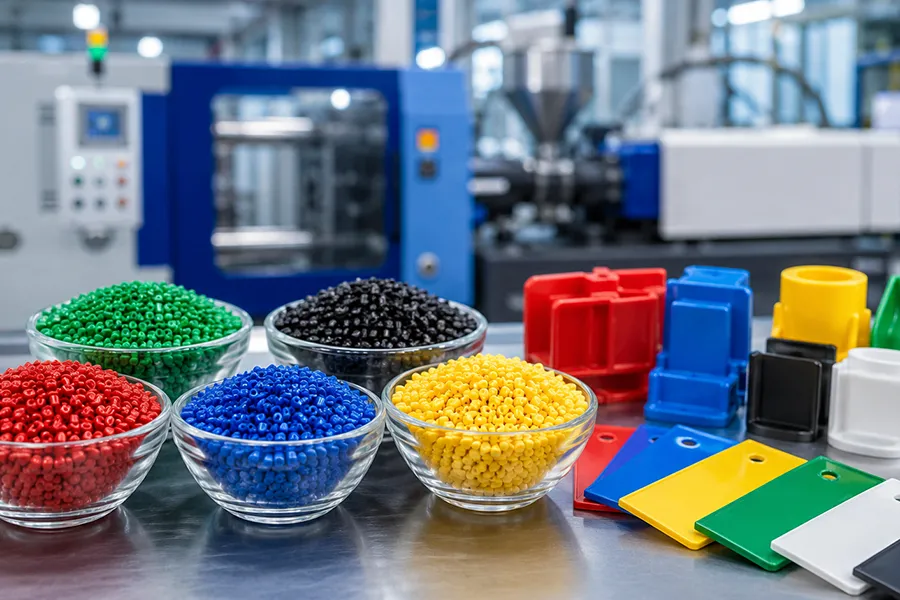
For both manufacturers and consumers, color consistency is a key criterion for measuring product quality! Especially in the plastics industry, achieving precise colors is no easy feat. The physical properties of plastics are incredibly diverse; from transparency to surface gloss, every detail can affect the final product’s color appearance.
1. How are colored plastics produced?
1.1 Masterbatch/Mixing
The first step in producing colored plastic products is typically to create granules using a masterbatch or mixing machine. Plastic extruders mix resin and colorants through a specific process to produce monochrome granules.
Depending on customer requirements, masterbatch manufacturers add additives and stabilizers to the formulation to impart specific properties to the polymer, such as heat resistance, moisture resistance, and UV protection. Colorants not only provide aesthetic appeal but also functionality. For example, adding carbon black enhances the weather resistance of automotive exterior plastic parts, while titanium dioxide increases the reflectivity of sunlight on the back of solar cells, thereby improving their efficiency.
1.2 Injection Molding
Processors use masterbatch or powder mixtures to mix with molten resin and add the necessary additives. Subsequently, molding techniques such as blow molding, thermoforming, or injection molding are used to bring the polymer to the customer’s desired shape.
After molding, the product undergoes cooling, cleaning, and rigorous quality control checks, including inspection for deformation, defects, and color quality.

1.3 Delivery
The crucial decision of determining the final product’s color and quality often falls to toy companies, car manufacturers, or home furnishing brands.
Regardless of the application area of the plastic product, implementing precise formulation and comprehensive quality control measures from the project’s inception is undoubtedly essential for the overall success of the product.
2. Basic Pigment Performance Considerations
2.1 Color Characteristics
Color: We must first ensure that the selected pigment’s color matches the expected color of the plastic product. For example, when producing red toys, we need to find a bright, pure red pigment. Some azo red pigments, with their particularly vibrant colors, are very suitable for this type of product. Different chemical structures determine the unique color trajectories of pigments; organic pigments often have more vibrant colors.
Color Intensity: This refers to the pigment’s ability to produce varying shades of color. Sometimes, when producing thin films, high-intensity pigments can achieve the desired color depth with just a small amount, ensuring color accuracy while reducing costs. Carbon black, for example, has very high color intensity, giving it a significant advantage in producing black plastic products.
2.2 Dispersibility
This is a crucial indicator. Poor pigment dispersion results in uneven coloring in plastic products, with patches of dark and light pigments. Especially in processes like blown film and injection molding, poor dispersibility severely impacts product appearance and quality. Generally, pigments with special surface treatments exhibit better dispersibility. For instance, when producing white plastic pipes, using micronized titanium dioxide allows for uniform dispersion within the plastic, resulting in a more uniform pipe color.
2.3 Migration Resistance
During use, pigment migration in plastic products can cause significant problems. For example, if children play with plastic toys for extended periods and pigments migrate, it could potentially harm their health. Similarly, pigment migration in automotive interior plastic products can cause discoloration and contaminate other parts. Some organic pigments have poor migration resistance. When selecting pigments for plastic products such as food packaging and children’s products, it is essential to choose those with good migration resistance. Cadmium-based inorganic pigments, for example, excel in this regard.

3. Environmental Compatibility
3.1 Lightfastness and Weather Resistance
For outdoor plastic products, such as plastic seats and awnings, lightfastness and weather resistance are crucial. Poor pigment performance in these areas will cause the plastic products to fade or discolor after a period of exposure to sun and rain. Generally, quinacridone pigments have good lightfastness and weather resistance, maintaining color stability for a longer period when used in outdoor plastic products. Phthalocyanine pigments also perform well in this regard, and are commonly used in many outdoor advertising signs.
3.2 Heat Resistance
Different plastic products have different processing temperatures, so pigments with suitable heat resistance must be selected. For example, injection molding temperatures are relatively high, requiring pigments with high heat resistance. If producing polyamide plastics, the molding temperature can reach around 270°C. Therefore, pigments that are stable at this temperature and will not decompose or change color should be selected. Some metal oxide pigments have excellent heat resistance.
4. Core Components of Pigment Masterbatch
| Components | Main Functions | Impact on Color Consistency |
| Pigments or dyes | Provide the source of color | Determine hue, tinting strength, hiding power, and weather resistance |
| Carrier resin | Carries pigments and is compatible with the substrate | Affects dispersion, processing stability, and compatibility. |
| Dispersant | Helps pigments distribute evenly | Reduces pigment spots, streaks, and agglomeration |
| Processing aids | Improve processing flowability and stability | Reduce color difference caused by processing fluctuations |
| Functional additives | Provide functions such as weather resistance, antioxidant properties, and UV protection | Affect long-term color retention |
5. How to Choose a Suitable Pigment Masterbatch?
When selecting pigment masterbatch, one should not only consider whether the colors are similar, but also make a comprehensive judgment based on the material, process, application, and performance requirements.
5.1 Clarify the Resin Used
First, confirm whether the product uses PE, PP, ABS, PET, PVC, PA, or other materials. Different resin systems require pigment masterbatches matched with different carriers.
5.2 Clarify the Processing Technology
Injection molding, blown film, extrusion, blow molding, spinning, and other processes have different requirements for masterbatches. For example, blown film focuses more on dispersibility and film surface quality; injection molding focuses more on color difference, flowability, and surface defects; extrusion focuses more on long-term production stability.
5.3 Clarify Color Standards
It is recommended that customers provide standard color swatches, Pantone color codes, RAL color codes, or physical samples. For products with high requirements, color should be confirmed through sampling, rather than relying solely on pictures or verbal descriptions.
5.4 Define the Usage Environment
Is the product intended for indoor or outdoor use? Will it be exposed to sunlight for extended periods? Will it come into contact with high temperatures, oil, chemicals, or food? These factors will influence the selection of pigments and additives.
For example, outdoor products should focus on weather resistance and UV resistance; food packaging should prioritize safety and compliance; and high-temperature processing materials should prioritize pigment heat resistance.
5.5 Define Performance Requirements
In addition to color, factors such as hiding power, transparency, gloss, migration resistance, heat resistance, weather resistance, environmental requirements, and mechanical properties also need to be considered.
Summary
Pigment masterbatches are not only a coloring material for plastics but also a crucial tool for achieving color consistency, production stability, and quality standardization in plastic products. For plastic processing companies, selecting appropriate pigment masterbatches can effectively reduce color differences, color spots, color streaks, batch fluctuations, and production scrap issues.