
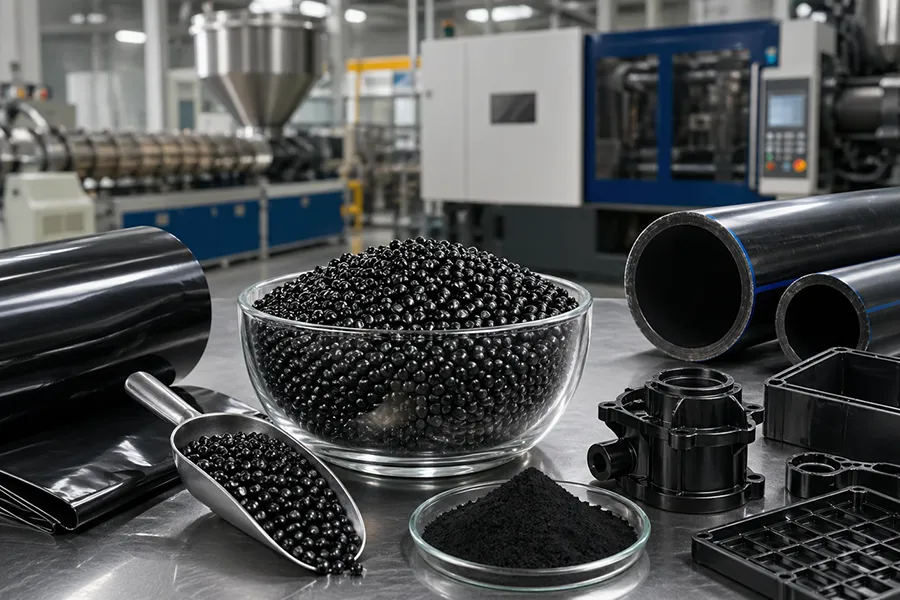
Carbon black masterbatch is not merely a plastic coloring agent; it is a functional masterbatch that simultaneously offers properties such as opacity, weather resistance, UV protection, and processing stability. Particularly in the fields of film extrusion, pipe manufacturing, and injection molding, the quality of the carbon black masterbatch directly impacts a product’s appearance, service life, production efficiency, and ultimate performance in its end application.
1. What is Carbon Black Masterbatch?
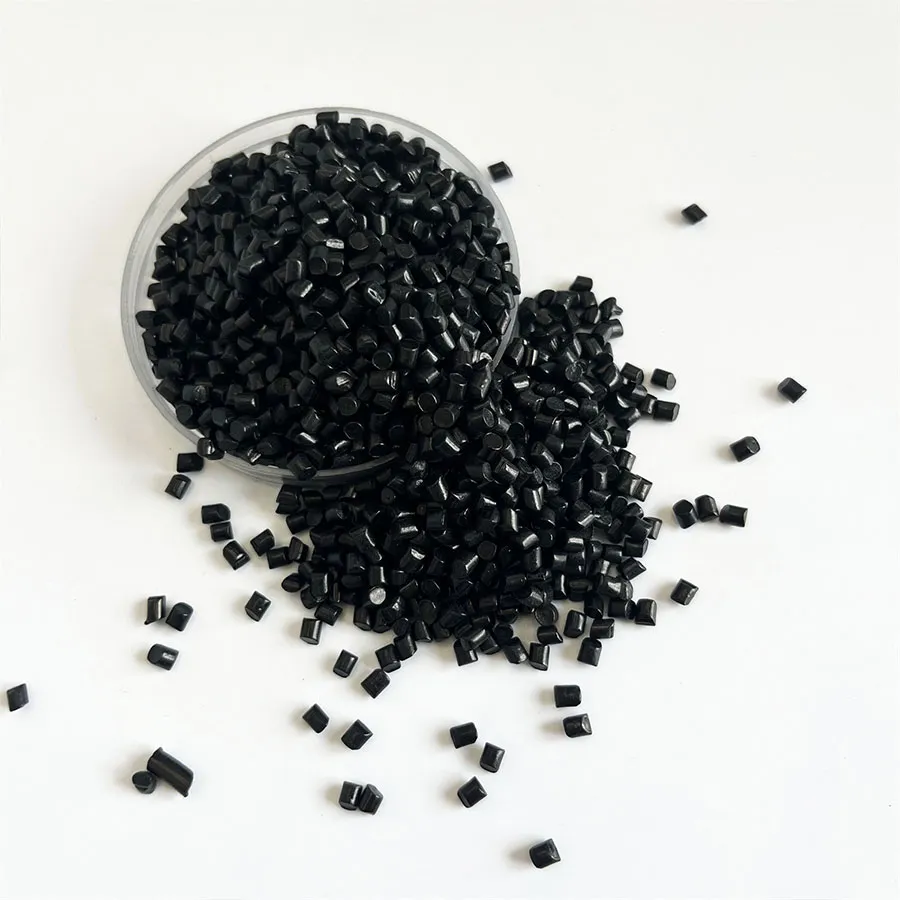
Carbon black masterbatch—commonly referred to in English as “Black Masterbatch”—is a granular plastic additive. It is manufactured using carbon black as the primary functional ingredient, utilizing resins such as PE, PP, EVA, PS, and ABS as carriers, and incorporating dispersants, lubricants, and other auxiliary agents. The production process typically involves high-speed mixing, melt extrusion, cooling, and pelletizing.
Simply put, carbon black masterbatch involves the pre-dispersion of fine carbon black powder uniformly within a resin carrier, allowing downstream plastic processing enterprises to add it directly to their raw materials at a specific ratio. Compared to using raw carbon black powder directly, carbon black masterbatch offers superior dispersibility, significantly reduced dust pollution, easier handling during feeding, and more consistent coloring results.
In actual production, carbon black masterbatch is frequently used for the coloring and functional modification of materials such as PE, PP, ABS, PVC, and PS. It is particularly well-suited for continuous, large-scale, and automated plastic manufacturing environments.
2. Core Components of Carbon Black Masterbatch
The performance of a carbon black masterbatch depends on more than just its “blackness”; it is also closely tied to the type of carbon black used, the carrier resin, the dispersion system, and the processing technology employed.
2.1 Carbon Black
Carbon black is the most critical component within the masterbatch; it determines the product’s blackness, opacity, tinting strength, weather resistance, and UV absorption capabilities. High-quality carbon black is characterized by fine particle size, a well-engineered structure, strong tinting power, and excellent dispersibility, enabling plastic products to exhibit a deep, uniform, and stable black appearance.
2.2 Carrier Resin
The carrier resin serves to hold the carbon black and facilitates its compatibility with the base plastic material during the processing stage. Common carrier resins include PE, PP, EVA, and ABS. The selection of the appropriate carrier resin depends on the specific requirements of the intended application. For instance, PE-carrier carbon black masterbatches are commonly used for films and pipes, whereas PP-carrier carbon black masterbatches are better suited for PP injection-molded parts.
2.3 Dispersants
Carbon black particles are extremely fine and prone to agglomeration. If dispersion is poor, the surface of the finished product may exhibit defects such as black spots, color patches, streaks, or uneven gloss. The function of a dispersant is to enhance the wetting and dispersion of carbon black within the resin, thereby improving the aesthetic quality and performance stability of the final product.
2.4 Processing Aids
Processing aids serve to improve the flow properties, plasticization efficiency, and processing stability of carbon black masterbatches. For applications involving films, pipes, and injection molding, superior processing performance helps minimize pressure fluctuations in equipment, reduce product defects, and boost production efficiency.
3. Why Are Carbon Black Masterbatches Crucial in Film Production?
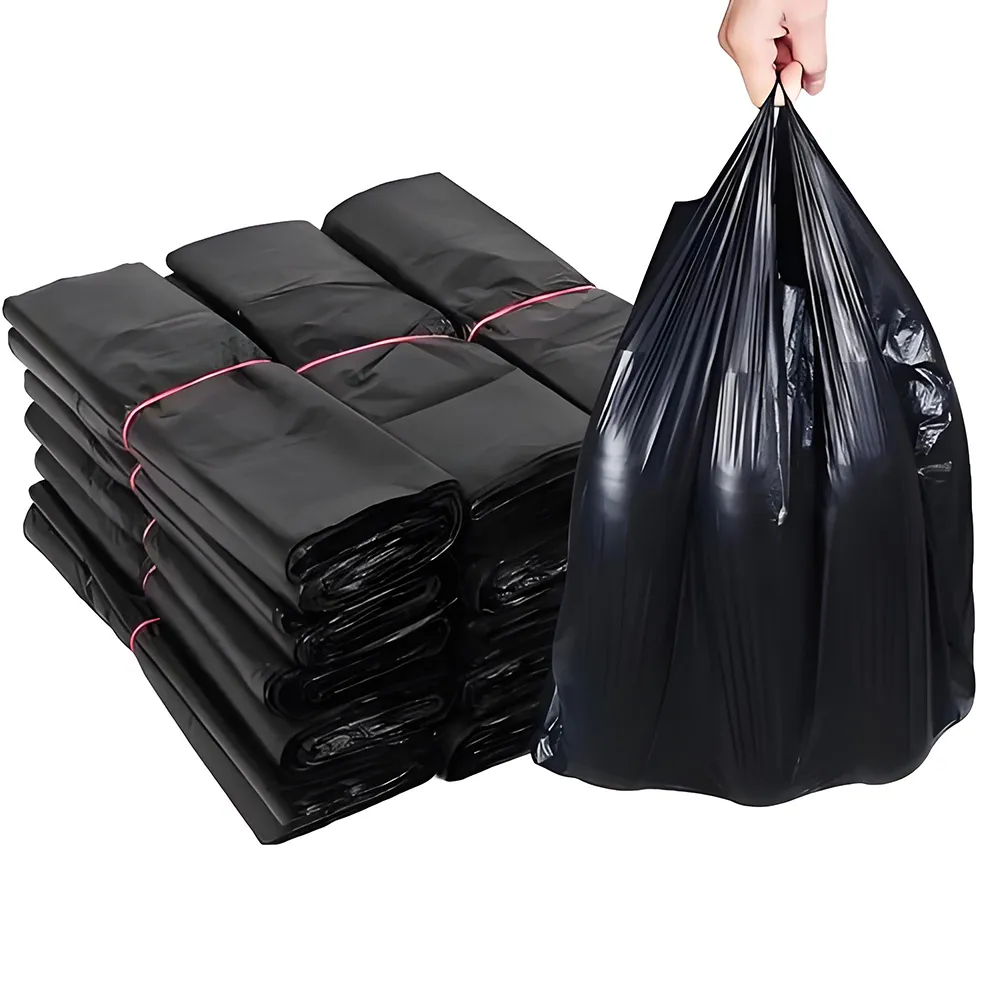
The film industry constitutes one of the key application sectors for carbon black masterbatches. Products such as garbage bags, courier bags, industrial packaging films, agricultural mulching films, light-shielding films, and impermeable liners all utilize carbon black masterbatches extensively.
3.1 Providing a Stable Black Appearance
Film products are typically thin and therefore demand a high degree of color uniformity. If the carbon black is poorly dispersed, the film surface is highly susceptible to defects such as color spots, streaks, or cloudy color variations. High-quality carbon black masterbatches undergo thorough pre-dispersion, ensuring uniform distribution during the film blowing or casting processes, which results in a more stable and consistent film color.
3.2 Enhancing Light-Blocking Properties
In applications such as garbage bags, agricultural films, and industrial packaging films, light-blocking capability is of paramount importance. Carbon black possesses strong covering power and light-absorption capabilities, effectively blocking light transmission through the film to protect the packaged contents or to fulfill specific functional requirements.
For example, black garbage bags typically need to conceal their internal contents; agricultural mulching films may require control over light exposure; and industrial packaging films often need to enhance visual opacity and product protection capabilities.
3.3 Improving Weather Resistance
Outdoor films are constantly exposed to sunlight, rain, and temperature fluctuations, making them susceptible to aging, embrittlement, and a decline in mechanical strength over time. Carbon black possesses inherent UV-absorbing properties; therefore, the judicious use of carbon black masterbatches can significantly enhance a film’s resistance to ultraviolet radiation and extend its service life.
3.4 Suitable for Processing Recycled Plastic Films
Recycled plastic raw materials often feature complex coloration and significant batch-to-batch variations. Carbon black masterbatches can effectively mask the inherent杂色 (miscellaneous colors) of recycled materials, resulting in a more uniform appearance for the final film products. Consequently, carbon black masterbatches hold immense practical value in the production of recycled garbage bags, recycled packaging films, and industrial-grade films.
4. Why Are Carbon Black Masterbatches Crucial in Pipe Manufacturing?
The pipe manufacturing industry demonstrates a pronounced reliance on carbon black masterbatches—particularly for products such as PE water supply pipes, gas pipes, drainage pipes, communication conduits, drip irrigation tubing, and cable protection ducts.
4.1 Enhancing Pipe Weather Resistance
Many plastic pipes are required to function for extended periods outdoors, underground, or within complex environmental settings. Carbon black acts by absorbing ultraviolet (UV) radiation, thereby mitigating the degradation of the resin material caused by photo-oxidative aging. Consequently, high-quality carbon black masterbatches play a pivotal role in bolstering the long-term weather resistance of pipes.
For outdoor PE pipes, agricultural irrigation tubing, and communication protection conduits, weather resistance directly dictates the product’s service life and the overall reliability of the engineering project.
4.2 Ensuring Color and Appearance Consistency
Pipe manufacturing typically employs a continuous extrusion process, which demands a high degree of stability in raw materials. If the carbon black masterbatch is poorly dispersed, the pipe surface may exhibit black spots, color streaks, color variations, or uneven gloss—issues that compromise the product’s aesthetic appeal and hinder customer acceptance.
Highly dispersible carbon black masterbatches enable pipes to maintain a consistent black appearance throughout prolonged, continuous production runs, thereby enhancing product uniformity.
4.3 Improving Hiding Power
Pipe manufacturing processes may occasionally incorporate recycled materials or raw materials from different production batches, leading to potential color discrepancies in the base substrate. Carbon black masterbatches possess strong hiding power, allowing them to mask these color fluctuations in the base material and ensure a more uniform visual appearance for the finished pipes.
4.4 Meeting Engineering Application Requirements
Pipes are classified as functional plastic products; consequently, many application scenarios impose specific requirements regarding pressure resistance, aging resistance, and resistance to environmental stress cracking (ESCR). Although carbon black masterbatches primarily serve the functions of coloring and weather protection, an improper selection can inadvertently compromise the pipe’s overall performance characteristics. Therefore, when selecting carbon black masterbatches for pipe manufacturing, critical attention must be paid to carrier compatibility, dispersion efficacy, and processing stability.
5. Why Are Carbon Black Masterbatches Crucial in Injection Molding?
Injection molding is widely used to produce automotive parts, appliance housings, toolboxes, turnover boxes, pallets, electronic and electrical enclosures, daily necessities, and industrial components. Carbon black masterbatches also hold significant value in the injection molding process.
5.1 Enhancing Product Appearance and Texture
Black injection-molded parts typically require uniform coloration, a clean surface, and an absence of visible color spots or flow marks. High-quality carbon black masterbatches enable products to achieve a deeper, more uniform black finish, thereby enhancing their visual texture and perceived quality.
For automotive interior components, appliance housings, and electronic product accessories, visual consistency directly influences the end customer’s judgment regarding product quality.
5.2 Minimizing Color Variation and Batch-to-Batch Fluctuations
Injection molding production often involves large-volume deliveries across multiple batches. If there are significant color discrepancies between different batches, it can compromise assembly consistency and hinder customer acceptance. Through pre-dispersion and stabilized formulations, carbon black masterbatches help manufacturers minimize color variations between batches and improve production controllability.
5.3 Suitability for Automated Dosing and Continuous Production
Carbon black masterbatches are granular in form, facilitating automated dosing, pneumatic conveying, and mixing. Compared to raw carbon black powder, masterbatches are better suited for the automated production systems found in modern injection molding facilities; they help reduce errors associated with manual material feeding and boost production efficiency.
5.4 Reducing Dust Contamination
Direct use of carbon black powder in an injection molding workshop can easily lead to dust contamination, negatively impacting equipment, molds, and the overall work environment. Carbon black masterbatches significantly mitigate dust-related issues, creating a cleaner production environment and facilitating color changeovers as well as equipment maintenance.
6. How to Select the Right Carbon Black Masterbatch?
Different plastic products impose varying requirements on carbon black masterbatches. When making a selection, manufacturers should prioritize the following key factors:
6.1 Application Process
For film applications, carbon black masterbatches should prioritize dispersibility, flow properties, and surface finish quality; for pipe applications, the focus should be on weather resistance, material compatibility, and stability during continuous extrusion; for injection molding applications, the emphasis should be placed on aesthetics, blackness intensity, flow properties, and batch-to-batch consistency.
6.2 Base Material Type
Materials such as PE, PP, ABS, and PVC each require a carbon black masterbatch formulated with a specific, compatible carrier resin. Incompatibility between the carrier and the base resin can lead to a decline in product performance, surface defects, or processing instability.
6.3 Consider Carbon Black Content and Addition Ratio
A higher carbon black content does not necessarily mean the masterbatch is more suitable. While high-concentration masterbatches allow for lower addition ratios, poor dispersion within the system can introduce processing issues. Therefore, the choice should be based on a comprehensive assessment of the product’s required blackness, thickness, opacity requirements, and cost objectives.
6.4 Evaluate Dispersion Performance
High-quality carbon black masterbatches should result in finished products free of visible black spots, color patches, particle agglomerates, or streaks. Dispersion performance is particularly critical for thin films and precision injection-molded parts.
6.5 Assess Weather Resistance Requirements
If the product is intended for outdoor use—such as pipes, agricultural films, drip irrigation tubing, or cable sheathing—a carbon black masterbatch with superior weather resistance should be selected and tested specifically within its intended operating environment.
7. Common Issues and Solutions
7.1 Black Spots in Films
This may be caused by poor carbon black dispersion, insufficient plasticization of the masterbatch, or inappropriate processing temperatures. It is recommended to select a highly dispersible carbon black masterbatch and to optimize temperature settings and screw shear conditions.
7.2 Uneven Surface Color in Pipes
This issue may be linked to uneven mixing of the masterbatch, fluctuations in the addition ratio, or variations between raw material batches. It is recommended to utilize an automatic metering system and ensure thorough mixing of the masterbatch with the base resin.
7.3 Grayish Surface Appearance in Injection-Molded Parts
This may be attributed to the quality of the carbon black, the masterbatch addition level, carrier compatibility, or the condition of the mold surface. A comprehensive troubleshooting process involving the raw materials, processing parameters, and mold conditions is required to identify the root cause.
7.4 Deterioration in Processing Flowability
If the carbon black content is excessively high or the addition ratio is too large, it may negatively impact melt flowability. It is recommended to select a carbon black masterbatch specifically formulated for the particular processing method, rather than simply prioritizing high concentration.
Summary
Carbon black masterbatches play a pivotal role in the production of films, pipes, and injection-molded parts. Their importance lies not only in their ability to provide a consistent black aesthetic but also in their capacity to enhance opacity, improve weather resistance, boost processing stability, and enable manufacturers to achieve cleaner, more efficient production operations. In the field of films, carbon black masterbatches enhance light-blocking properties, color uniformity, and the masking effect of recycled materials; in the pipe sector, they help improve outdoor weather resistance and the stability of continuous extrusion processes; and in injection molding, they enhance the surface aesthetics and texture of finished products, minimize color variations, and facilitate compatibility with automated production systems.