
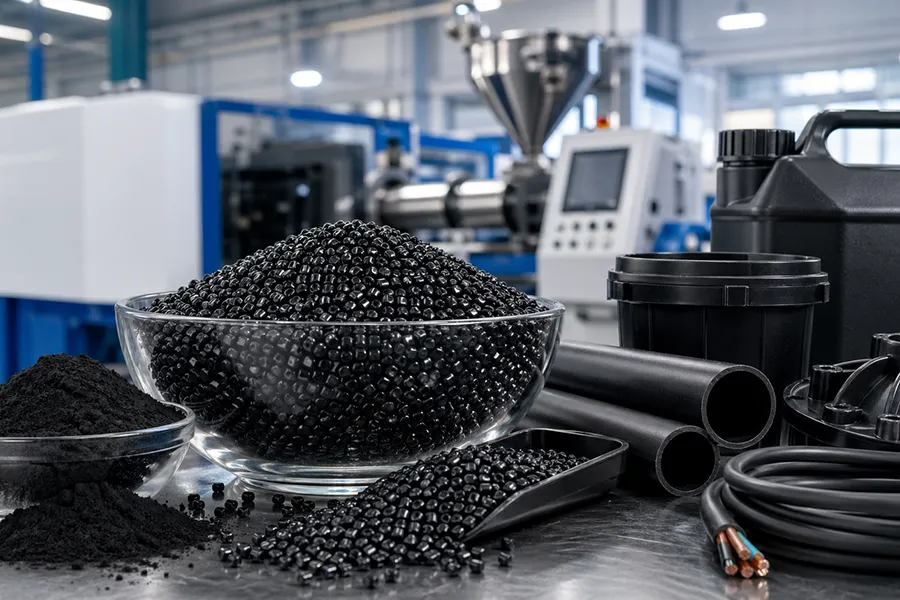
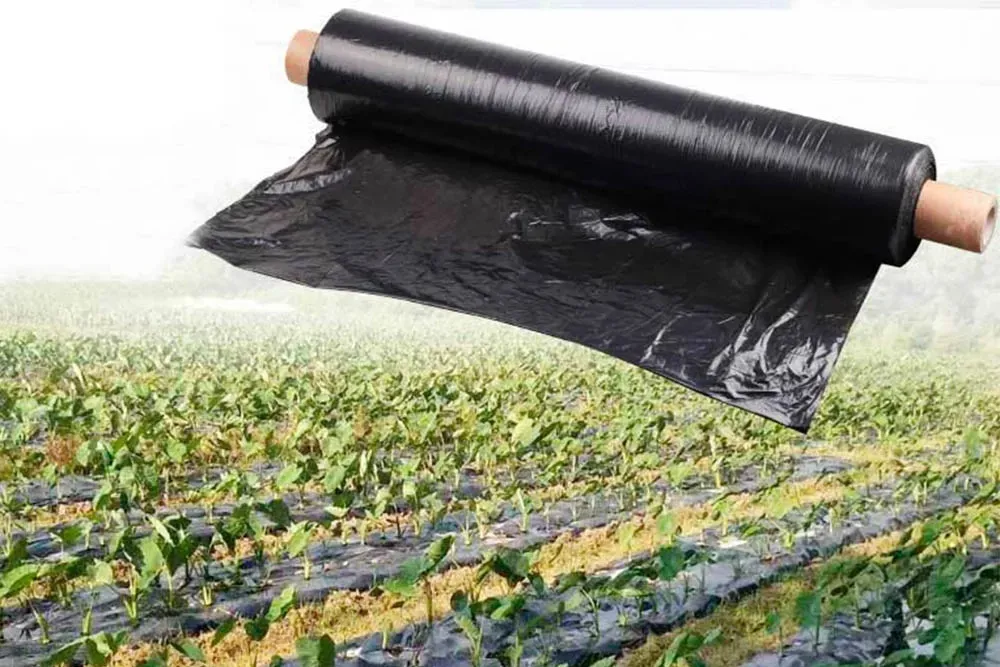
In the production of plastic products, black is an extremely common and widely utilized color. From garbage bags, agricultural films, drip irrigation tubing, and cable sheathing to automotive plastic components, appliance housings, industrial pallets, and recycled plastic products, black plastics span across numerous industries, including packaging, construction, agriculture, automotive, electrical power, and daily consumer goods. In the process of imparting this black coloration to plastics, black masterbatch stands out as one of the most frequently used, stable, and industrially suitable coloring materials available.
1. What is Black Masterbatch?
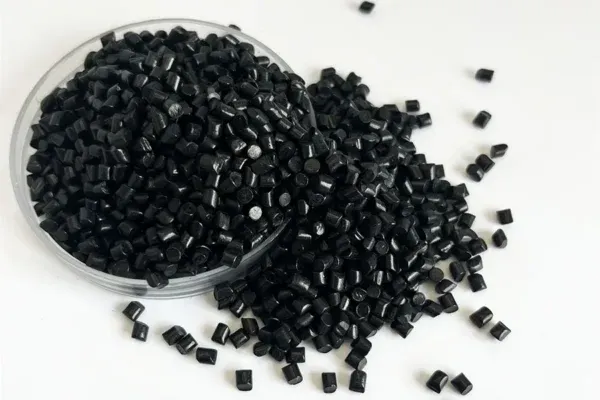
Black masterbatch is the most commonly used colorant in plastic processing and represents the variety of masterbatch with the highest demand. Typically, masterbatches are manufactured by fusing one or more dyes or pigments (acting as the coloring agents) with a thermoplastic resin carrier. This mixture undergoes a rigorous processing and dispersion procedure to create a uniform coloring compound, to which various additives are incorporated to achieve specific functional properties. High-quality masterbatches facilitate excellent color dispersion within the plastic parts and demonstrate superior compatibility with the material being colored.
Advantages of Nuoxin Masterbatch
Our products feature environmental certifications and a comprehensive suite of system certifications. They offer stable product quality, can impart a smooth and glossy surface finish, and are available in a rich variety of color options. Furthermore, they effectively resolve dispersion-related defects often encountered in injection-molded parts—such as color spots, blotches, and streaks.
2. Key Components of Black Masterbatch
While the formulation of black masterbatch may appear simple on the surface, it actually involves a sophisticated underlying composition. Black masterbatch is not merely a collection of individual carbon black particles; rather, it is a complex, composite plastic additive. Its primary constituents fall into three main categories: the carrier resin, carbon black, and various additives.
The carrier resin is typically selected for its high compatibility with the specific plastic material being colored—common choices include PE and PP. Carbon black serves as the primary coloring agent; its particle size and structural properties directly influence the resulting depth of blackness and dispersion quality. Finally, the additives—such as dispersants and lubricants—are incorporated to enhance the material’s processing performance.
Tips for Selecting Key Raw Materials
- Carbon Black Selection: The smaller the particle size, the higher the degree of blackness; however, the more difficult it becomes to achieve proper dispersion.
- Carrier Resin: Compatibility with the base material’s melting characteristics must be carefully considered.
- Additive Ratio: An excessive amount can negatively impact mechanical properties, while an insufficient amount results in uneven dispersion.
- Special Requirements: If functions such as UV resistance or electrical conductivity are required, appropriate modifying agents must be added.
3. Black Masterbatch Uses
Depending on their intended use, black masterbatches are categorized into injection molding grades, blow molding grades, fiber spinning grades, and others; each category may be further subdivided into various quality grades.
- Premium Injection Molding Masterbatch is used for high-end products such as cosmetic packaging, toys, and appliance housings.
- Standard Injection Molding Masterbatch is used for general daily-use plastic products and industrial containers.
- Premium Blow Molding Masterbatch is designed for the coloring of ultra-thin blow-molded products.
- Standard Blow Molding Masterbatch is used for coloring general packaging bags and woven sacks.
- Fiber Spinning Masterbatch is specifically formulated for coloring textile fibers; it features fine pigment particles, high concentration, strong tinting strength, and excellent resistance to heat and light.
4. Core Advantages of Black Masterbatch
4.1 Strong Tinting Strength
Carbon black possesses exceptionally high coloring power; by adding just a small amount of black masterbatch to the raw plastic material, the finished product achieves a rich, uniform black color with a highly pronounced coloring effect.
4.2 Excellent Hiding Power
For raw plastic materials that are naturally dark-colored or contain minor imperfections, black masterbatch provides effective coverage, ensuring the surface of the finished product appears clean and uniform.
4.3 Outstanding Weather Resistance
High-quality black masterbatch exhibits excellent weather resistance, effectively withstanding environmental factors such as UV radiation, high temperatures, and humidity. This ensures that plastic products do not easily fade or degrade during long-term use, thereby maintaining their aesthetic appeal and performance integrity.
4.4 Enhanced Plastic Performance
In addition to providing color, certain types of black masterbatch can simultaneously enhance the mechanical properties of plastic products—such as strength, rigidity, and abrasion resistance—thereby improving the overall quality of the final product.
5. Applications of Black Masterbatch
5.1 Automotive Components
Black masterbatch provides weather resistance for automotive parts, imparts superior light-blocking properties to packaging materials, ensures color uniformity and anti-static properties for electronic housings, enhances the anti-aging performance of construction materials, and meets the diverse aesthetic and durability requirements of daily-use products. It serves as a pivotal element in achieving efficient and environmentally friendly manufacturing processes.
5.2 Wire and Cable Industry
The outer sheathing of wires and cables typically utilizes black masterbatch for coloration. This serves not only an aesthetic purpose but, more importantly, allows the black color to resist ultraviolet (UV) radiation, thereby protecting the internal wires from damage and extending the overall service life of the cables.
5.3 Pipe Manufacturing
Drainage pipes, gas pipelines, and similar products frequently employ black masterbatch. The black pigmentation prevents the proliferation of algae and other microorganisms within the pipes, while also enhancing their resistance to corrosion and aging.
5.4 Electronic and Appliance Housings
The housings for many electronic devices and appliances—such as television cabinets and computer cases—are often chosen to be black. Housings colored with black masterbatch are not only aesthetically pleasing and elegant but also provide a certain degree of shielding against electromagnetic interference.
6. How to Select High-Quality Black Masterbatch?
When selecting black masterbatch, one should focus primarily on the following aspects:
| Selection Factors | Key Assessment Points |
| Blackness | Whether the target color depth can be achieved |
| Dispersibility | Are there issues such as black spots, color patches, or streaks |
| Compatibility | Does the carrier resin match the substrate |
| Inclusion Ratio | Can the desired effect be achieved within a reasonable dosage range |
| Thermal Stability | Whether the target color depth can be achieved |
| Weather Resistance | Suitable for outdoor use or environments with prolonged light exposure |
| Processing Stability | Does it affect flowability, moldability, and product performance |
| Batch Stability | Is the color consistent across different batches |
7. Common Questions and Solutions Regarding Black Masterbatch
7.1 What materials constitute black masterbatch?
The materials comprising black masterbatch include: A. Carbon black; B. Carrier resin; C. Carbon black wetting agents; D. Carbon black dispersants; E. Other processing aids.
7.2 Which types of carbon black are used in black masterbatch?
According to international classifications, my country produces over thirty varieties of carbon black, broadly categorized into two major groups: those intended for rubber applications and those intended for non-rubber applications.
Among carbon blacks for rubber applications, the primary type is abrasion-resistant carbon black, which effectively enhances the wear resistance of rubber tires. Conversely, among carbon blacks for non-rubber applications, only a select few varieties are truly suitable for use in black masterbatch formulations.
7.3 Why does carbon black require wetting agents?
Carbon black has a specific gravity of approximately 2 g/cm³. However, due to the extremely small particle size of carbon black, its apparent density is very low; it appears fluffy and seems deceptively light. To ensure smooth processing, the carbon black must first be properly wetted. The selection of the appropriate wetting agent is therefore critical.
7.4 Does black masterbatch also require processing aids?
Absolutely. A smooth and efficient processing operation necessitates the careful selection of antioxidants, internal lubricants, external lubricants, modifiers, and antistatic agents.
Summary
For manufacturers of plastic products, selecting the appropriate black masterbatch not only enhances the aesthetic quality of the final product but also improves production stability, thereby minimizing color variations and reducing the rate of defective products. Particularly in production scenarios involving large-scale, continuous processes and strict requirements for color consistency, black masterbatch serves as an efficient, stable, and mature solution for coloring plastics. If you are currently seeking the right coloring material for your black plastic products, please feel free to contact us!