
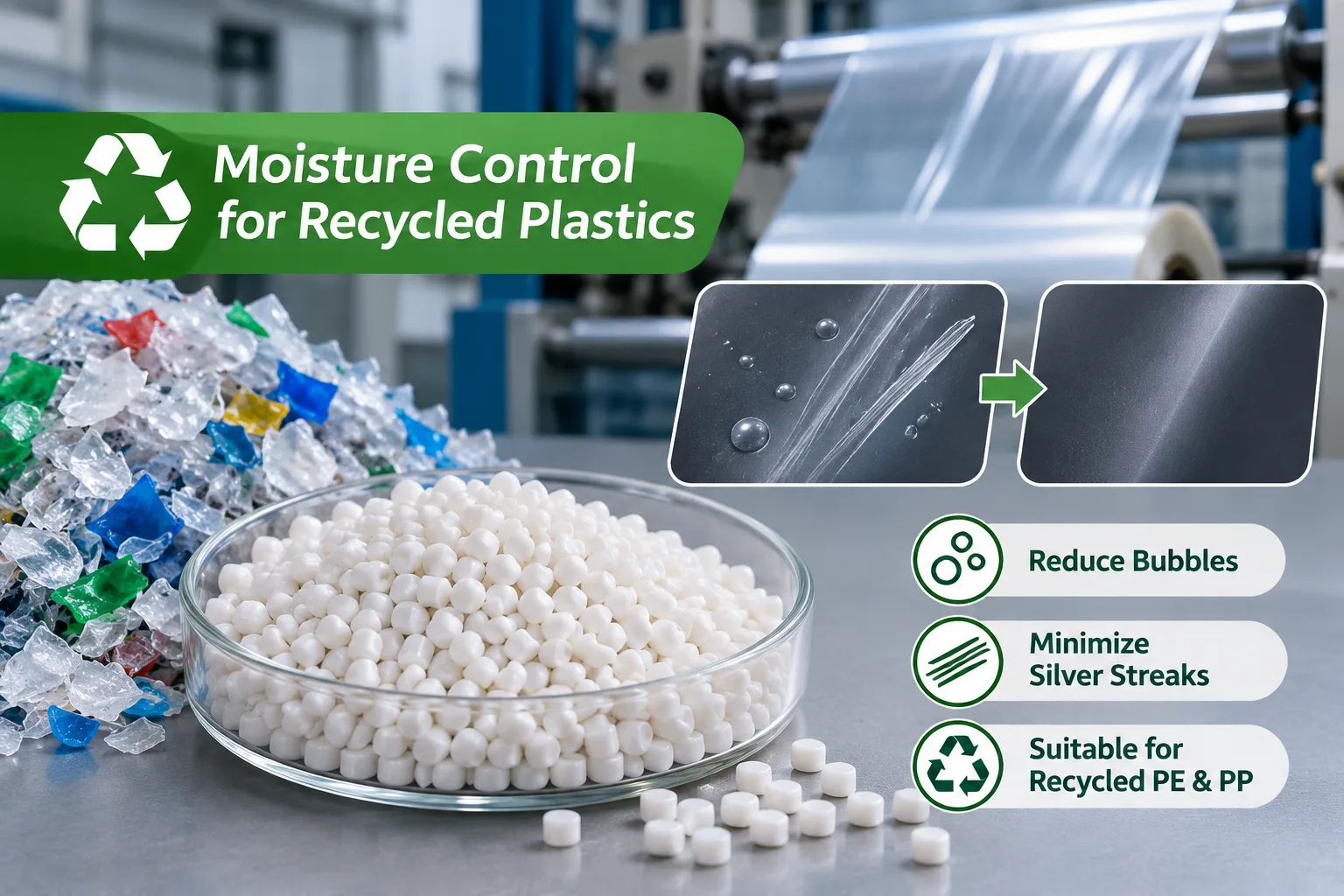
Bubbles, silver streaks, and rough surfaces are common production challenges when manufacturers process recycled plastic materials. Residual moisture from washing, storage, or contaminated feedstock can affect finished-product quality and increase production waste.
Desiccant masterbatch for recycled plastic helps control residual moisture during processing, reducing moisture-related bubbles, silver streaks, and surface defects in suitable recycled PE and PP applications.
However, not every defect is caused by moisture. Understanding the problem and selecting the correct desiccant formulation are essential for achieving consistent production results.
Why Do Bubbles and Silver Streaks Appear in Recycled Plastic?
Recycled plastics often contain moisture introduced during collection, washing, pelletizing, or storage. Even when the base polymer has low moisture absorption, water can remain on pellet surfaces or enter through contaminated material.
During extrusion or injection molding, heat converts residual moisture into vapor, which may become trapped in the molten plastic.
This can produce several defects:
- Bubbles: Gas pockets inside films, molded components, or extruded products.
- Silver Streaks: Silvery or whitish marks on injection-molded surfaces, often associated with moisture vapor or other gases.
- Pinholes and Fisheyes: Small holes or visible irregularities that affect film appearance.
- Rough Surfaces: Inconsistent finishes caused by trapped gas, contamination, or unstable processing.
Silver streaks are not always moisture-related. Excessive melt temperatures, material degradation, trapped air, and inadequate mold venting can produce similar defects.
Therefore, manufacturers should confirm the source of the problem before adding moisture-control additives.
How Desiccant Masterbatch for Recycled Plastic Works
Desiccant masterbatch is a functional plastic additive containing moisture-absorbing ingredients dispersed in a compatible polymer carrier.
A common active ingredient is calcium oxide (CaO), which chemically reacts with water to form calcium hydroxide:
CaO + H₂O → Ca(OH)₂
This reaction helps bind residual water before it can contribute to vapor-related defects during processing.
For recycled PE and PP manufacturers, a properly selected desiccant masterbatch offers several potential advantages.
Reduce Moisture-Related Bubbles and Silver Streaks
By reducing available moisture in the material, desiccant masterbatch can help minimize gas formation and improve surface appearance.
This is particularly useful in recycled film production, injection molding, and extrusion processes where variable moisture levels create inconsistent output.
Support More Stable Production
A compatible desiccant masterbatch can be blended directly with recycled plastic feedstock, allowing manufacturers to incorporate moisture control into an existing production process.
In suitable applications, this may simplify material handling and reduce production interruptions associated with moisture-related defects.
Reduce Scrap and Processing Costs
Fewer moisture-related defects can mean less rejected material and reduced reprocessing.
Actual cost savings depend on the recycled material quality, moisture concentration, masterbatch dosage, and equipment settings.
Nuoxin Desiccant Masterbatch for Recycled PE and PP
Nuoxin New Materials offers calcium oxide-based desiccant masterbatch designed for moisture control in plastic processing.
The product is suitable for selected PE and PP applications, including recycled plastic film, injection molding, and extrusion.
Product Specifications
| Parameter | Specification |
|---|---|
| Product Name | Desiccant Masterbatch |
| Active Ingredient | Calcium Oxide (CaO) |
| Active Content | 50%–80% (Customizable) |
| Carrier Resin | PE / PP |
| Recommended Dosage | 1%–5% |
| Processing Temperature | 160–280°C |
| Applications | Blown Film, Injection Molding, Extrusion |
With compatible carrier resins and customizable active content, Nuoxin’s desiccant masterbatch can be evaluated for different recycled plastic formulations.
The company also emphasizes manufacturing quality control and consistent product specifications for repeat orders.
How to Reduce Defects in Recycled Plastic Production
Using desiccant masterbatch effectively requires identifying the defect, checking the material, and optimizing the addition rate.
The following table provides a practical troubleshooting reference.
| Production Problem | Possible Cause | Recommended Solution |
|---|---|---|
| Bubbles in recycled film | Residual moisture in washed PE or PP | Check material moisture and evaluate desiccant masterbatch |
| Silver streaks on molded parts | Moisture, trapped air, or thermal degradation | Verify moisture first; inspect molding settings and venting |
| Pinholes in plastic film | Moisture vapor or contamination | Improve material preparation and moisture control |
| Rough extruded surfaces | Moisture, impurities, or melt instability | Inspect feedstock, filtration, and processing conditions |
| Defects vary between batches | Inconsistent recycled feedstock | Monitor raw material quality and adjust the validated formulation |
Recommended Dosage and Production Testing
Nuoxin publishes a recommended addition range of 1%–5%, but the optimum dosage varies with moisture content, polymer type, and processing conditions.
Manufacturers can follow these steps to identify a suitable formulation:
- Check the recycled resin: Identify the polymer type, recycled content, moisture level, and visible defects.
- Select a compatible grade: Choose PE- or PP-based desiccant masterbatch appropriate for the production process.
- Run controlled trials: Test dosage levels within the supplier’s recommended range while keeping other processing conditions consistent.
- Evaluate finished products: Compare bubble frequency, silver streaks, surface appearance, and relevant mechanical properties.
Excessive desiccant addition may affect product appearance, dispersion, or mechanical performance. Increasing dosage should not be the default solution when defects persist.
For moisture-sensitive materials such as PET or PA, proper drying remains essential. Desiccant masterbatch should not be treated as a universal replacement for controlled resin drying.
Applications of Desiccant Masterbatch in Recycled Plastics
Desiccant masterbatch can support several recycling-related manufacturing processes when residual moisture is a confirmed source of defects.
Recycled Blown Film and Garbage Bags
Recycled PE films may develop bubbles, pinholes, or inconsistent surfaces when feedstock contains residual moisture. Desiccant masterbatch helps manage this moisture and supports improved film appearance.
Recycled Plastic Injection Molding
Recycled PP and PE injection-molded products may show silver streaks or surface bubbles. A suitable moisture-control formulation can help reduce defects associated with residual water.
Recycled Plastic Extrusion
Manufacturers producing recycled plastic sheets, profiles, and other extruded products can evaluate desiccant masterbatch to reduce moisture-related surface irregularities.
In every application, consistent results depend on feedstock quality, mixing efficiency, and processing conditions.
Frequently Asked Questions
Can desiccant masterbatch remove bubbles from recycled plastic?
Desiccant masterbatch can help reduce bubbles caused by residual moisture in recycled plastics. However, it cannot eliminate bubbles caused by trapped air, polymer degradation, or other non-moisture-related problems.
Can desiccant masterbatch prevent silver streaks in injection molding?
It can help reduce silver streaks when residual moisture is the primary cause. If streaks result from excessive temperatures, poor mold venting, or trapped air, manufacturers must correct those processing problems separately.
How much desiccant masterbatch should be added to recycled plastic?
Nuoxin recommends a general dosage range of 1%–5%. The appropriate addition rate depends on the recycled resin, moisture level, processing conditions, and target product quality. Production trials are recommended.
Is desiccant masterbatch suitable for recycled PE and PP?
Yes. Desiccant masterbatch with a compatible PE or PP carrier can be used in suitable recycled polyethylene and polypropylene applications, including film blowing, injection molding, and extrusion.
Can desiccant masterbatch replace plastic drying equipment?
In some recycled PE and PP applications, it may reduce the need for separate drying operations. However, heavily wet materials and moisture-sensitive polymers often require proper drying, and the masterbatch has a limited moisture-absorption capacity.
Conclusion
Moisture-related bubbles, silver streaks, and surface defects can reduce production efficiency and finished-product quality in recycled plastic manufacturing.
Choosing the right desiccant masterbatch for recycled plastic provides a practical way to manage residual moisture, improve product appearance, and potentially reduce defective output in suitable PE and PP processes.
Nuoxin New Materials offers CaO-based desiccant masterbatch solutions for recycled plastic manufacturers seeking consistent processing performance and application-specific formulations.
Need a moisture-control solution for your recycled plastic production?
Contact Nuoxin with your resin type, recycled content, processing method, and current production defects. Our team can help you evaluate suitable desiccant masterbatch options.