

Moisture contamination is a common challenge in plastic processing, particularly when manufacturers use recycled materials or raw materials exposed to humid storage conditions. In blown film production, excess moisture can cause bubbles, pinholes, fisheyes, and uneven film surfaces, leading to higher scrap rates and inconsistent product quality.
PE desiccant masterbatch is a functional additive designed to help control residual moisture during polyethylene processing. Formulated with moisture-absorbing active ingredients and a compatible carrier resin, it helps reduce moisture-related defects and supports more stable production.
For manufacturers producing plastic films, bags, and packaging materials, choosing the right desiccant masterbatch requires an understanding of its working principle, recommended dosage, processing conditions, and polymer compatibility.
What Is PE Desiccant Masterbatch?
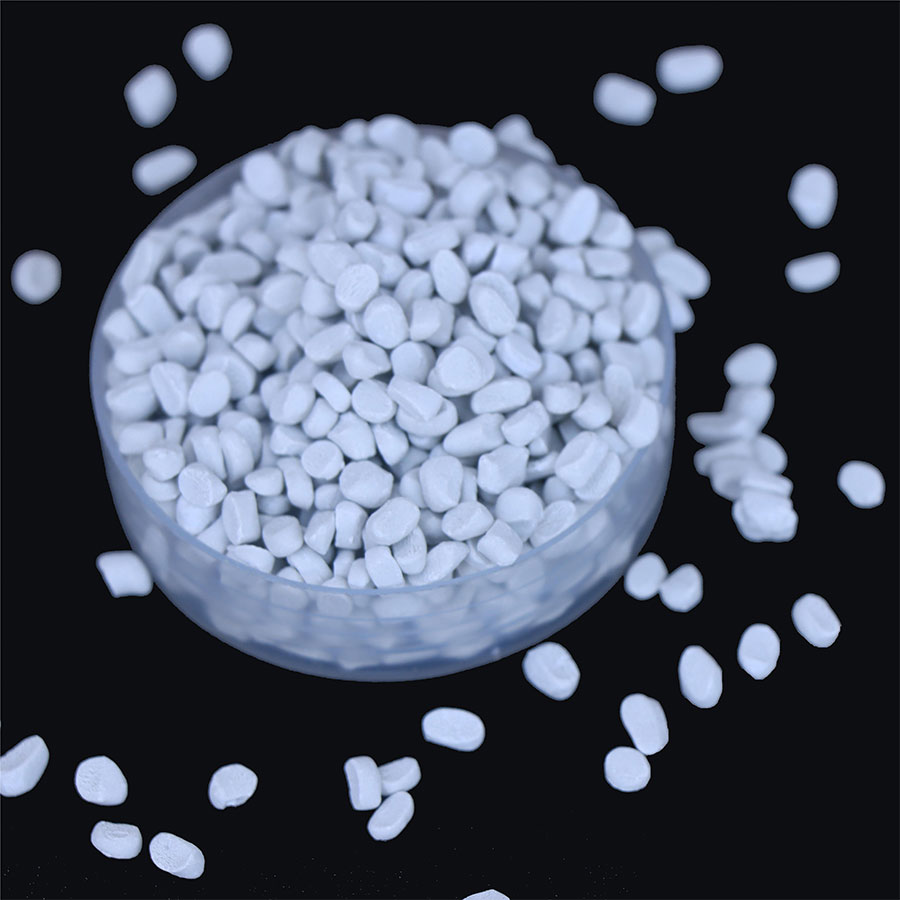
PE desiccant masterbatch is a moisture-control additive designed for polyethylene processing. It contains moisture-absorbing components dispersed in a polyethylene carrier, allowing manufacturers to incorporate the additive into their raw materials during production.
Calcium oxide (CaO) is a commonly used active ingredient in desiccant masterbatch formulations. It reacts chemically with water to form calcium hydroxide:
CaO + H₂O → Ca(OH)₂
This reaction helps bind available moisture that could otherwise contribute to defects during plastic processing.
Unlike color masterbatch, which primarily provides color, PE desiccant masterbatch focuses on reducing moisture-related production problems. It is particularly useful when processing recycled PE materials, damp feedstock, and other suitable raw materials with residual moisture.
How Does Desiccant Masterbatch Improve Blown Film Production?
Blown film extrusion requires stable melt conditions and consistent film formation. When moisture enters the extrusion process, it may vaporize and contribute to bubbles, pinholes, fisheyes, and other surface defects.
PE desiccant masterbatch helps manufacturers manage these issues in several ways.
Reduce bubbles and pinholes. By reacting with available moisture, a suitable formulation helps reduce defects caused by residual water in the raw material.
Improve film surface quality. Better moisture control can support a smoother, more uniform film surface, improving the appearance of packaging films and plastic bags.
Support recycled PE processing. Recycled polyethylene may contain residual moisture from washing, storage, and handling. Desiccant masterbatch provides an additional way to manage moisture-related defects during extrusion.
Reduce material waste. Fewer moisture-related defects can help lower scrap rates and improve production consistency. Actual savings depend on the incoming material, processing conditions, and dosage.
Desiccant masterbatch is not a universal solution for every film defect. Poor dispersion, unstable extrusion conditions, contamination, and incorrect temperature settings can also affect film quality and should be investigated separately.
Applications in Blown Film and Woven Bags
1. PE Blown Film and Plastic Bags
PE desiccant masterbatch is suitable for compatible polyethylene film applications, including:
- Recycled PE blown film
- Shopping bags and garbage bags
- General-purpose packaging films
- PE liners and film-based packaging
- Other polyethylene film products affected by residual moisture
The recommended formulation depends on the PE grade, recycled-material content, film thickness, and processing conditions.
2. Woven Bags and Raffia Products
Woven packaging requires careful material selection because conventional woven sacks are commonly manufactured from polypropylene (PP) raffia tape rather than polyethylene.
For PP woven bags, a PP-compatible desiccant masterbatch is generally the appropriate starting point. A PE-carrier grade should not be assumed to be suitable for PP tape extrusion without confirming compatibility with the supplier.
For bag structures that include PE film liners, PE coatings, or other polyethylene layers, a PE desiccant masterbatch may be considered for the relevant PE processing stage.
Selecting the correct carrier resin helps support additive dispersion, processing stability, and finished-product quality.
PE Desiccant Masterbatch Specifications
Nuoxin publishes the following general specifications for its desiccant masterbatch range.
| Parameter | Published Specification |
|---|---|
| Active ingredient | Calcium Oxide (CaO) |
| Active content | 50%–80%, customizable |
| Carrier resin | PE / PP |
| Recommended dosage | 1%–5% |
| Processing temperature | 160°C–280°C |
| Main applications | Blown film, injection molding, extrusion |
| Target defects | Bubbles, pinholes, fisheyes, and other moisture-related defects |
These are general product specifications, not a guarantee that every grade is suitable for every application. Confirm the carrier resin, technical data sheet, and recommended processing conditions for the specific grade before purchasing.
Nuoxin’s product information also states that its desiccant masterbatch can absorb more than 20% of its own weight in water. Buyers should request the relevant test method and grade-specific results when comparing moisture absorption performance.
Recommended Dosage and Processing Guidelines
Nuoxin lists 1%–5% as a general recommended dosage range for its desiccant masterbatch. The appropriate addition ratio depends on the grade, moisture level, resin type, and production conditions.
For better results, manufacturers should follow these steps:
1. Confirm the base resin. Identify whether the production line processes LDPE, LLDPE, HDPE, PP, or a blend of materials. Select a compatible carrier resin.
2. Evaluate the moisture problem. Check whether bubbles, pinholes, or surface irregularities are related to residual moisture rather than contamination or extrusion instability.
3. Start with supplier guidance. Use the grade-specific recommended dosage instead of automatically applying the maximum addition ratio.
4. Mix thoroughly. Ensure the desiccant masterbatch is evenly distributed through the raw material before processing.
5. Conduct a production trial. Compare film appearance, defect frequency, extrusion stability, and finished-product properties at different addition ratios.
6. Protect the material during storage. Keep opened packaging sealed and store the product in a dry environment to limit unnecessary exposure to ambient humidity.
Desiccant masterbatch may reduce the need for separate pre-drying in suitable applications, but it should not be considered a universal replacement for drying equipment. The appropriate approach depends on the polymer, moisture level, and product quality requirements.
How to Choose a Reliable Desiccant Masterbatch Supplier
When comparing desiccant masterbatch suppliers, manufacturers should evaluate more than the quoted price.
- Carrier compatibility: Confirm that the formulation is suitable for your PE film or PP raffia production line.
- Active content: Check the declared CaO content and whether the specification is consistent between batches.
- Moisture absorption performance: Request test data and clarify the conditions used to measure absorption.
- Dispersion and processing stability: Evaluate whether the additive distributes evenly without introducing new defects.
- Technical support: Choose a supplier that can recommend a grade and dosage based on your raw material and production process.
- Batch consistency: Request product specifications and test samples before committing to large-volume orders.
Providing the supplier with your base resin, recycled-material percentage, production method, current defects, and target dosage will make product recommendations more accurate.
Conclusion
PE desiccant masterbatch provides a practical way to manage residual moisture in suitable polyethylene processing applications. By helping reduce bubbles, pinholes, and fisheyes, it can support improved film appearance, more consistent production, and lower moisture-related waste.
For blown film manufacturers, the key is to select a compatible formulation, determine the appropriate dosage, and verify performance under actual production conditions. For woven bag manufacturers, carrier-resin compatibility is equally important: PE film applications and conventional PP woven tape production may require different grades.
Looking for a desiccant masterbatch solution for your plastic film or packaging production?
Visit Nuoxin Desiccant Masterbatch to explore product specifications and contact our team for application guidance and a customized quotation.
Frequently Asked Questions
1. What is PE desiccant masterbatch used for?
PE desiccant masterbatch helps control residual moisture during polyethylene processing. It is commonly used in blown film production and other suitable PE applications to reduce moisture-related bubbles, pinholes, and fisheyes.
2. What is the recommended dosage of PE desiccant masterbatch?
A general starting range published by Nuoxin is 1%–5%. The optimal dosage depends on the material, moisture level, formulation, and processing conditions. Confirm the recommended ratio with the supplier and validate it through production trials.
3. Can PE desiccant masterbatch be used for PP woven bags?
Not automatically. Conventional woven bags are usually made from PP raffia tape, so a PP-compatible desiccant masterbatch is generally the appropriate choice. A PE grade may be suitable for a separate PE liner or film layer, depending on the application.
4. Does desiccant masterbatch eliminate all bubbles in blown film?
No. It helps address defects associated with residual moisture, but bubbles can also result from contamination, trapped air, unstable extrusion, or incorrect processing conditions. The cause should be identified before adjusting the additive dosage.
5. Can desiccant masterbatch replace raw material drying?
Not in every situation. It may simplify material preparation for suitable PE and PP applications, but moisture-sensitive polymers and processes with strict moisture limits may still require controlled pre-drying.