
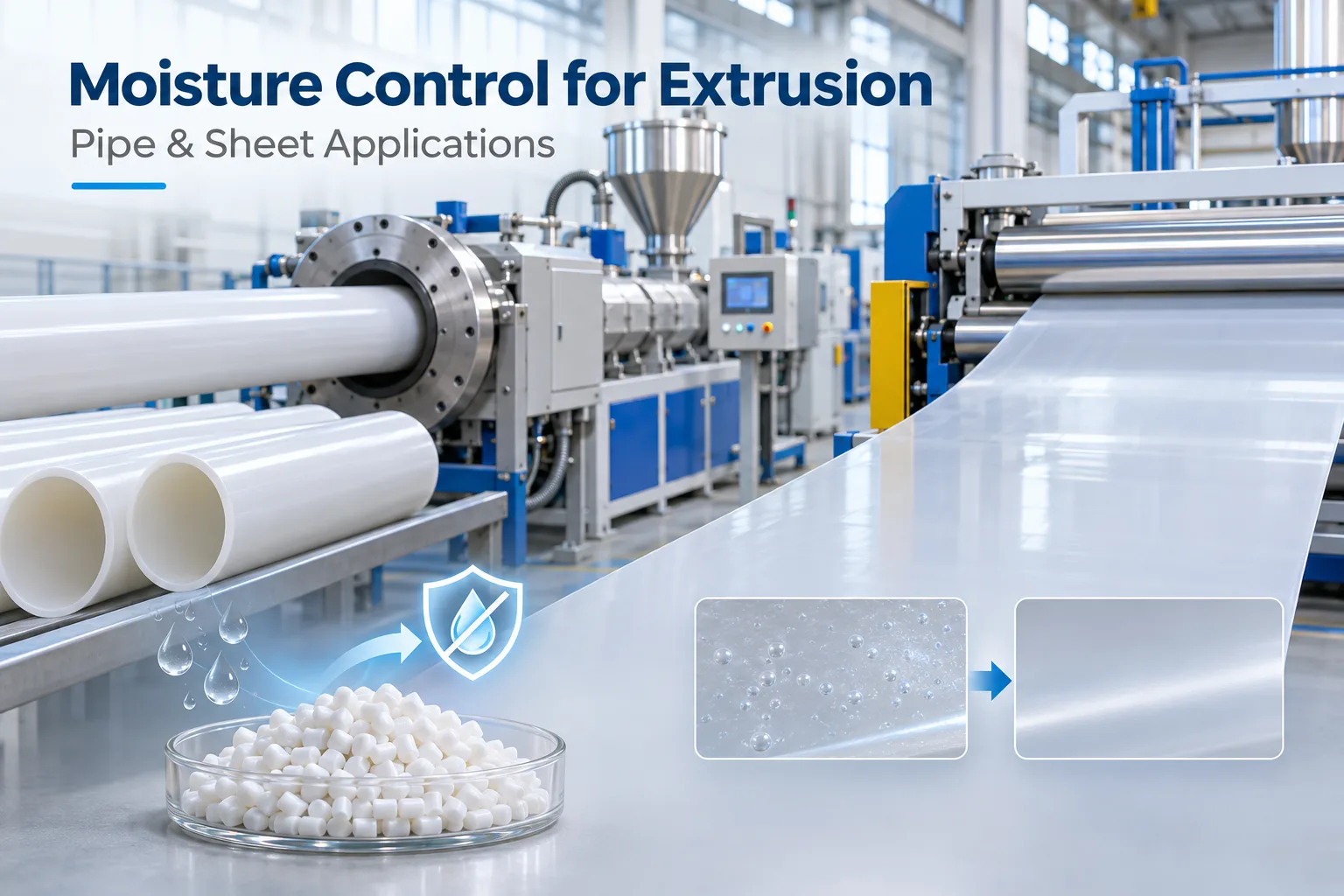
Moisture is a common processing challenge in plastic pipe and sheet extrusion, particularly when manufacturers use recycled polyethylene (PE), polypropylene (PP), or materials stored under humid conditions. Excess moisture can lead to bubbles, internal voids, rough surfaces, and inconsistent product quality.
Calcium oxide masterbatch is a moisture-absorbing additive designed to reduce these defects during plastic extrusion. By incorporating calcium oxide (CaO) into a compatible polymer carrier, manufacturers can control residual moisture in the melt and improve processing consistency.
For PE and PP pipe and sheet manufacturers, CaO-based desiccant masterbatch offers a practical moisture-control solution, especially when processing recycled materials. However, its effectiveness depends on raw material moisture, dosage, dispersion, and the performance requirements of the finished product.
1. Why Is Moisture a Problem in Pipe and Sheet Extrusion?
Plastic extrusion requires consistent material feeding, melting, and cooling to produce products with uniform dimensions and acceptable surface quality.
Although PE and PP are relatively low-moisture-absorption polymers, water can still enter the extrusion process through recycled materials and additives.
Common Sources of Moisture
- Recycled PE and PP flakes: Residual water may remain after washing and incomplete drying.
- Recycled pellets and regrind: Improper storage can introduce surface moisture.
- Mineral fillers: Some fillers may carry residual moisture into the polymer blend.
- Humid storage conditions: Condensation can occur when materials are exposed to changing temperatures and humidity.
During extrusion, residual moisture may vaporize under processing heat. If the vapor becomes trapped in the molten polymer, it can create defects in the extruded product.
Typical Moisture-Related Extrusion Defects
| Extrusion Defect | Possible Moisture-Related Cause | Product Impact |
|---|---|---|
| Surface bubbles | Water vapor trapped near the surface | Poor appearance and additional scrap |
| Internal voids | Vapor pockets inside the melt | Potential reduction in structural consistency |
| Rough surfaces | Moisture-related gas release | Uneven product finish |
| Pinholes | Localized gas escape | Surface imperfections or reduced sheet quality |
| Unstable extrusion | Variations in moisture and melt behavior | Inconsistent output and dimensions |
These symptoms are not always caused by moisture. Incorrect temperature settings, poor dispersion, degraded recycled materials, and die-related problems can produce similar defects.
Identifying moisture as the actual cause is essential before adjusting masterbatch dosage.
2. How Does Calcium Oxide Masterbatch Work?
Calcium oxide masterbatch contains moisture-reactive CaO particles dispersed in a polymer carrier such as PE or PP.
When the masterbatch is blended with raw materials and processed through an extruder, the calcium oxide reacts chemically with available water.
The reaction is:
CaO + H₂O → Ca(OH)₂
Calcium oxide reacts with moisture to form calcium hydroxide. This chemically binds water and helps reduce the amount of free moisture available to form vapor-related defects during processing.
Unlike ordinary physical moisture absorption, this reaction chemically transforms the absorbed water.
Key Functions in Plastic Extrusion
Moisture Control
The active CaO component helps capture residual water originating from recycled materials, fillers, and other feedstock components.
Reduction of Moisture-Related Bubbles
Lowering free moisture in the melt can reduce vapor-related bubbles and internal voids in suitable extrusion applications.
Improved Surface Quality
When surface defects are caused by moisture, effective moisture control can help produce smoother pipes and sheets.
Simplified Material Preparation
For suitable feedstock, adding desiccant masterbatch may reduce the need for additional drying operations. Heavily contaminated or excessively wet material may still require conventional drying or degassing.
The actual performance depends on the formulation, moisture level, mixing efficiency, and extrusion conditions.
3. Calcium Oxide Masterbatch in Plastic Pipe Extrusion
Pipe extrusion requires consistent material flow and accurate dimensional control. The final product must maintain its specified diameter, wall thickness, surface finish, and mechanical performance.
Moisture-related defects can become particularly important when pipes are manufactured with recycled PE or PP materials.
3.1 HDPE Pipe Extrusion
High-density polyethylene (HDPE) is commonly processed into pipes, conduits, and industrial extrusion products.
In suitable recycled HDPE formulations, residual moisture may create small bubbles or voids as the material passes through the extrusion die.
Calcium oxide masterbatch may help reduce these defects by controlling moisture within the polymer blend.
Potential benefits include:
- Fewer moisture-related bubbles in extruded walls.
- Improved surface consistency.
- Reduced rejection of products affected by moisture defects.
- More consistent processing of suitable recycled feedstock.
This approach is particularly relevant to non-pressure pipes and conduits where recycled materials are permitted by the applicable product specification.
For pressure-rated pipes, including drinking-water and gas distribution systems, any additive must be evaluated against the relevant performance and regulatory requirements. CaO masterbatch should not be assumed suitable without qualification testing.
3.2 PP Pipe and Conduit Extrusion
Polypropylene is used in various industrial pipes, protective conduits, and extruded components.
When recycled PP is incorporated into the production blend, moisture introduced during washing or storage can affect finished-product appearance.
A PP-compatible calcium oxide masterbatch can be evaluated to help control residual moisture without requiring a major change to the extrusion process.
The selection should consider the PP grade, masterbatch carrier, existing additives, and required pipe properties.
3.3 Recycled Plastic Conduits and Profiles
Recycled plastic extrusion often involves variations in feedstock quality.
For example, production batches may contain different proportions of recycled pellets, regrind, or mineral-filled materials.
These differences can produce variations in residual moisture and extrusion behavior.
Adding CaO-based desiccant masterbatch provides a potential method for managing moisture-related defects in suitable recycled-material formulations.
However, the additive cannot eliminate the effects of contamination, incompatible polymers, or excessive thermal degradation.
4. Calcium Oxide Masterbatch in Plastic Sheet Extrusion
Plastic sheet extrusion has different quality requirements from pipe extrusion.
While pipes often prioritize dimensional accuracy and mechanical performance, sheets may require smooth surfaces, consistent thickness, uniform color, and reliable downstream forming behavior.
Residual moisture can affect these requirements, especially when recycled polymer content is relatively high.
4.1 PP Sheet Extrusion
PP sheets are widely used in industrial packaging, protective products, and thermoforming applications.
In sheet extrusion, moisture-related defects may appear as small bubbles, surface marks, or internal imperfections.
These defects can become more noticeable after the sheet passes through polishing or cooling rollers.
Calcium oxide masterbatch can help control residual moisture and reduce moisture-related surface defects in suitable PP formulations.
For sheets intended for thermoforming, manufacturers should also verify that the additive does not negatively affect sheet flexibility, heating behavior, or forming consistency.
4.2 PE Sheet Extrusion
Polyethylene sheets are used in industrial liners, protective sheets, packaging-related products, and other applications.
When recycled PE is introduced into the extrusion process, residual moisture may contribute to bubbles and inconsistent surface appearance.
A PE-based calcium oxide masterbatch can be incorporated into the material blend to help manage these issues.
For applications involving thin sheets or demanding surface requirements, dispersion quality and additive particle characteristics are particularly important.
4.3 Recycled Plastic Boards and Sheets
Recycled plastic boards may use PE or PP formulations containing reprocessed material and compatible additives.
In these formulations, moisture can originate from several components rather than the base resin alone.
CaO masterbatch may help reduce moisture-related defects, particularly when the recycled feedstock contains limited residual water.
Manufacturers should monitor whether the additive affects surface appearance, impact resistance, stiffness, or other required properties.
5. Pipe vs. Sheet Extrusion: Different Moisture-Control Priorities
Although calcium oxide masterbatch can be used in both processes, pipe and sheet manufacturers should focus on different quality indicators.
| Evaluation Factor | Pipe Extrusion | Sheet Extrusion |
|---|---|---|
| Typical materials | HDPE, PP, recycled PE/PP | PP, PE, recycled PE/PP |
| Common moisture defects | Bubbles, internal voids, surface roughness | Surface bubbles, pinholes, visible imperfections |
| Main quality priorities | Wall consistency, dimensions, mechanical performance | Surface finish, thickness, appearance, forming behavior |
| Important production checks | Wall thickness, voids, pressure or impact performance as applicable | Surface defects, thickness, tensile properties, thermoforming performance |
| Masterbatch considerations | Low defect levels without compromising pipe requirements | Effective moisture control with good dispersion and acceptable sheet properties |
The main purpose of calcium oxide masterbatch is the same in both processes: reduce moisture-related defects while maintaining the required performance of the finished product.
6. Nuoxin Calcium Oxide Masterbatch: Technical Specifications
Nuoxin New Materials supplies CaO-based desiccant masterbatch developed for PE and PP processing applications, including film blowing, injection molding, and extrusion.
According to Nuoxin’s product specifications, its desiccant masterbatch is available with customizable active calcium oxide content and compatible PE or PP carrier systems.
Product Specifications
| Parameter | Nuoxin Specification |
|---|---|
| Product | Desiccant Masterbatch |
| Active Ingredient | Calcium Oxide (CaO) |
| Active Content | 50%–80%, customizable |
| Carrier Resin | PE / PP |
| Recommended Dosage | 1%–5% |
| Listed Processing Temperature | 160–280°C |
| Processing Applications | Film Blowing / Injection / Extrusion |
| Relevant Extrusion Products | Pipes, Sheets, Profiles |
| Primary Function | Moisture Absorption and Defect Reduction |
The processing temperature range is a product-level specification rather than a recommended barrel temperature profile for every extrusion machine.
Specific formulation requirements should be confirmed according to the polymer type, production conditions, and finished-product specifications.
For additional information, visit Nuoxin Desiccant Masterbatch.
7. How Much Calcium Oxide Masterbatch Should Be Added?
The recommended dosage for Nuoxin’s calcium oxide masterbatch is generally 1%–5% by weight, depending on the moisture content of the raw materials and processing conditions.
However, the appropriate dosage should be determined through controlled production trials rather than using one fixed percentage for all pipe and sheet applications.
Factors Affecting Dosage
- Raw material moisture: Higher residual moisture may require greater moisture-control capacity or additional pre-drying.
- Recycled material content: Recycled material may introduce more variability in moisture levels.
- CaO concentration: Different masterbatch formulations contain different percentages of active CaO.
- Extrusion conditions: Mixing, melt temperature, residence time, and ventilation affect performance.
- Finished-product requirements: Mechanical properties, surface finish, and regulatory requirements may limit acceptable additive levels.
Practical Dosage Trial
A controlled trial can begin with the existing formulation and introduce different masterbatch concentrations within the supplier’s recommended range.
For example, in a 100 kg total material batch:
| Trial | Base Material | CaO Masterbatch | Masterbatch Dosage |
|---|---|---|---|
| Control | 100 kg | 0 kg | 0% |
| Trial A | 99 kg | 1 kg | 1% |
| Trial B | 98 kg | 2 kg | 2% |
| Trial C | 97 kg | 3 kg | 3% |
These are illustrative trial formulations, not universal recommended settings.
The trials should use the same raw material lot and comparable extrusion conditions wherever possible.
Manufacturers should compare visible defects, dimensional consistency, scrap rates, and finished-product properties before selecting a production dosage.
8. How to Use Calcium Oxide Masterbatch in an Extrusion Line
CaO masterbatch can generally be introduced through conventional material blending and feeding systems when the formulation and equipment are compatible.
Step 1: Check Raw Material Conditions
Inspect the feedstock for excessive moisture, contamination, and inconsistent material quality.
Where possible, measure the moisture content before processing instead of relying solely on visual inspection.
Step 2: Select a Compatible Carrier
Choose a masterbatch with a carrier suitable for the polymer being processed.
For PE extrusion, a compatible PE-based carrier is generally preferred. For PP extrusion, a suitable PP carrier should be considered.
Carrier compatibility helps maintain proper dispersion and process consistency.
Step 3: Blend Materials Uniformly
Use a suitable mixer or controlled feeding system to distribute the desiccant masterbatch throughout the feedstock.
Poor distribution can create inconsistent moisture absorption and local differences in finished-product quality.
Step 4: Run a Controlled Extrusion Trial
Maintain appropriate machine settings and monitor the process under stable operating conditions.
Pay particular attention to melt pressure, output stability, bubbles, and surface appearance.
Step 5: Inspect Finished Products
For pipe extrusion, check internal voids, dimensions, wall thickness, and relevant mechanical properties.
For sheet extrusion, examine surface quality, thickness uniformity, and any required downstream forming performance.
Only increase the masterbatch dosage when the trial results justify the adjustment.
9. Calcium Oxide Masterbatch vs. Conventional Material Drying
Calcium oxide masterbatch and conventional resin drying address moisture problems through different mechanisms.
| Comparison | Calcium Oxide Masterbatch | Conventional Drying |
|---|---|---|
| Operating principle | Chemically binds available moisture | Removes moisture before extrusion |
| Process stage | During material processing | Before processing |
| Additional equipment | Often unnecessary for direct blending | May require drying equipment |
| Best suited to | Compatible formulations with manageable residual moisture | Materials requiring controlled moisture removal |
| Main limitation | Adds a reactive mineral-containing formulation to the product | Requires drying time, energy, and equipment |
For recycled PE and PP extrusion, CaO masterbatch may reduce the need for additional drying when residual moisture is manageable.
However, it is not a universal replacement for material drying.
Excessively wet flakes, moisture-sensitive polymers, and applications with strict product specifications may still require proper drying or degassing.
10. How to Choose the Right Calcium Oxide Masterbatch Supplier
The performance of desiccant masterbatch depends on more than its calcium oxide percentage.
For industrial pipe and sheet extrusion, manufacturers should evaluate several technical factors before purchasing.
CaO Content and Moisture Absorption
Ask for the active content and relevant moisture-absorption test information. Higher CaO concentration does not automatically guarantee better performance in every extrusion line.
Dispersion Quality
Good dispersion is particularly important for products where visible particles, surface marks, or local imperfections are unacceptable.
Polymer Compatibility
Confirm that the carrier and other formulation ingredients are compatible with the PE or PP grade being processed.
Batch Consistency
Stable composition and controlled manufacturing quality are important for long-term extrusion production.
Technical Support and Samples
Select a supplier that can provide product information and samples for production testing.
Why Consider Nuoxin?
Nuoxin New Materials is a China-based manufacturer specializing in functional plastic masterbatch products for PE and PP applications.
Its product portfolio includes black, color, filler, and desiccant masterbatches.
For manufacturers working with recycled PE or PP pipe and sheet extrusion, Nuoxin offers CaO-based masterbatch formulations with customizable active content and carrier options.
These options allow manufacturers to evaluate a formulation against their particular material composition and extrusion requirements.
11. Frequently Asked Questions
Q1. What is calcium oxide masterbatch used for in extrusion?
Calcium oxide masterbatch is used to control residual moisture in suitable plastic extrusion materials. It helps reduce bubbles, internal voids, and surface defects associated with moisture, particularly in recycled PE and PP applications.
Q2. Can calcium oxide masterbatch be used in HDPE pipe extrusion?
Yes, compatible CaO-based desiccant masterbatch can be evaluated for suitable HDPE extrusion formulations. However, pressure-rated and regulated pipe applications require additional qualification to confirm that the additive does not compromise the finished pipe’s specifications.
Q3. Is calcium oxide masterbatch suitable for PP sheet extrusion?
Yes. A PP-compatible desiccant masterbatch may help control residual moisture during PP sheet extrusion. Manufacturers should verify surface quality, mechanical performance, and downstream thermoforming behavior where applicable.
Q4. What is the recommended dosage of CaO masterbatch?
Nuoxin lists a general recommended dosage of 1%–5%. The appropriate percentage depends on raw material moisture, active CaO content, extrusion conditions, and finished-product requirements.
Q5. Can calcium oxide masterbatch completely replace drying equipment?
Not in every application. It may reduce the need for separate drying in some PE and PP extrusion processes, but heavily wet feedstock and moisture-sensitive materials may still require conventional drying or degassing.
Q6. Will CaO masterbatch affect the mechanical properties of plastic pipes and sheets?
It can affect finished-product properties depending on the formulation and dosage. Therefore, manufacturers should evaluate relevant mechanical characteristics, including tensile properties, impact resistance, and other application-specific requirements before commercial use.
Q7. Is calcium oxide masterbatch the same as calcium carbonate filler masterbatch?
No. Calcium oxide (CaO) masterbatch is primarily designed for moisture absorption, while calcium carbonate (CaCO₃) filler masterbatch is mainly used to modify material properties and reduce formulation costs. They perform different functions and should not be treated as interchangeable.
Conclusion
Calcium oxide masterbatch provides a practical moisture-control option for suitable PE and PP pipe and sheet extrusion processes, especially when using recycled materials.
By chemically binding residual water, CaO-based desiccant masterbatch can help manufacturers reduce moisture-related bubbles, internal voids, and surface imperfections.
However, successful application depends on choosing the correct formulation, controlling dosage, and verifying finished-product performance.
For manufacturers seeking a reliable desiccant masterbatch supplier, Nuoxin offers customizable CaO-based solutions for PE and PP extrusion applications.