
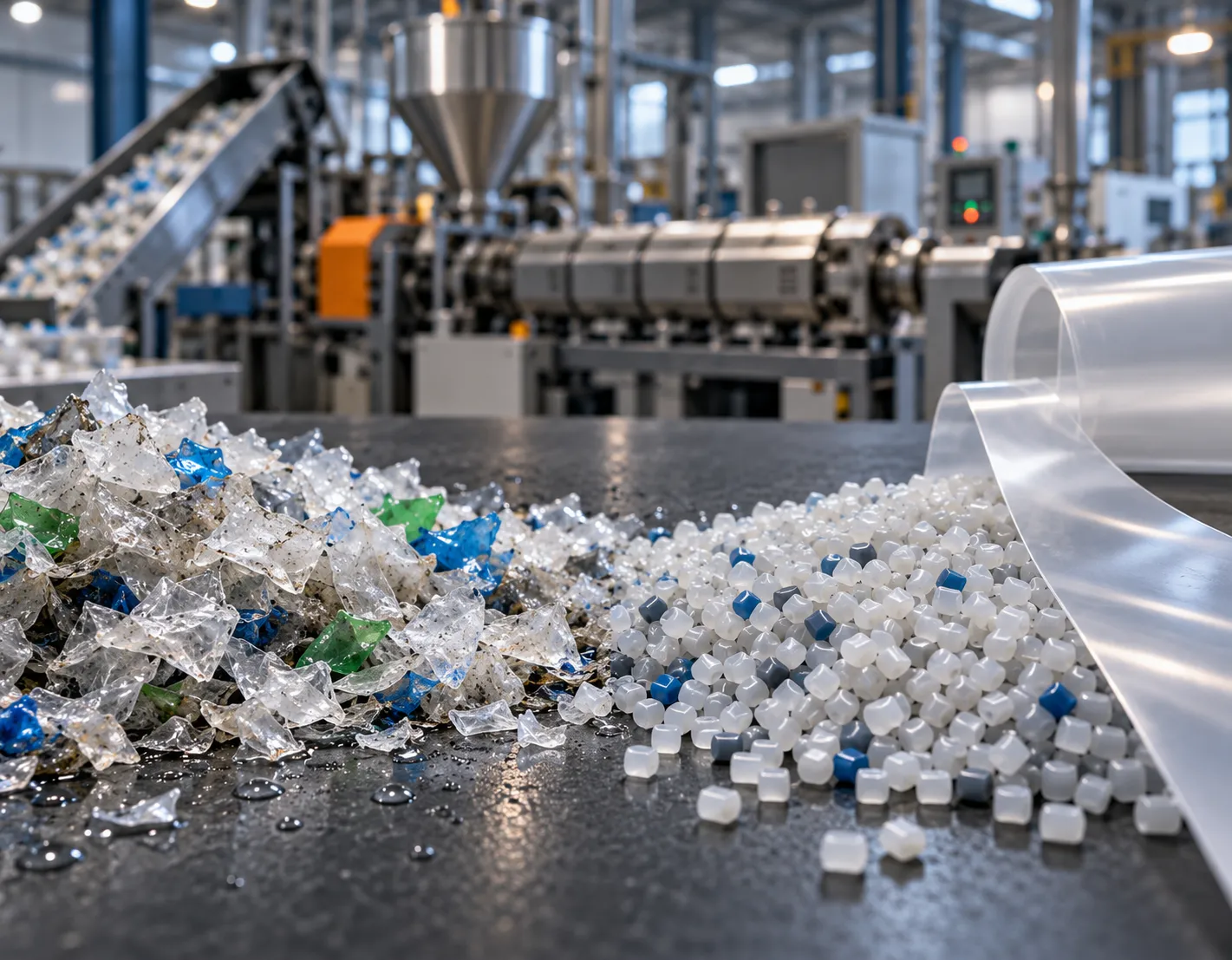
Recycled plastics can be difficult to process consistently. One batch of pellets may produce a smooth film, while the next creates bubbles, pinholes, or rough surfaces under the same machine settings. Residual moisture is one possible cause, especially when material has been washed, stored in humid conditions, or blended with damp fillers.
Moisture absorber masterbatch helps control that residual water during melt processing. For manufacturers using recycled PE and PP, it can be a practical way to reduce moisture-related defects and improve the consistency of finished products. The key is to use it for the right material, at a dosage confirmed by production trials.
Why Moisture Is a Problem in Recycled Plastics
Recycled feedstock often passes through collection, washing, shredding, and storage before it reaches an extruder or molding machine. Water can remain on the surface of flakes, within contaminants, or in other ingredients added to the blend.
As the material heats up, residual water may turn into vapor. If that vapor becomes trapped in the melt, the finished product can show:
- Bubbles or voids
- Pinholes in blown film
- Silver streaks or rough surfaces
- Inconsistent appearance between batches
- More rejected parts and production waste
These symptoms are not always caused by moisture. Contamination, poor dispersion, incompatible polymers, or unsuitable processing settings can create similar defects. Identifying the cause before changing the formulation saves time and material.
What Is Moisture Absorber Masterbatch?
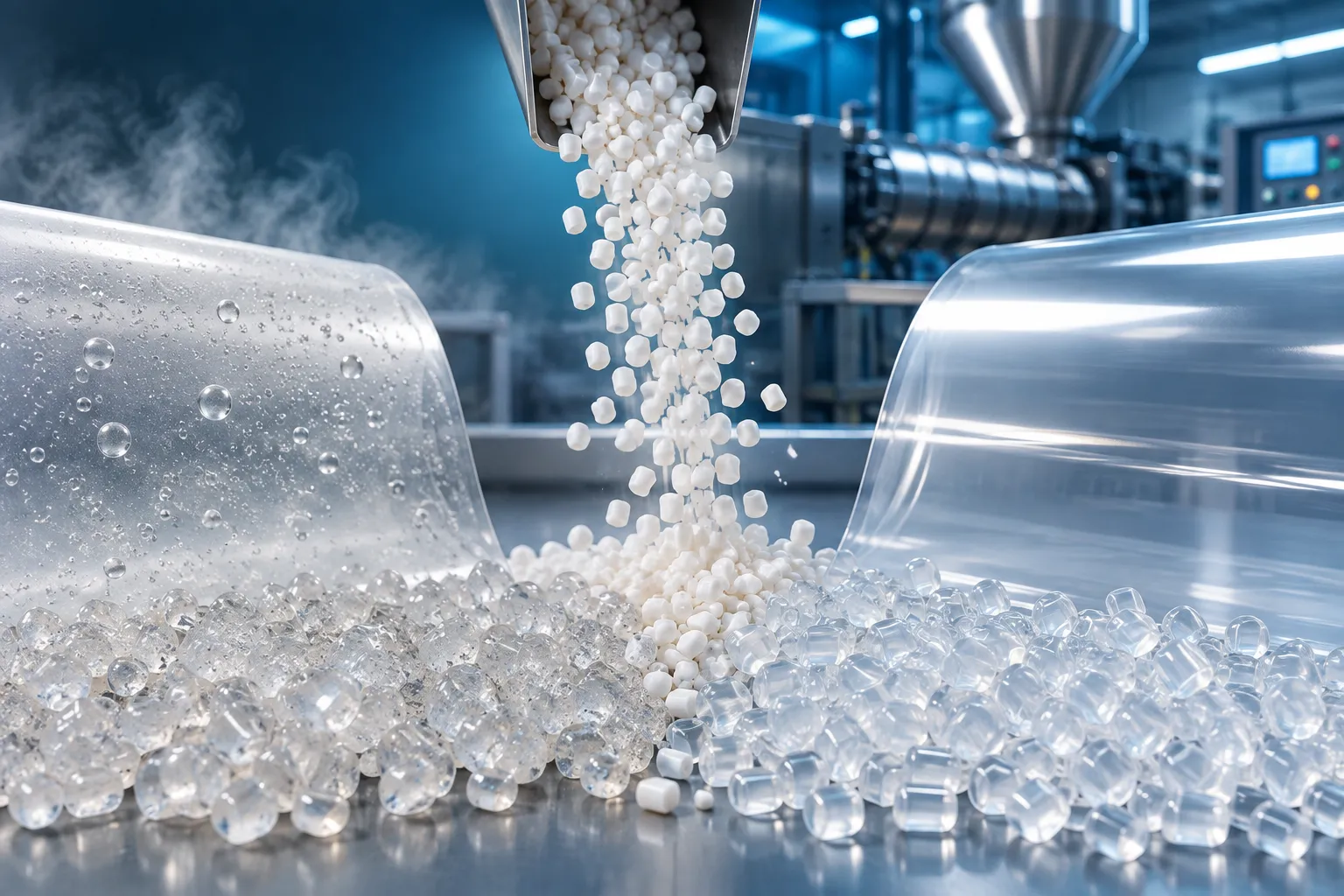
Moisture absorber masterbatch, also called desiccant masterbatch, is a concentrated additive supplied as pellets. It combines a moisture-absorbing ingredient with a carrier resin that can be mixed into plastic feedstock.
In a calcium oxide (CaO) formulation, the active ingredient reacts with water during processing to form calcium hydroxide. This helps prevent some residual water from becoming vapor in the melt. Nuoxin’s desiccant masterbatch uses CaO with PE or PP carrier resins and is intended for PE and PP film blowing, injection molding, and extrusion.
How Does It Improve Recycled PE and PP?
1. It helps reduce moisture-related bubbles
Bubbles are especially visible in recycled film and molded products. By reacting with residual water during processing, moisture absorber masterbatch can reduce the water available to form vapor pockets.
For blown film producers, fewer bubbles may mean fewer pinholes and a more uniform film surface. For injection molders, it may help reduce visible marks associated with damp feedstock. Results depend on the incoming material and processing conditions.
2. It supports a more consistent appearance
Recycled materials vary from batch to batch. If moisture is contributing to surface defects, controlling it can help produce a more consistent appearance across a production run.
This matters for products such as garbage bags, packaging film, molded containers, sheets, and profiles, where visible defects can lead to rejected output.
3. It can reduce waste linked to moisture defects
When bubbles or pinholes cause a product to fail inspection, the producer loses material and machine time. Reducing those defects can improve usable output. The benefit should be measured during a trial—for example, by comparing defect counts or rejection rates before and after adding the masterbatch.
Moisture absorber masterbatch will not correct defects caused by dirt, mixed incompatible polymers, or worn processing equipment.
Where Is Moisture Absorber Masterbatch Most Useful?
The strongest fit is a recycled PE or PP line with a confirmed residual-moisture problem. Common applications include blown film, injection molding, and extrusion of sheets, pipes, or profiles.
It may be useful when washed regrind has been dried but still causes occasional bubbles, or when material stored in humid conditions shows variable performance. It can also help processors evaluate moisture control without making an immediate change to their drying equipment.
Resin compatibility matters. A PE or PP carrier should be checked against the polymer and end-use requirements of the final product. Do not assume that a formulation intended for recycled PE or PP is suitable for PET or other moisture-sensitive resins.
How Much Should You Add?
Nuoxin lists 1%–5% as the recommended dosage range for its desiccant masterbatch. That is a starting range for trials, not a fixed setting for every recycled material. The appropriate amount depends on the feedstock’s moisture level, the masterbatch formulation, the process, and the finished product’s requirements.
A useful production trial follows four steps:
- Establish a baseline. Record feedstock condition, machine settings, defect rate, and finished-product quality.
- Start at the lower end of the supplier’s range. Mix the masterbatch evenly with the feedstock.
- Adjust one factor at a time. Increase the dosage only if moisture-related defects remain and product properties are acceptable.
- Check the final product. Compare appearance, mechanical performance, and rejection rate—not just whether bubbles have disappeared.
Keep the masterbatch sealed and dry before use. A moisture-absorbing additive that has already reacted with water during storage may deliver less benefit on the production line.
Can It Replace Drying?
That depends on the resin and the condition of the feedstock. For recycled PE and PP with limited residual moisture, a compatible desiccant masterbatch may be a useful part of the process. Very wet material still calls for better washing, dewatering, drying, or storage control.
PET requires particular care. Research on recycled PET shows that moisture during melt processing can contribute to hydrolytic degradation and reduced molecular weight. A masterbatch that improves surface appearance should not be treated as proof that PET has been dried sufficiently to protect its properties. Follow the resin and process requirements for moisture measurement and drying.
How to Choose a Moisture Absorber Masterbatch Supplier
Before placing a production order, ask the supplier for:
- The active ingredient and its concentration
- The carrier resin and compatible applications
- A recommended trial dosage range
- Storage and handling instructions
- Samples for testing with your own recycled feedstock
Share the resin type, processing method, typical defects, and any measured moisture data. This gives the supplier a clearer basis for recommending a grade and helps your team judge the trial against a defined problem.
Final Thoughts
Moisture absorber masterbatch can improve recycled plastic processing when residual water is causing bubbles, pinholes, or inconsistent surfaces. It is especially relevant to recycled PE and PP film, molding, and extrusion lines. The best results come from confirming that moisture is the cause, selecting a compatible formulation, and testing the dosage against finished-product quality.
For a recycled PE or PP application, review Nuoxin’s desiccant masterbatch specifications and request a sample for a production trial.
Frequently Asked Questions
Is moisture absorber masterbatch suitable for all recycled plastics?
No. Check the active ingredient, carrier resin, and end-use requirements for each material. Nuoxin’s listed PE/PP carrier formulations are positioned for PE and PP applications.
Will it remove every bubble in recycled film?
No. It targets moisture-related defects. Bubbles can also result from contamination, trapped air, or processing conditions, so the cause should be checked first.
What is the recommended dosage?
Nuoxin lists 1%–5% for its desiccant masterbatch. Start with a controlled trial and adjust according to the feedstock and finished-product results.
Do I still need to dry recycled plastic?
Possibly. The answer depends on the resin, moisture level, and product requirements. A desiccant masterbatch is not a substitute for proper drying where the material needs strict moisture control.