
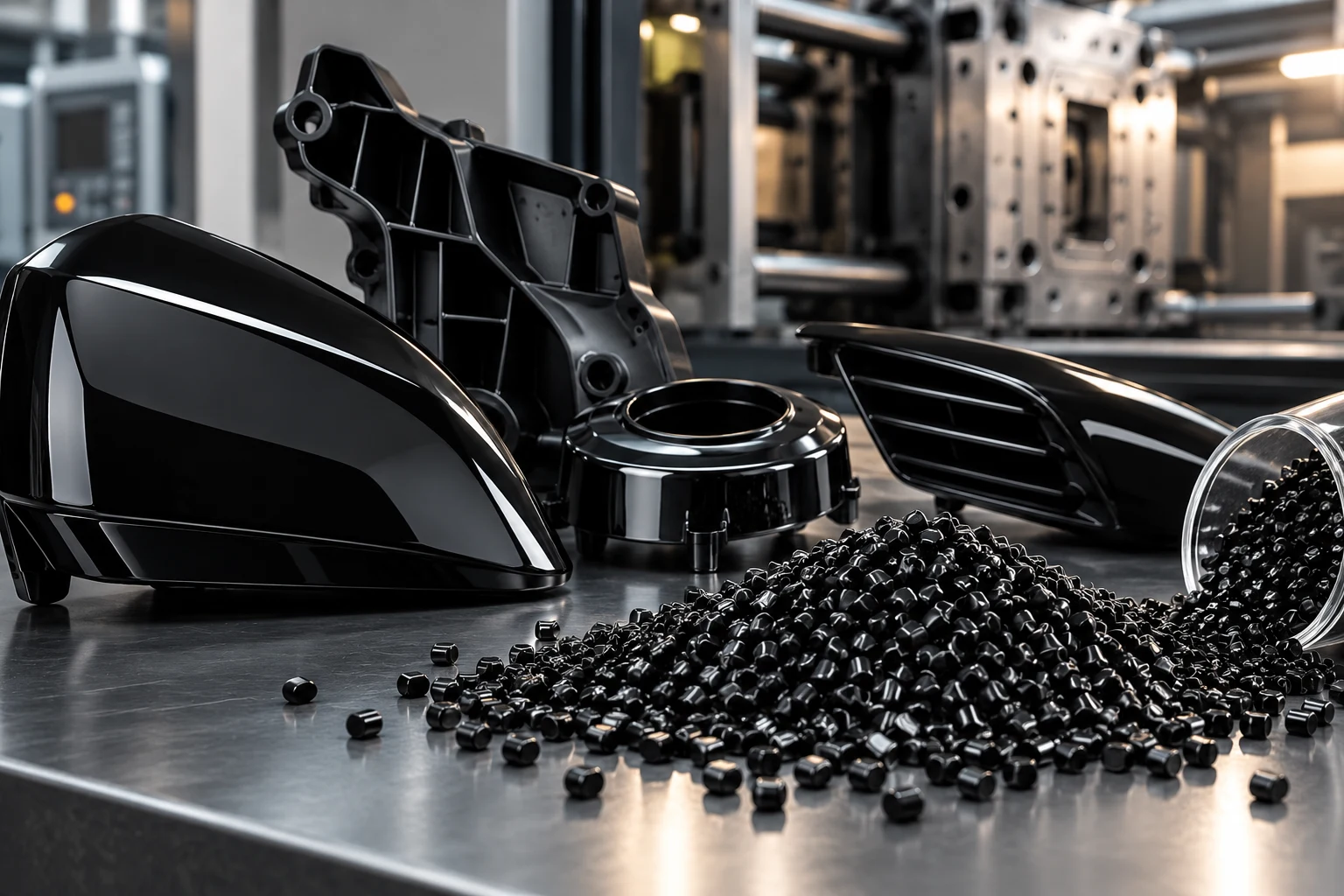
High-jetness master batch black is a concentrated plastic colorant designed to deliver intense black coloration, good pigment dispersion, and consistent surface appearance. By combining selected carbon black pigments with compatible carrier resins and processing additives, manufacturers can achieve a richer black tone while maintaining stable production performance.
However, not all black masterbatch formulations deliver the same results. Carbon black quality, dispersion technology, and processing compatibility directly influence the appearance of finished plastic products.
What Makes High Jetness Master Batch Black Different?
Jetness refers to the perceived depth and intensity of black coloration. A high-jetness plastic surface appears darker and richer than an ordinary black surface under comparable viewing conditions.
Unlike conventional black masterbatch, which may focus primarily on opacity and cost efficiency, high-jetness formulations place greater emphasis on visual appearance and consistent coloration.
The main advantages include:
- Deeper Black Color: High-quality carbon black helps create a rich, intense black appearance for premium plastic components.
- Uniform Dispersion: Well-dispersed pigments minimize visible specks, streaks, and uneven coloration.
- Improved Surface Appearance: Suitable formulations help produce smooth, visually consistent plastic surfaces.
- Consistent Color Quality: Controlled formulation and manufacturing processes support repeatable results across production batches.
High jetness should not be confused with high gloss. Jetness describes black color depth, while gloss describes the way a surface reflects light. Both properties contribute to the appearance of premium plastic parts, but they must be evaluated separately.
Key Factors Affecting Black Color Depth and Surface Quality
Achieving high jetness requires more than simply increasing the amount of carbon black. Several formulation and processing factors determine the final appearance of plastic products.
1. Carbon Black Particle Characteristics
Carbon black is the primary pigment responsible for black coloration. Its particle characteristics, surface area, and aggregate structure influence tinting strength, jetness, and dispersion behavior.
Certain fine-particle carbon black grades can produce deeper black coloration. However, they may also require more intensive dispersion during masterbatch manufacturing.
2. Carbon Black Dispersion
Poorly dispersed carbon black can form agglomerates that cause uneven coloring, visible black specks, and surface imperfections.
High-quality master batch black uses appropriate dispersing agents and compounding technology to distribute carbon black more uniformly throughout the carrier resin.
Good dispersion is particularly important for premium injection-molded products, where surface defects are easily visible.
3. Carrier Resin Compatibility
The carrier resin affects how the black masterbatch mixes with the base polymer during plastic processing.
For example, PE- or PP-based masterbatch formulations may be suitable for compatible polyolefin applications. Engineering plastics such as ABS, PC, or PC/ABS may require specially selected carrier systems.
Choosing the correct formulation helps maintain color uniformity, processing stability, and the required mechanical properties of the finished part.
4. Injection Molding Conditions
Even a high-quality black masterbatch cannot guarantee a premium surface if processing conditions are unsuitable.
Melt temperature, injection speed, mold surface quality, material moisture, and cooling conditions can all affect the final appearance.
For this reason, manufacturers should evaluate masterbatch performance using actual production materials and molding conditions.
Applications of High-Jetness Black Masterbatch
High-jetness black masterbatch is particularly valuable in industries where plastic components must combine attractive appearance with dependable manufacturing performance.
Automotive Plastic Components
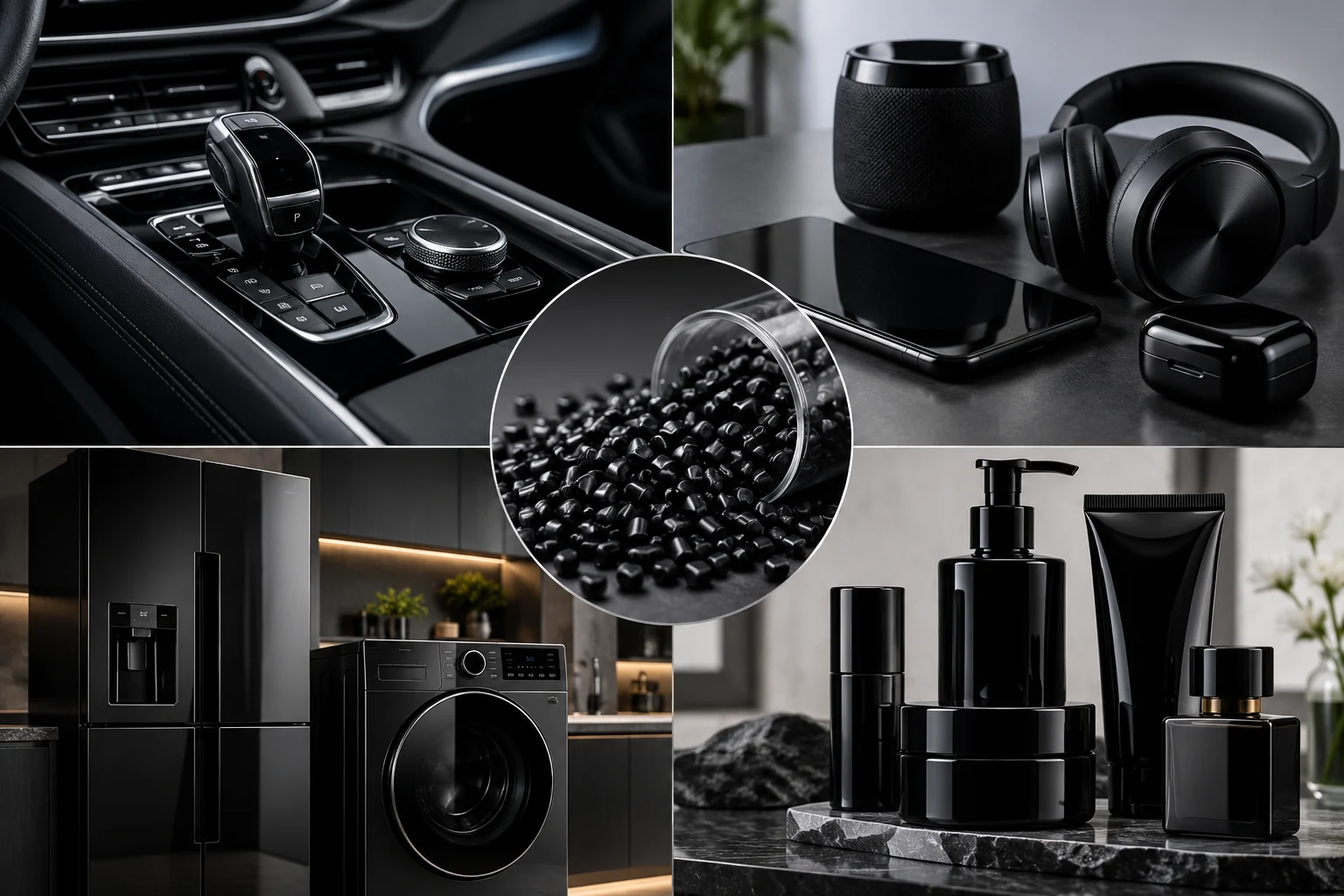
Automotive interior trim, control panels, decorative covers, and other visible components often require deep black coloration and consistent surface quality. Properly selected black masterbatch helps manufacturers maintain uniform color across molded parts.
Consumer Electronics
Electronic device housings, speaker enclosures, and equipment covers frequently use black finishes to create a clean, modern appearance. High-jetness formulations are suitable for applications where consistent color and minimal visible defects are important.
Household Appliances
From appliance control panels to decorative plastic housings, black masterbatch helps manufacturers produce a uniform finish across components. A stable formulation can reduce differences in black tone between production batches.
Premium Consumer Products
Cosmetic packaging, decorative accessories, and high-end plastic containers can also benefit from deeper black coloration. For these applications, manufacturers should consider both jetness and surface gloss when selecting a masterbatch.
How to Choose the Right Master Batch Black for Premium Plastic Parts
Selecting the appropriate masterbatch requires evaluating color performance, resin compatibility, processing conditions, and production cost.
The following factors should be considered before purchasing:
| Selection Factor | What Manufacturers Should Check |
|---|---|
| Black color depth | Jetness, visual appearance, and color consistency |
| Carbon black dispersion | Pigment agglomerates, surface specks, and streaking |
| Carrier compatibility | Suitability for the base polymer and processing method |
| Addition ratio | Dosage needed to achieve the required black appearance |
| Thermal stability | Color and processing performance at production temperatures |
| Batch consistency | Repeatable coloration and quality across deliveries |
For applications requiring strict visual standards, manufacturers can also compare molded samples using CIELAB L* measurements. Lower L* values generally indicate darker surfaces under standardized measurement conditions.
Surface gloss should be measured separately, using a consistent test method and measurement angle.
The best masterbatch is not necessarily the one with the highest carbon black concentration. A well-designed formulation should achieve the required blackness while maintaining dispersion, processability, and product performance.
Black Masterbatch Solutions for Plastic Manufacturers
As a professional masterbatch manufacturer in China, Nuoxin New Materials (Shandong) Co., Ltd. supplies black masterbatch formulations for different plastic processing requirements.
Nuoxin’s black masterbatch products use carbon black, compatible carrier resins, and specialized additives to support deep black coloration, uniform dispersion, and stable processing performance.
According to Nuoxin’s published product information, its black masterbatch range offers:
- Carbon Black Content: 30–55%, depending on formulation requirements.
- Carrier Resin Options: PE, PP, and other compatible plastic systems.
- Recommended Addition Ratio: 1–10%, depending on the target color depth and application.
- Processing Applications: Injection molding, blow molding, and extrusion.
These are general product-range specifications. For premium applications requiring particularly high jetness, the actual formulation, resin compatibility, and color performance should be confirmed through sample testing.
With more than 10 years of manufacturing experience, Nuoxin focuses on consistent product quality, dependable supply, and formulation support for plastic processors.
Manufacturers can explore Nuoxin’s Black Masterbatch Products to identify suitable grades for their production requirements.
Frequently Asked Questions About High-Jetness Master Batch Black
1. What is high-jetness master batch black?
High-jetness master batch black is a concentrated carbon black colorant formulated to produce a deep, intense black appearance in plastic products. It is commonly considered for premium molded components where surface quality and color consistency are important.
2. Does higher carbon black content always produce a deeper black color?
No. Carbon black grade, particle characteristics, dispersion quality, and processing conditions also influence jetness. Increasing pigment concentration without proper dispersion may reduce surface quality.
3. Can high-jetness black masterbatch be used in injection molding?
Yes. High-jetness black masterbatch can be formulated for injection molding applications. The carrier resin, melt flow behavior, and thermal stability must match the base polymer and molding conditions.
4. How can manufacturers achieve a glossy black plastic finish?
A glossy black finish requires an appropriate black masterbatch, good pigment dispersion, suitable molding conditions, and a properly finished mold surface. High jetness contributes to color depth, but gloss must also be controlled independently.
Conclusion
High-jetness master batch black plays an important role in producing premium plastic parts with deep black coloration and consistent appearance.
By selecting high-quality carbon black, ensuring proper pigment dispersion, and matching the masterbatch formulation to the base resin, manufacturers can improve the visual quality of finished products while maintaining reliable processing performance.
Looking for a reliable black masterbatch supplier?
Nuoxin provides black masterbatch solutions for plastic manufacturers seeking consistent coloration and dependable production quality.
Contact Nuoxin to discuss your resin type, processing requirements, target blackness, and recommended masterbatch formulation.