

CaCO3 filler is one of the most widely used mineral fillers in the plastics industry. Also known as calcium carbonate filler, it can reduce raw material costs while improving rigidity, dimensional stability, surface properties, and processing efficiency.
In film blowing, injection molding, blow molding, extrusion, pipe, and sheet production, CaCO3 filler is commonly added in the form of filler masterbatch. With the right particle size, surface treatment, carrier resin, and addition rate, it can help plastic manufacturers achieve a better balance between product performance, processing stability, and production cost.
What Is CaCO3 Filler?
CaCO3 filler is a calcium carbonate-based material used to modify the physical and processing properties of plastics. The two main types used in plastic manufacturing are ground calcium carbonate and precipitated calcium carbonate.
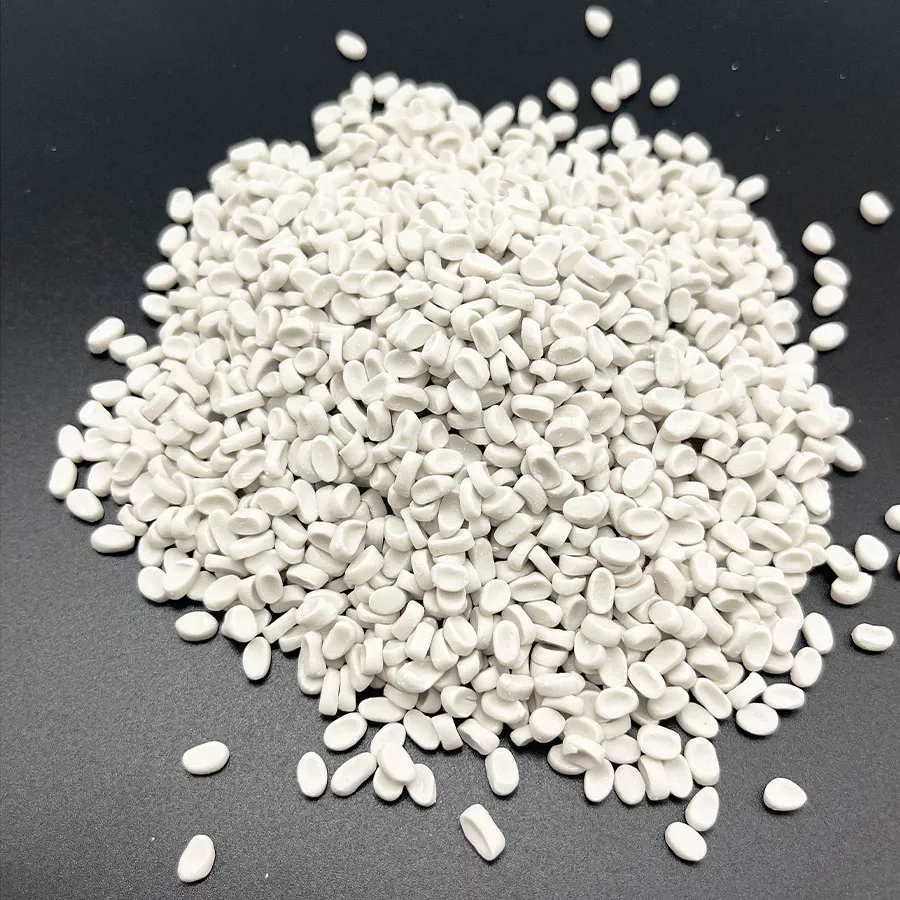
Instead of adding calcium carbonate powder directly, many manufacturers use CaCO3 filler masterbatch. It is usually produced by mixing surface-treated calcium carbonate powder with a carrier resin, dispersing agents, and other processing additives. The mixture is then melted, extruded, cooled, and pelletized.
Compared with loose powder, CaCO3 filler masterbatch offers several practical advantages:
- Easier handling and accurate dosing
- Less dust in the production environment
- More uniform dispersion in the base resin
- Lower risk of calcium carbonate agglomeration
- Easier storage and transportation
- More stable continuous production
How Does CaCO3 Filler Enhance Plastic Strength?
CaCO3 filler does more than increase the weight of a plastic product. When properly selected and dispersed, it can modify the mechanical structure of the polymer and improve certain strength-related properties.
Increased Rigidity
Calcium carbonate particles are more rigid than common thermoplastics such as polyethylene and polypropylene. Once dispersed throughout the polymer matrix, the particles restrict the movement of polymer chains under external force.
As a result, CaCO3 filler can increase stiffness and flexural modulus. This is useful for products that need to maintain their shape, including:
- Plastic sheets
- Packaging containers
- Injection-molded housings
- Plastic furniture
- Pipes and profiles
- Household plastic products
Improved Compressive Performance
Uniformly dispersed CaCO3 filler particles can help the material withstand external pressure. This may improve structural stability during stacking, transportation, and everyday use.
However, compressive performance also depends on the base resin, filler content, product structure, wall thickness, and processing conditions. Increasing the filler ratio alone does not always produce a stronger product.
Controlled Impact Performance
Fine and surface-treated CaCO3 filler can help distribute stress more evenly throughout the polymer matrix. Under suitable formulation conditions, this may reduce localized stress concentration and maintain acceptable impact resistance.
However, oversized particles, poor dispersion, or excessive filler content may reduce impact strength and elongation at break. Manufacturers must therefore select the addition level according to the performance requirements of the finished product.
How Does CaCO3 Filler Improve Dimensional Stability?
Dimensional stability is another important benefit of using CaCO3 filler in plastics.
Reduced Molding Shrinkage
Thermoplastics naturally shrink as they cool after molding or extrusion. Adding CaCO3 filler reduces the relative proportion of polymer in the formulation and limits the overall shrinkage of the material.
This makes it particularly useful for injection-molded components, sheets, pipes, and profiles that require consistent dimensions.
Lower Risk of Warping
Uneven cooling and shrinkage can cause a plastic product to warp or deform. A properly formulated CaCO3 filler masterbatch can improve dimensional retention and help the product maintain a more stable shape.
The final result also depends on mold design, processing pressure, cooling time, temperature control, and filler dispersion.
Better Stability Under Temperature Changes
CaCO3 filler is an inorganic mineral and does not soften or expand in the same way as a polymer. Its addition can help reduce the thermal expansion of plastic materials, allowing products to retain their dimensions more effectively under changing temperatures.
However, CaCO3 filler does not fundamentally increase the heat-resistance rating of the base resin. High-temperature products still require an appropriate polymer and stabilizer system.
Other Benefits of CaCO3 Filler in Plastics
Reduced Raw Material Costs
CaCO3 filler is generally less expensive than common virgin plastic resins. By replacing part of the resin with filler masterbatch, manufacturers can reduce the raw material cost per unit.
The actual savings depend on several factors:
- Resin and masterbatch prices
- CaCO3 filler addition rate
- Finished-product weight
- Processing efficiency
- Defect and rejection rates
- Required mechanical properties
Manufacturers should calculate the total production cost rather than comparing masterbatch prices alone.
Improved Processing Performance
A well-formulated CaCO3 filler masterbatch may improve melt behavior and processing stability. Depending on the application and equipment, it can provide benefits such as:
- More stable extrusion
- Improved opening performance in plastic films
- Reduced material sticking
- Faster cooling for certain molded products
- Shorter production cycles
- Higher processing efficiency
The results vary according to the carrier resin, equipment type, processing temperature, particle size, and filler concentration.
Improved Surface Properties
Fine and evenly dispersed CaCO3 filler can contribute to a smoother and more uniform product surface. In films, sheets, and injection-molded parts, a suitable addition rate may also help control gloss, texture, and printability.
Poor-quality filler with coarse particles or weak dispersion can cause white spots, surface roughness, die buildup, gels, and film breakage.
Higher Opacity and Whiteness
High-whiteness CaCO3 filler can increase the opacity and visual whiteness of plastic products. In certain applications, this may reduce the amount of white pigment required.
However, calcium carbonate cannot completely replace titanium dioxide. CaCO3 filler mainly provides filling, rigidity, and moderate opacity, while titanium dioxide offers much stronger whitening and hiding power.
Common Applications of CaCO3 Filler
Blown Film
CaCO3 filler masterbatch is widely used in shopping bags, garbage bags, packaging films, agricultural films, and industrial films. A suitable grade can improve stiffness, opening properties, and production economics.
Blown-film production requires fine particles, excellent dispersion, and reliable filtration. Excessive addition may reduce tensile strength, elongation, transparency, and heat-sealing performance.
Injection Molding
CaCO3 filler can be used in plastic pallets, storage boxes, waste bins, furniture, household products, and industrial parts. It helps increase rigidity, reduce molding shrinkage, and potentially shorten cooling cycles.
For injection molding, manufacturers should evaluate material flow, impact resistance, surface appearance, and dimensional accuracy before determining the final addition rate.
Blow Molding
In selected bottles, containers, and other hollow plastic products, CaCO3 filler may improve stiffness and dimensional stability while reducing resin consumption.
The appropriate ratio depends on wall thickness, drop-test requirements, container design, and intended use.
Plastic Pipes and Profiles
Calcium carbonate filler is commonly used in PVC pipes and profiles and may also be used in certain PE and composite products. It can increase rigidity, improve dimensional stability, and reduce formulation costs.
For these applications, manufacturers should pay particular attention to particle size, moisture content, surface treatment, oil absorption, and compatibility with the base resin.
Nonwoven Fabrics and Woven Products
CaCO3 filler masterbatch may be used in selected polypropylene nonwoven fabrics, woven bags, and plastic weaving applications. It can help adjust stiffness, texture, breathability, and material cost.
These applications require good dispersion and melt filtration to reduce fiber breakage, screen blockage, and surface defects.

Factors Affecting Calcium Carbonate Performance
Particle Size and Distribution
Particle size is one of the most important factors influencing the performance of CaCO3 filler. Fine particles generally provide more uniform mechanical properties and better surface quality.
Important specifications include:
- Average particle size
- Particle size distribution
- Maximum particle size
- Sieve residue
- Batch-to-batch consistency
The finest particle size is not always the best choice. It must match the processing method, base resin, equipment, and finished-product requirements.
Surface Treatment
Calcium carbonate is naturally hydrophilic, while common polyolefin resins such as PE and PP are hydrophobic. Untreated particles may therefore have poor compatibility with the polymer and form agglomerates.
Surface treatment with stearic acid, coupling agents, or other modifiers improves compatibility, wetting, and dispersion. Effective surface treatment is especially important for thin films and products with strict surface-quality requirements.
Carrier Resin
The carrier resin in CaCO3 filler masterbatch should be compatible with the base material:
- PE products generally require a PE-compatible carrier.
- PP products typically require a PP-based or compatible carrier.
- PVC and engineering plastics require specially designed formulations.
An unsuitable carrier may cause poor dispersion, delamination, reduced strength, surface defects, or unstable processing.
Filler Concentration
The calcium carbonate concentration in the masterbatch influences cost, dispersion, melt flow, and final product performance. A higher CaCO3 content does not automatically mean better quality or greater cost savings.
A reliable masterbatch must balance mineral content with sufficient carrier resin, dispersing agents, and processing additives.
Addition Rate
The correct CaCO3 filler addition rate depends on the base resin, application, equipment, and product requirements. General-purpose products may accept a relatively high ratio, while thin films, load-bearing components, and impact-resistant products usually require more conservative dosing.
Production trials should be conducted before using a new formulation in large-scale manufacturing.
What Happens If Too Much CaCO3 Filler Is Added?
Excessive or unsuitable use of CaCO3 filler can create several quality and processing problems:
- Reduced tensile strength
- Lower elongation at break
- Decreased impact resistance
- Lower film transparency
- Poor heat-sealing performance
- Rough or uneven surfaces
- White spots and particle agglomeration
- More frequent filter replacement
- Higher product density
- Increased finished-product weight
For this reason, CaCO3 filler should not be evaluated only by its calcium carbonate content or purchase price. Dispersion, consistency, processability, output efficiency, and finished-product quality are equally important.
How to Choose the Right CaCO3 Filler Masterbatch
Before selecting a masterbatch, manufacturers should clearly define their processing method and product requirements.
The selection process should include the following steps:
- Identify the base resin, such as PE, PP, or PVC.
- Confirm the processing method, including film blowing, injection molding, blow molding, or extrusion.
- Define the required stiffness, toughness, appearance, and color.
- Check particle size, whiteness, moisture content, and mineral purity.
- Confirm the carrier resin and surface-treatment system.
- Evaluate dispersion and melt-flow performance.
- Test different addition rates under actual production conditions.
- Compare the total production cost rather than the masterbatch price alone.
It is generally advisable to begin with a moderate addition rate and gradually adjust the formulation after evaluating equipment operation, surface quality, mechanical properties, and dimensional stability.
Conclusion
CaCO3 filler is a cost-effective material for improving the rigidity, dimensional stability, opacity, and processing performance of many plastic products. It can reduce resin consumption and help manufacturers control production costs.
However, successful use depends on more than simply adding calcium carbonate. Particle size, surface treatment, carrier resin, dispersion quality, and addition rate must all be matched to the application.
By selecting a suitable CaCO3 filler masterbatch and validating it through production trials, plastic manufacturers can achieve a reliable balance between product quality, processing stability, and cost efficiency.