
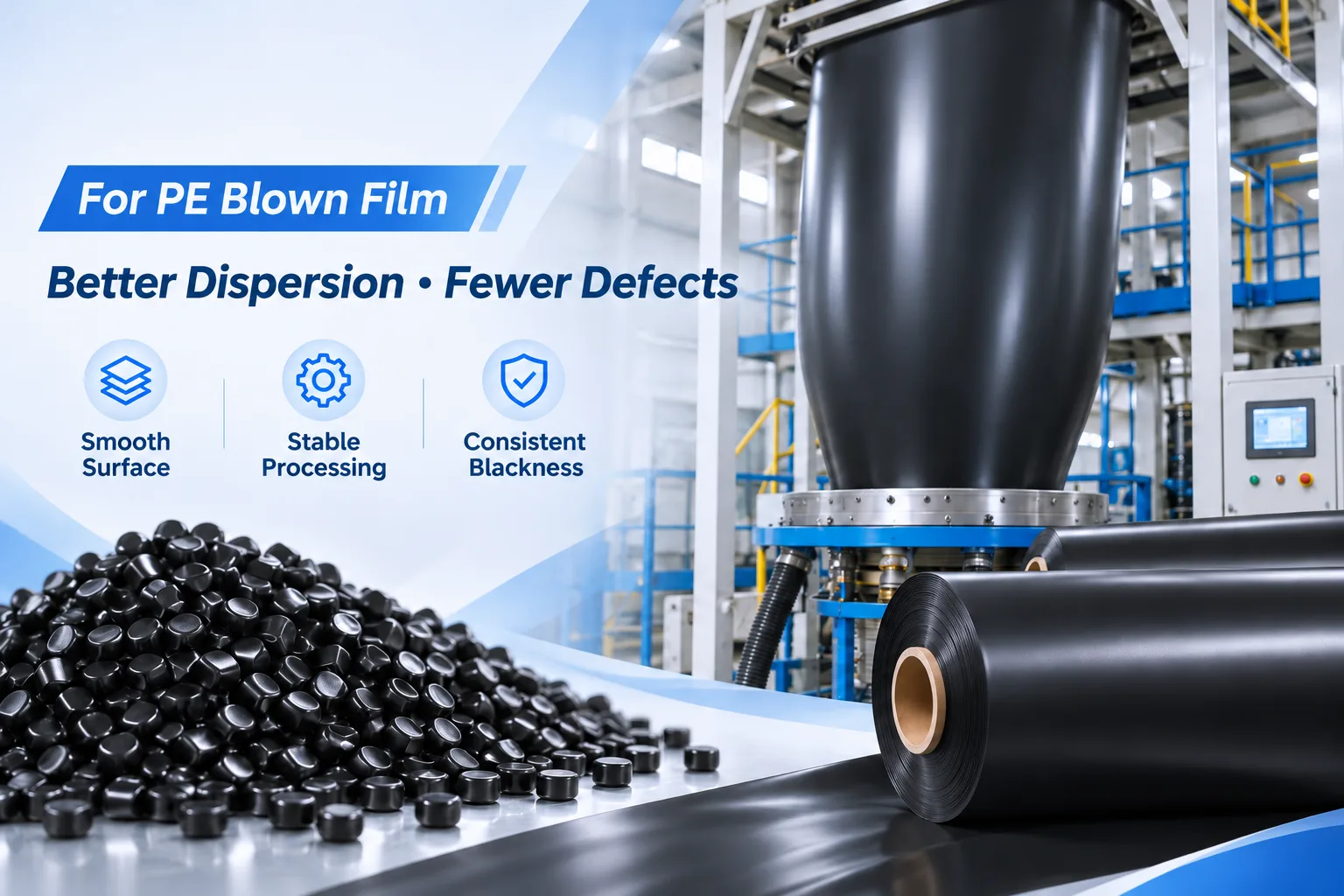
Pinholes, unexpected tearing, and frequent bubble breaks can reduce production efficiency in black blown film manufacturing. These defects often result from poor carbon black dispersion, resin contamination, incompatible materials, or unstable extrusion conditions.
Choosing the right blown film black masterbatch helps reduce pigment-related defects and supports consistent film strength. However, manufacturers must also control raw material quality, film thickness, and processing parameters to achieve reliable results.
This guide explains the main causes of pinholes and tears, how black masterbatch affects film quality, and practical ways to improve PE blown film production.
What Causes Pinholes and Tears in Black Blown Film?
Black blown films are commonly manufactured using LDPE, LLDPE, or HDPE resins. During extrusion, the molten polymer forms a thin bubble that stretches in both the machine direction (MD) and transverse direction (TD).
Even small material defects can become critical as the film becomes thinner.
Poor Carbon Black Dispersion
Carbon black provides the deep color and opacity required for black plastic films. However, poorly dispersed carbon black can form agglomerates within the polymer matrix.
These agglomerates may create:
- Black specks and uneven film surfaces.
- Localized weak points around pigment clusters.
- Pinholes during film stretching.
- Premature tearing under mechanical stress.
High-quality black masterbatch for blown film distributes carbon black more uniformly, reducing the risk of pigment-related defects.
Moisture and Raw Material Contamination
Moisture, dust, foreign particles, and degraded polymers can also create defects during film extrusion.
Recycled PE materials are particularly susceptible to inconsistent feedstock quality. When moisture vaporizes or contaminants enter the melt, the resulting bubbles, gels, or inclusions may produce pinholes.
A suitable black masterbatch cannot compensate for severe material contamination. Manufacturers should address moisture and raw material cleanliness separately.
Uneven Film Thickness and Excessive Stretching
Film tearing is not always caused by masterbatch quality.
Incorrect extrusion temperatures, unstable bubble cooling, excessive drawdown, and uneven film thickness can reduce mechanical performance.
Thin sections of film experience greater localized stress, making them more vulnerable to tearing during production or subsequent bag conversion.
How Blown Film Black Masterbatch Helps Reduce Defects
Selecting a suitable blown film black masterbatch involves more than achieving a deep black color. Dispersion quality, carrier compatibility, and dosage directly influence processing performance.
1. Uniform Carbon Black Dispersion
Well-dispersed carbon black allows the pigment to distribute consistently throughout the PE film.
This helps manufacturers achieve smoother surfaces, uniform opacity, and fewer defects associated with large pigment agglomerates.
For thin-film applications, evaluating dispersion in the finished film is particularly important because defects that remain unnoticed in thicker products can become critical weak points.
2. Compatible Carrier Resin
The carrier resin should be compatible with the base polymer used during film extrusion.
For LDPE, LLDPE, and HDPE films, PE-based black masterbatch is generally preferred.
A compatible carrier promotes homogeneous mixing and helps minimize processing problems associated with poorly matched materials.
Manufacturers should also consider melt flow characteristics, processing temperatures, and the selected film resin formulation.
3. Optimized Masterbatch Dosage
Using more black masterbatch does not necessarily produce stronger or better-quality film.
Excessive addition can alter the overall formulation and may affect melt behavior or mechanical properties, depending on the masterbatch composition.
The appropriate addition rate depends on:
- Carbon black concentration.
- Film thickness and opacity requirements.
- PE resin composition.
- Mechanical strength requirements.
The objective is to achieve sufficient blackness while maintaining consistent film quality and stable extrusion.
Nuoxin Black Masterbatch for PE Blown Film
Nuoxin New Materials manufactures black masterbatch using carbon black, compatible carrier resins, and processing additives.
Its product range is designed for various plastic applications, including blown film packaging, agricultural films, injection molding, and extrusion.
According to Nuoxin’s published product specifications:
| Technical Parameter | Published Product Range |
|---|---|
| Carbon Black Content | 30–55% |
| Carrier Resin | PE / PP / Other compatible plastics |
| Melt Flow Index (MFI) | 10–20 g/10 min, adjustable |
| Pellet Size | 3 ± 0.3 mm |
| Recommended Dosage | 1–10% |
For blown film manufacturers, the important considerations include carbon black dispersion, stable color consistency, and compatibility with the intended polyethylene formulation.
Nuoxin also emphasizes batch-to-batch quality control, helping manufacturers maintain consistency across repeat orders.
Practical Solutions to Prevent Pinholes and Film Tears
Reducing defects requires a combination of suitable masterbatch selection and controlled extrusion conditions.
The following troubleshooting guide helps identify common problems and corrective actions.
| Film Problem | Possible Cause | Recommended Solution |
|---|---|---|
| Pinholes around black specks | Carbon black agglomeration | Evaluate masterbatch dispersion |
| Random holes and surface bubbles | Moisture or contaminated resin | Inspect feedstock and moisture levels |
| Frequent film tearing | Thin spots, weak regions, or excessive stretching | Check film gauge, formulation, and drawdown |
| Visible gels and rough surfaces | Degraded resin or contaminants | Inspect screen packs, melt filtration, and die cleanliness |
| Unstable film bubble | Processing imbalance or inconsistent melt behavior | Check temperature, cooling, and bubble settings |
| Uneven black coloration | Poor pigment mixing or inconsistent dosing | Improve blending and verify masterbatch addition rate |
Recommended Production Checks
Before switching to mass production, manufacturers should perform controlled trials using their intended PE resin and target film thickness.
Start with a stable reference formulation, then evaluate the proposed black masterbatch without changing multiple process variables simultaneously.
Monitor visible defects, extrusion pressure, bubble stability, and thickness uniformity.
Film performance should also be tested using appropriate methods for dart impact resistance, tensile properties, and MD/TD tear resistance.
These checks help determine whether defects originate from the masterbatch, base resin, contamination, or processing conditions.
Choosing Black Masterbatch for Different Film Applications
Different blown film products require different combinations of appearance, processing stability, and mechanical performance.
Garbage Bags and Trash Liners
These products require consistent black coloration and adequate resistance to puncturing and tearing. Good dispersion helps minimize pigment-related weak points, particularly in thinner films.
Shopping Bags and T-Shirt Bags
Manufacturers should prioritize stable processing and film strength because these products experience stretching during bag conversion and everyday use.
Agricultural Mulch Films
Agricultural films require uniform black coverage and consistent film quality. When UV protection or extended outdoor durability is required, the complete formulation should be evaluated for the intended service conditions.
Industrial Packaging Films
Industrial films often require reliable mechanical properties and consistent thickness. Selecting a compatible masterbatch helps maintain uniform coloration without unnecessarily compromising film performance.
For application-specific guidance, explore Nuoxin’s Blown Film Masterbatch Solutions.
Frequently Asked Questions
Can black masterbatch cause pinholes in blown film?
Yes. Poorly dispersed carbon black agglomerates or contaminants introduced with the masterbatch can create localized defects that develop into pinholes during extrusion. However, moisture, degraded resin, and processing conditions can also cause pinholes.
How can manufacturers prevent black PE film from tearing?
Manufacturers should use compatible materials, maintain uniform film thickness, control extrusion and cooling conditions, and verify film mechanical properties. Well-dispersed black masterbatch helps reduce pigment-related weak points but cannot eliminate every cause of tearing.
What is the recommended dosage of black masterbatch for blown film?
The appropriate dosage depends on the carbon black concentration, required opacity, film thickness, and resin formulation. Nuoxin publishes a general black masterbatch dosage range of 1–10%, but the correct addition rate for a specific blown film application must be established through testing.
Is PE black masterbatch suitable for LDPE, LLDPE, and HDPE films?
PE-based black masterbatch is generally suitable for compatible polyethylene film formulations. However, the carrier resin, melt flow characteristics, and final film performance must be evaluated for the specific LDPE, LLDPE, or HDPE grade.
Conclusion
Preventing pinholes and tears in black blown film production requires careful attention to raw material quality, carbon black dispersion, resin compatibility, and extrusion stability.
Choosing the right blown film black masterbatch can help reduce pigment-related defects, improve color consistency, and support more reliable manufacturing performance.
Nuoxin New Materials provides black masterbatch solutions for PE film producers seeking consistent quality and application-specific formulations.