
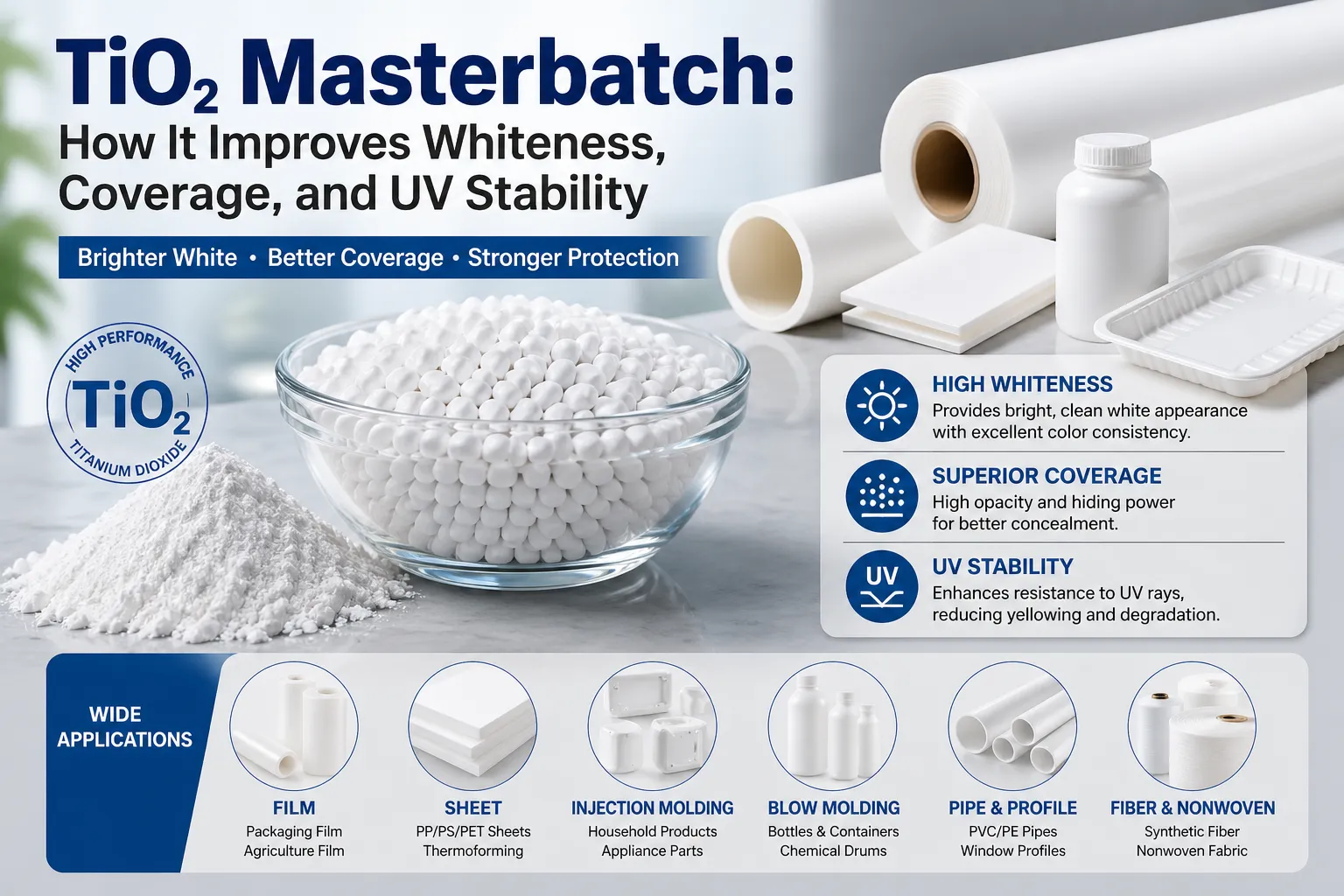
In the production of plastic products, white is an extremely important and widely utilized color. Whether for food packaging films, plastic sheets, disposable food containers, appliance housings, daily-use product containers, and cosmetic packaging—or for pipes, profiles, fibers, and automotive plastic components—whiteness, opacity (covering power), and long-term color stability directly impact a product’s aesthetic quality and market competitiveness. To achieve a stable, uniform, and high-quality white effect, TiO2 masterbatches serve as a critical class of materials for plastic coloring and functional modification.
1. What Are TiO2 Masterbatches?
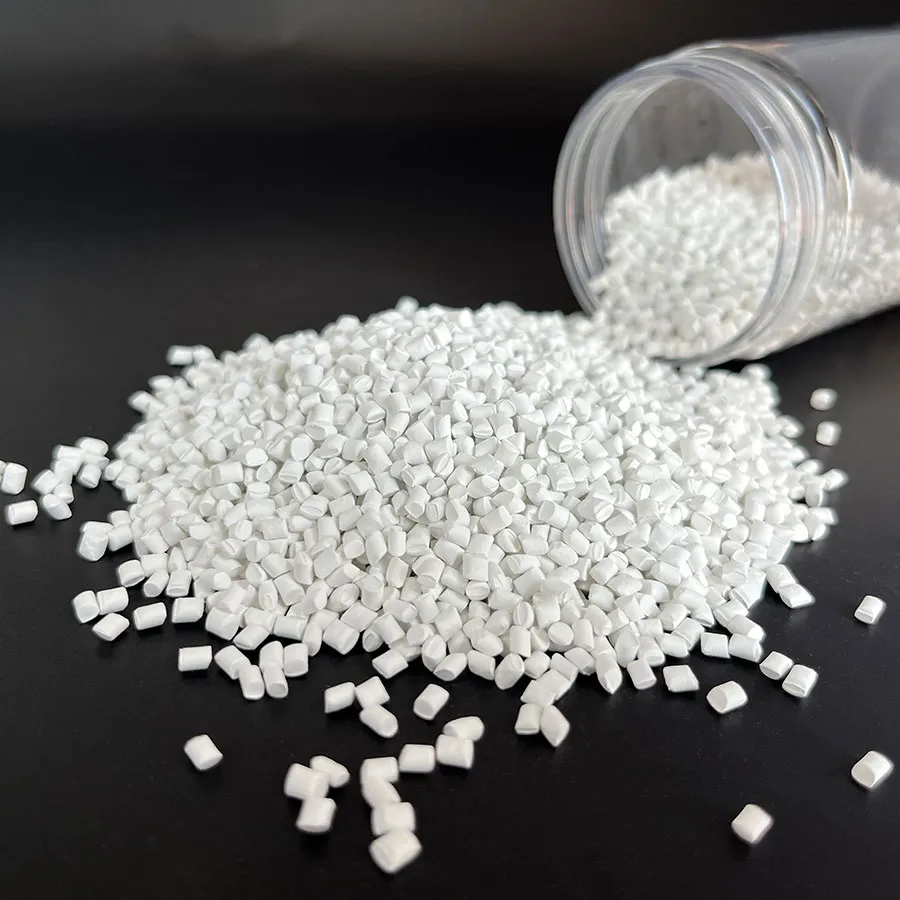
A TiO2 masterbatch is a white granular material produced by uniformly dispersing titanium dioxide powder into a plastic carrier resin, aided by additives such as dispersants, lubricants, and antioxidants, through processes involving high-speed mixing, melt extrusion, cooling, and granulation.
In this context, TiO2 stands for Titanium Dioxide—a high-performance white pigment characterized by excellent whiteness, opacity, refractive index, and weather resistance. Within the plastics industry, titanium dioxide is the core material used to enhance the whiteness and opacity of plastic products.
Simply put, a TiO2 masterbatch is a “pre-dispersed concentrate of titanium dioxide.” Downstream plastic processing manufacturers need only add it in a specific ratio to raw plastic materials—such as PE, PP, PS, ABS, PET, or PA—to produce plastic products that exhibit high whiteness, strong opacity, and a uniform appearance.
2. Key Components of TiO2 Masterbatches
A TiO2 masterbatch is not merely a collection of individual titanium dioxide particles; rather, it is a composite functional masterbatch for plastics. Its performance is primarily determined by the combined influence of the titanium dioxide type, the carrier resin, the dispersion system, and the processing technology employed.
| Components | Primary Functions | Impact on Performance |
| Titanium Dioxide (TiO2) | Provides whiteness, opacity, and UV-shielding capabilities. | Determines whiteness, brightness, opacity, and weather resistance. |
| Carrier Resin | Carries TiO2 and is compatible with the substrate | Influences processing stability, dispersibility, and product performance |
| Dispersant | Improves TiO2 powder dispersion | Reduces white spots, color spots, agglomeration, and surface defects |
| Processing Aids | Improve Flowability and Plasticization | Enhance Production Efficiency and Processing Stability |
| Functional Additives | Provide properties such as antioxidant protection, weather resistance, and UV resistance. | Enhance the long-term performance of finished products. |
3. How Do TiO2 Masterbatches Enhance the Whiteness of Plastic Products?
Whiteness is a crucial metric for evaluating the aesthetic quality of white plastic products. In sectors such as packaging, home appliances, daily necessities, and plastic sheeting, higher whiteness typically renders a product looking cleaner, brighter, and more premium in texture.
The fundamental reason why TiO2 masterbatches enhance whiteness lies in titanium dioxide’s inherent capacity for high light reflectivity. Titanium dioxide effectively reflects visible light, thereby endowing plastic products with a bright, pure white appearance.
3.1 High Refractive Index Yields Superior Whiteness
TiO2 possesses a high refractive index, enabling it to scatter light intensely. When light enters plastic products containing TiO2, it undergoes significant scattering and reflection, thereby creating a visual effect characterized by high brightness and exceptional whiteness. This is a primary reason why titanium dioxide is widely utilized across the white plastics, coatings, inks, and paper industries.
3.2 High-Quality TiO2 Ensures Purer Colors
Titanium dioxide of varying grades differs in terms of whiteness, undertone, particle size distribution, and surface treatment. High-quality TiO2 masterbatches typically incorporate titanium dioxide grades characterized by high whiteness, stable hue, and an optimal particle size distribution; this ensures that plastic products exhibit a cleaner, purer white appearance, effectively preventing issues such as yellowing, graying, or color instability.
3.3 Pre-Dispersion Enhances Whiteness Uniformity
When titanium dioxide powder is added directly without adequate dispersion, the surface of the finished product may exhibit white spots, color patches, streaks, or localized color inconsistencies. By undergoing a pre-dispersion process, TiO2 masterbatches facilitate a more uniform distribution of titanium dioxide within the resin matrix, thereby enhancing the overall whiteness consistency of the final product.
4. How Do TiO2 Masterbatches Enhance Opacity?
Opacity—or hiding power—is one of the most critical performance attributes of TiO2 masterbatches. For applications involving films, sheets, packaging containers, and recycled plastic products, opacity directly determines the product’s ability to effectively mask the underlying color of the substrate, internal impurities, or the contents enclosed within.
4.1 TiO2 Particles Boost Light Scattering
The opacity of TiO2 stems primarily from its potent light-scattering capabilities. When a high concentration of TiO2 particles is uniformly dispersed throughout the plastic matrix, light struggles to penetrate the material directly; consequently, the finished product exhibits a significantly enhanced level of opacity.
This attribute is of paramount importance for white packaging films, food pouches, disposable food containers, plastic sheets, and various vessels. High opacity not only lends a cleaner, more polished aesthetic to the product but also elevates the overall visual quality of the packaging.
4.2 Ideal for Masking Discoloration in Recycled Materials
Recycled plastic feedstocks frequently present challenges such as complex coloration, visible impurities, and significant batch-to-batch color variations. The incorporation of TiO2 masterbatches serves to boost both whiteness and opacity, thereby improving the visual consistency of products manufactured from recycled materials and ensuring a more uniform, clean appearance. However, it is worth noting that if the recycled material has a relatively dark color, relying solely on standard TiO2 masterbatches may not provide complete opacity. Instead, a comprehensive adjustment is required, taking into account factors such as the additive ratio, product thickness, substrate color, and masterbatch concentration.
4.3 Thin-Walled Products Rely More on High-Opacity Masterbatches
In applications involving thin films, sheets, and thin-walled injection-molded parts, the material thickness is minimal, allowing light to penetrate the product more easily. Consequently, these applications demand a higher level of opacity from TiO2 masterbatches. High-concentration, highly dispersed TiO2 masterbatches can achieve superior opacity even at reduced thicknesses, thereby mitigating issues such as substrate show-through, graying, and dullness.
5. How Do TiO2 Masterbatches Enhance UV Stability?
In addition to providing whiteness and opacity, TiO2 masterbatches can also help enhance the UV stability of plastic products. Ultraviolet (UV) radiation is a primary factor contributing to the aging of plastics; plastic products subjected to prolonged exposure to sunlight are prone to issues such as yellowing, embrittlement, chalking, cracking, and a decline in mechanical strength.
5.1 TiO2 Acts as a UV Shield
Titanium dioxide possesses the ability to absorb and scatter a portion of incoming UV radiation, thereby reducing the direct damage inflicted by UV rays upon the plastic substrate. The judicious use of TiO2 masterbatches can, to a significant extent, bolster the UV resistance of plastic products and retard the aging process.
5.2 Rutile-Type TiO2 Is Better Suited for Weather-Resistant Applications
Common forms of TiO2 are primarily classified into two types: Anatase and Rutile. Generally, Rutile-type TiO2 exhibits superior weather resistance and stability, making it the preferred choice for outdoor plastic products, packaging materials, and applications where long-term color stability is a critical requirement.
If a product is expected to undergo prolonged exposure to sunlight, precipitation, high temperatures, or complex environmental conditions, it is highly recommended to prioritize the selection of TiO2 masterbatches formulated with Rutile-type titanium dioxide.
5.3 Surface Treatment Influences Long-Term Stability
The surface treatment applied to TiO2 is also a critical factor. When subjected to appropriate surface treatments, TiO2 exhibits reduced photocatalytic activity—thereby minimizing its degradative impact on the plastic resin—while simultaneously enhancing its dispersibility and stability within the plastic matrix.
Consequently, a TiO2 masterbatch that is truly optimized for plastic processing applications must be evaluated not merely on the basis of its titanium dioxide content, but also by considering the specific TiO2 type, surface treatment method, dispersion level, and overall formulation system.
6. Applications of TiO2 Masterbatch in Plastics Production
TiO2 masterbatch is suitable for a wide range of plastics processing techniques, including film blowing, injection molding, extrusion, blow molding, sheet production, and fiber spinning.
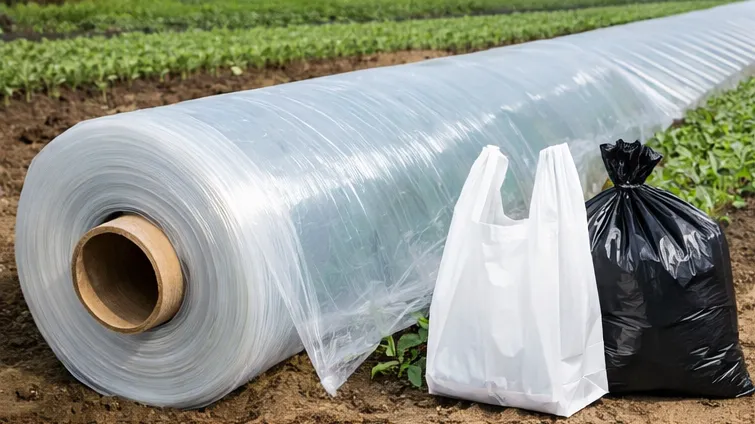
6.1 Packaging Films
In products such as shopping bags, food packaging films, courier bags, composite films, and labels, TiO2 masterbatch enhances whiteness, opacity, and the quality of the printing background. White film materials are frequently used to elevate the visual appeal of packaging and improve the clarity of printed graphics.
6.2 Sheets and Thermoforming
Products such as disposable food containers, trays, cup lids, and food packaging sheets demand high levels of opacity and whiteness. TiO2 masterbatch improves the whiteness and opacity of these sheets, resulting in thermoformed products that appear neater and more aesthetically pleasing.
6.3 Injection-Molded Products
Injection-molded parts—such as appliance housings, daily necessities, bottle caps, cosmetic packaging, and electronic device casings—frequently utilize TiO2 masterbatch to achieve a consistent white appearance. High-quality masterbatch helps minimize white spots, color variations, and surface defects, thereby enhancing the overall texture and quality of the product.
6.4 Blow-Molded Containers
Blow-molded products—including detergent bottles, chemical drums, personal care packaging, and food containers—often require superior opacity and a clean white finish. TiO2 masterbatch helps these containers achieve a uniform white color and improves the visual impact of the brand packaging.
6.5 Pipes and Profiles
In certain white or light-colored pipes and profiles, TiO2 masterbatch enhances whiteness and outdoor stability. For products such as architectural profiles and decorative materials, color stability and weather resistance are of paramount importance.
6.6 Fibers and Non-woven Fabrics
In applications involving chemical fibers, non-woven fabrics, and yarn spinning, TiO2 masterbatch is used to provide a matte finish, enhance whiteness, and improve overall aesthetics, resulting in fiber products with softer, more stable colors.
7. How to Select the Right TiO2 Masterbatch?
When selecting a TiO2 masterbatch, one should not base the decision solely on price or titanium dioxide content; instead, the choice should be made by carefully considering the specific plastic material, the processing method, and the requirements of the final application.
7.1 Consider the TiO2 Type
If the product is intended for general indoor applications, you may select a suitable product based on whiteness and cost considerations. However, if the product is to be used outdoors or in environments subject to prolonged light exposure, priority should be given to Rutile-type TiO2 masterbatches, which offer superior weather resistance.
7.2 Assess Carrier Resin Compatibility
For materials such as PE, PP, ABS, and PET, it is essential to select a carrier system that is either identical to the base resin or demonstrates excellent compatibility with it. An incompatible carrier can lead to poor dispersion, compromised mechanical properties, surface defects, or processing instability.
7.3 Evaluate Dispersion Performance
High-quality TiO2 masterbatches should result in finished products free from visible white spots, specks, streaks, or color patches. This requirement for superior dispersion is particularly critical for applications involving films, fibers, and thin-walled injection-molded parts.
7.4 Consider Opacity Requirements
Different products vary in thickness, and consequently, their requirements for opacity differ. Films, sheets, and light-colored packaging typically demand high-opacity TiO2 masterbatches, whereas thick-walled products allow for the adjustment of the addition ratio based on the specific whiteness levels required.
7.5 Check Processing Temperature
Processing temperatures vary significantly across different types of plastics. For materials processed at high temperatures—such as PET and PA—it is necessary to select TiO2 masterbatches with superior thermal stability to prevent yellowing, decomposition, or degradation of performance during processing.
Summary
TiO2 masterbatches are essential materials in plastic manufacturing, serving to enhance whiteness, opacity, and UV stability. With titanium dioxide as their core component, these masterbatches undergo a pre-dispersion process utilizing carrier resins, dispersants, and processing aids. This process enables plastic manufacturers to produce high-whiteness, high-opacity, and high-quality plastic products with greater ease and consistency.
For plastic manufacturing enterprises, the selection of a TiO2 masterbatch should focus primarily on the TiO2 type, whiteness, opacity, dispersion performance, carrier compatibility, thermal stability, and UV resistance. If you have any related requirements, please feel free to contact us.