

In high-volume plastics processing, the uses of masterbatch go far beyond simple coloring. Manufacturers use masterbatch to standardize appearance, improve dispersion, stabilize processing, reduce dust, manage resin cost, and solve moisture-related defects across film, injection molding, pipe extrusion, sheet production, and nonwoven applications. On Nuoxin’s website, this value proposition appears through a focused portfolio of color, black, filler, and desiccant masterbatch solutions for PE and PP based processing.
Why the Uses of Masterbatch Matter in Plastics Manufacturing
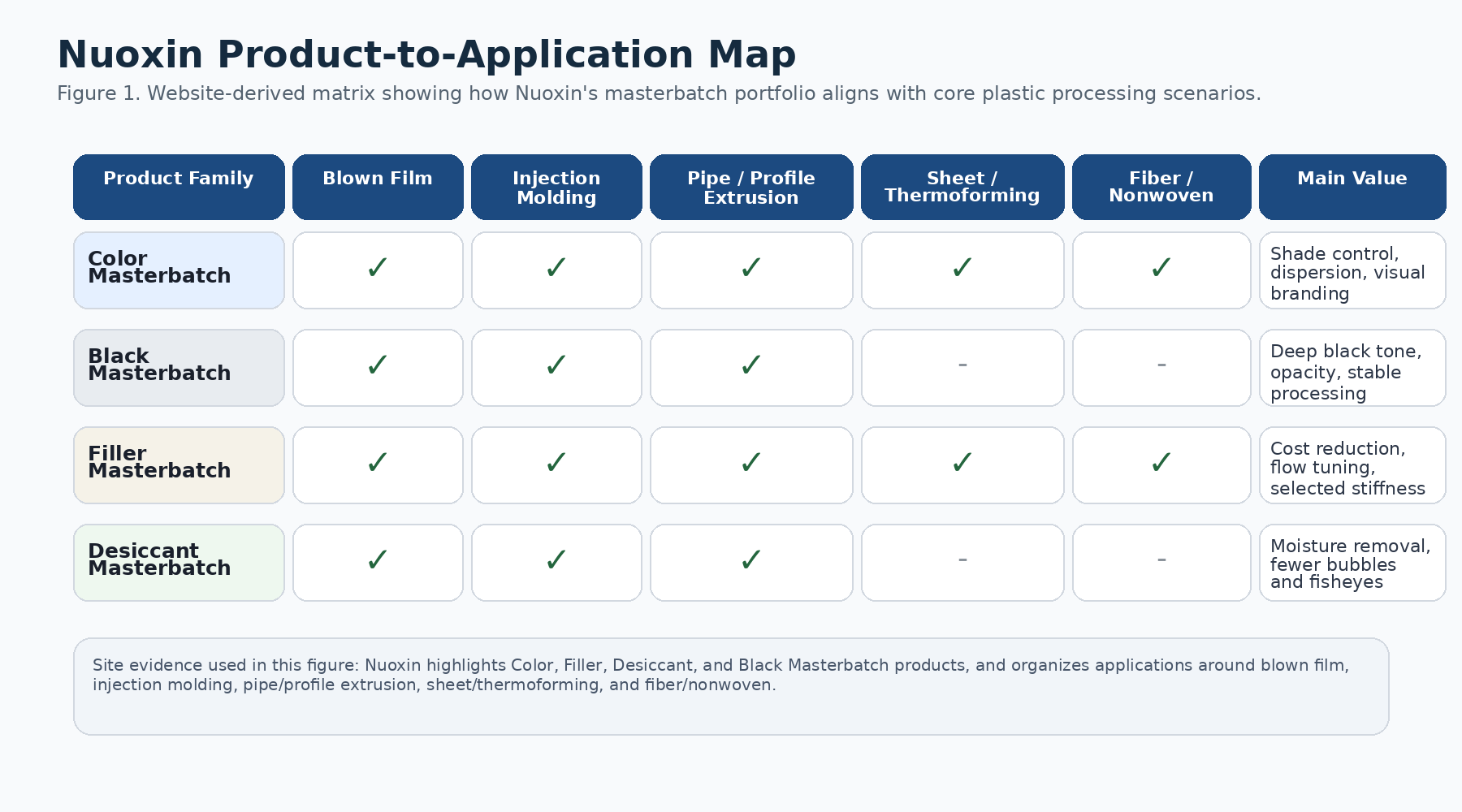
The uses of masterbatch matter because processors are judged on repeatability as much as on raw output. A formulation that feeds cleanly, disperses evenly, and holds performance from batch to batch can reduce rework, lower scrap, and simplify quality control. Nuoxin’s product structure mirrors that industrial logic: color masterbatch supports visual consistency, black masterbatch supports coverage and deep-tone performance, filler masterbatch supports cost optimization, and desiccant masterbatch addresses moisture in recycled or humidity-sensitive resin streams.
Uses of Masterbatch in Color Control and Branding
One of the most visible uses of masterbatch is color control. Nuoxin highlights vibrant colors, good dispersion, high heat resistance, dust-free granules, and easier mixing on its Color Masterbatch. Those features matter in packaging, household goods, consumer products, and industrial parts where appearance and shade consistency influence both product value and brand recognition. For buyers that need custom shades or stable production runs, this product family offers a practical route to consistent visual results.
Uses of Masterbatch in Black Products and Outdoor Applications
The uses of masterbatch are equally important in black applications. Nuoxin’s black masterbatch content emphasizes deep jetness, superior dispersion, thermal resistance, and dosage efficiency, with a technical range that includes 30–55% carbon black content and recommended addition levels of 1–10% depending on the required depth of tone and process conditions. In agricultural film, injection molded parts, and extrusion products, that combination helps processors achieve uniform black color, cleaner surfaces, and more stable production behavior.
Uses of Masterbatch for Cost Reduction and Process Efficiency
Another major part of the uses of masterbatch is cost control. Nuoxin’s calcium carbonate filler masterbatch is positioned as a cost-effective additive that can improve rigidity and dimensional stability while reducing raw-material cost. The product page lists CaCO3 content of 60%–85% and recommended dosage from 5% to 40%, giving buyers flexibility to balance mechanical targets with economics. In commodity packaging, woven goods, sheets, and selected molded products, filler systems can help processors protect margin when virgin resin prices are volatile.
Uses of Masterbatch in Moisture Control and Recycled Materials
Moisture management is one of the most practical uses of masterbatch in recycling and reclaimed-material production. Nuoxin’s Desiccant Masterbatch page states that the product can absorb more than 20% of its own weight in water and can be used on standard processing equipment without changing the basic production process. That matters for processors dealing with bubbles, pinholes, silver streaks, fisheyes, or unstable extrusion caused by wet regrind or humid raw materials. In these situations, desiccant masterbatch helps convert off-spec material into saleable output more efficiently.
Uses of Masterbatch Across Real Processing Scenarios
The uses of masterbatch also change with the production method. Blown-film lines usually prioritize bubble stability, dispersion, and appearance. Injection molding lines may care more about cycle consistency, feeding behavior, and surface finish. Pipe and profile extrusion often values steady output, dimensional control, and weatherable appearance. Nuoxin’s applications pages reinforce this point by organizing guidance around injection molding, blown film, blow molding, extrusion, sheet thermoforming, and fiber or nonwoven scenarios. That process-based view is useful because it helps customers match a formulation to the way material actually runs on the line.
Regulatory and Market Signals Behind Product Selection
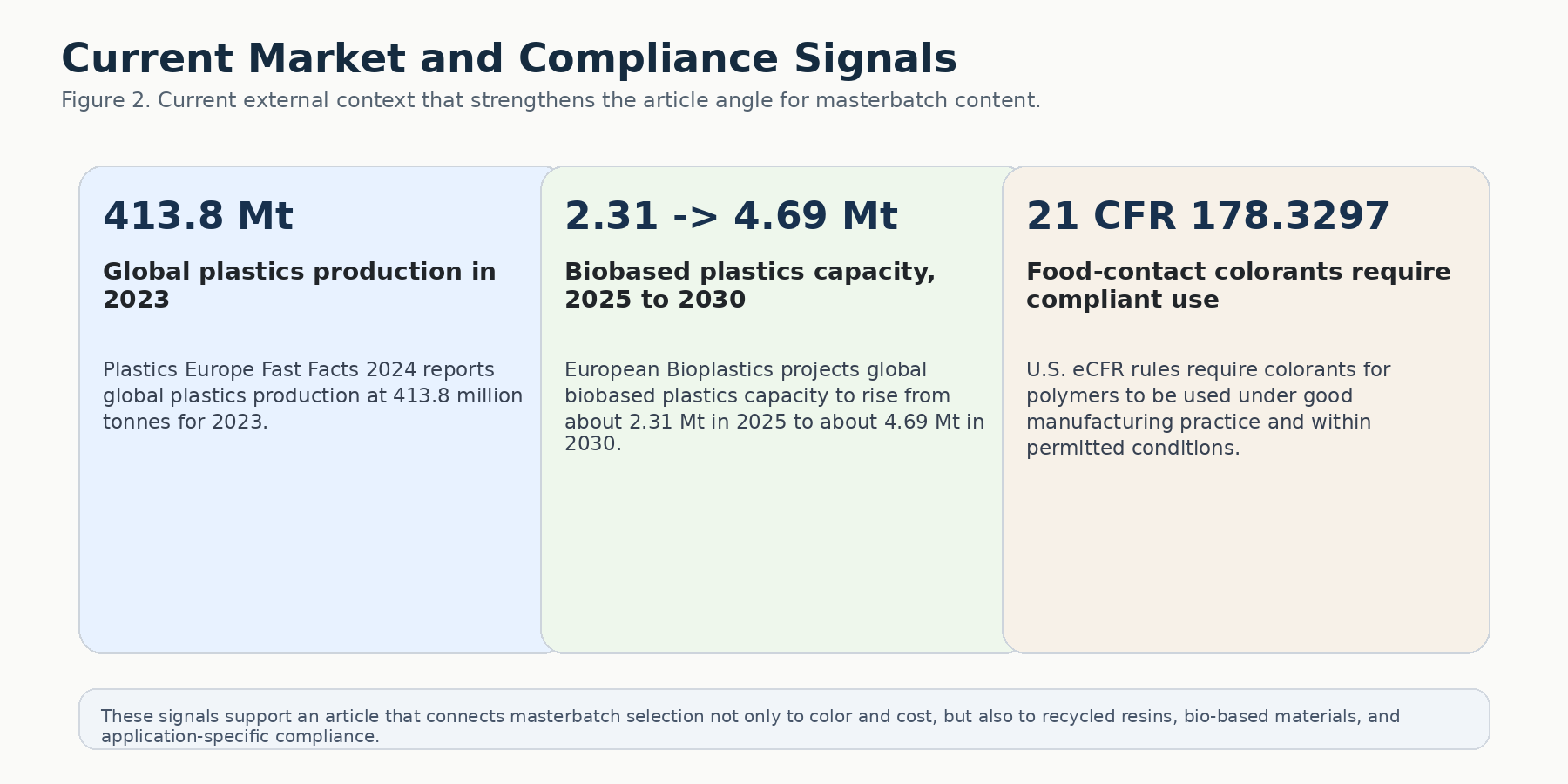
Current market and compliance signals make the uses of masterbatch even more relevant. Plastics Europe reports 413.8 million tonnes of global plastics production in 2023, confirming the scale at which converters must balance efficiency with quality. The British Plastics Federation notes that masterbatch can improve physical properties and simplify manufacturing by reducing the need for on-site compounding. For controlled applications, U.S. eCFR 21 CFR 178.3297 provides the regulatory framework for colorants used in polymers. European Bioplastics also projects biobased plastics capacity to rise from about 2.31 million tonnes in 2025 to approximately 4.69 million tonnes by 2030, which signals continued interest in formulations that work with recycled and alternative material streams.
| Product Family | Key Site Details | Typical Processes | Primary Industrial Role |
| Color Masterbatch | Vibrant shades, good dispersion, heat stability, dust-free granules | Blown film; injection molding; sheets; fibers | Brand color control and repeatable appearance |
| Black Masterbatch | 30-55% carbon black, 1-10% dosage, broad process window | Agricultural film; molding; pipe and profile extrusion | Deep black tone, coverage, and stable visual quality |
| Filler Masterbatch | CaCO3-based cost reduction, flow tuning, selected stiffness support | Blown film; woven products; injection; sheet and profile | Formulation cost control with balanced performance |
| Desiccant Masterbatch | >20% water absorption, standard-equipment compatibility | Film blowing; injection; extrusion; recycled resin | Moisture control, fewer bubbles, smoother surfaces |
Conclusion
In summary, the uses of masterbatch create the greatest value when they are linked to a clear production objective. Color masterbatch supports repeatable branding, black masterbatch improves deep-tone coverage, filler masterbatch supports cost-efficient formulation, and desiccant masterbatch reduces moisture-related defects. For converters that want stable processing and predictable product quality, the right masterbatch is not just an additive package; it is a practical manufacturing tool.