
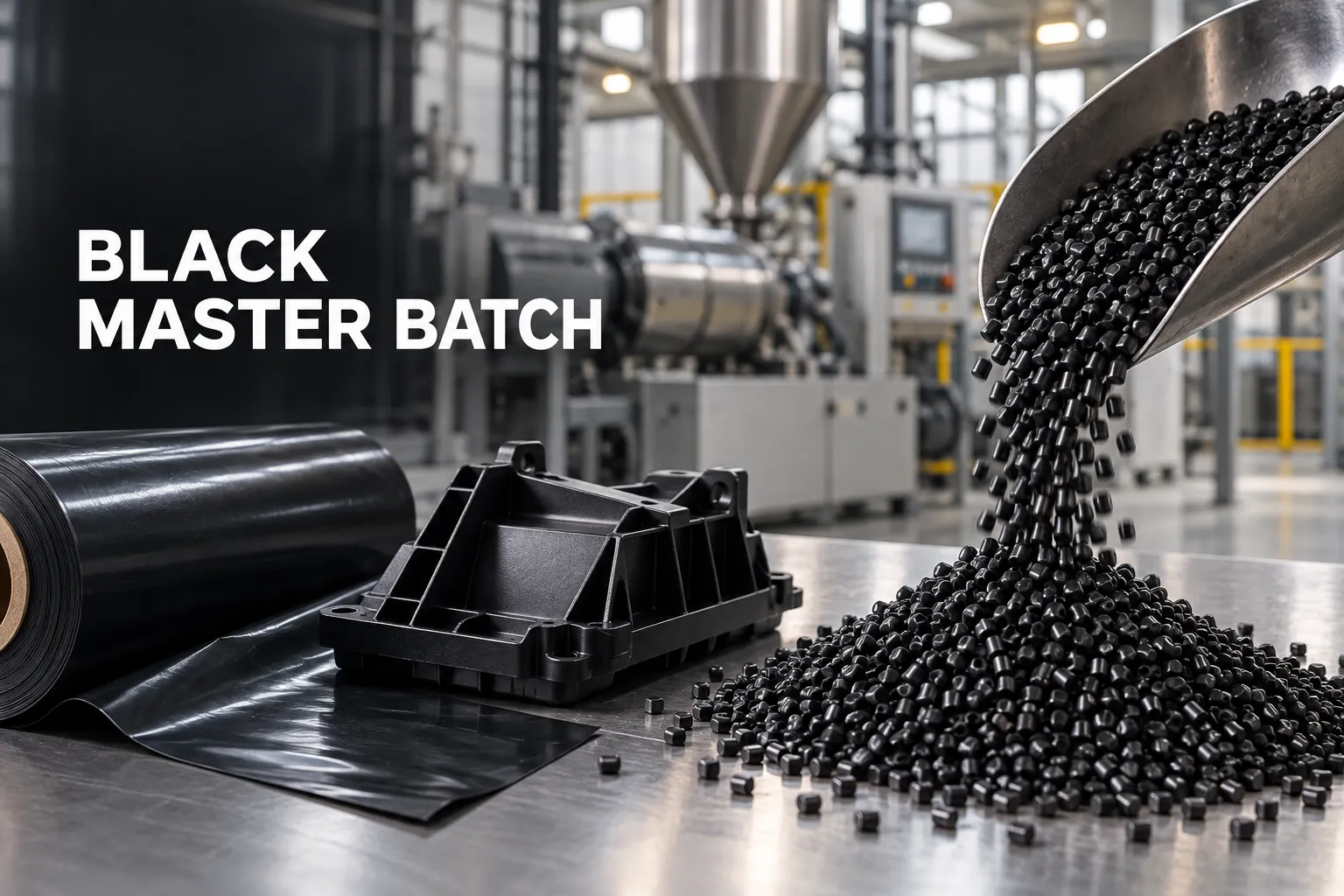
Black master batch is one of the most widely used coloring materials in plastic manufacturing. It gives plastic products a consistent black color while improving opacity, UV resistance, weatherability, and processing performance. From packaging films and irrigation pipes to automotive parts and electrical cables, manufacturers use different black masterbatch formulations according to the resin, production process, and performance requirements of the finished product.
This guide explains what black master batch is, how it is produced, where it is used, and how to select the right grade for plastic manufacturing.
What Is Black Master Batch?
Black master batch, more commonly written as black masterbatch, is a concentrated mixture of carbon black, carrier resin, and processing additives. Manufacturers melt, mix, disperse, and pelletize these materials to produce uniform black granules.
During plastic production, processors mix a controlled amount of black masterbatch with natural or recycled resin. The mixture is then processed through injection molding, film blowing, extrusion, blow molding, or another plastic manufacturing method.
A typical formulation contains three main components:
- Carbon black: Provides black color, opacity, and UV protection.
- Carrier resin: Helps distribute the carbon black evenly throughout the base polymer.
- Processing additives: Improve dispersion, flow, compatibility, and production stability.
Compared with adding carbon black powder directly, masterbatch is cleaner, easier to handle, and more accurate to dose. It also reduces dust and helps manufacturers achieve more consistent color across different production batches.
Benefits of Using Black Masterbatch
Black masterbatch does more than change the color of a plastic product. A suitable formulation can improve appearance, processing efficiency, and long-term product performance.
Consistent Black Color
Well-dispersed carbon black produces a uniform color without visible streaks, spots, or uneven areas. This is especially important for films, molded parts, pipes, and products with large visible surfaces.
Strong Covering Power
Black masterbatch can cover the natural color of virgin resin and help reduce color variation in recycled plastic materials. Strong covering power may allow manufacturers to achieve the required blackness at a lower addition rate.
UV and Weather Resistance
Carbon black absorbs ultraviolet radiation and can help protect plastic products from sunlight-related degradation. This makes UV-resistant black masterbatch suitable for outdoor pipes, agricultural films, geomembranes, containers, and construction products.
However, not every black masterbatch provides the same level of UV protection. Outdoor products should use a grade specifically designed and tested for long-term weather exposure.
Cleaner Production
Using loose carbon black powder may create dust and contaminate the production environment. Pelletized masterbatch is easier to transport, store, measure, and feed into processing equipment.
Improved Processing Efficiency
A compatible masterbatch melts and disperses efficiently in the base resin. It helps stabilize production, simplifies material preparation, and reduces the time required for color adjustment.
Better Use of Recycled Materials
Recycled resin can vary in color from batch to batch. Black masterbatch helps cover this variation and gives the final product a more consistent appearance. The formulation must still be compatible with the recycled material to avoid reducing mechanical performance.
Common Types and Applications
There is no single black masterbatch suitable for every plastic product. Manufacturers usually classify black masterbatch by carrier resin, carbon black concentration, processing method, and final application.
PE Black Masterbatch
PE-based black masterbatch is widely used with LDPE, LLDPE, and HDPE. Typical applications include:
- Shopping and garbage bags;
- Mulch and agricultural films;
- Blow-molded containers;
- HDPE pipes;
- Geomembranes;
- Plastic sheets;
- Cable jackets.

Film-grade products require particularly good dispersion because poorly dispersed particles can cause black spots, surface defects, or film breakage.
PP Black Masterbatch
PP black masterbatch uses polypropylene or a compatible carrier. It is commonly used in:
- Injection-molded household products;
- Automotive components;
- PP sheets;
- Woven bags;
- Nonwoven materials;
- Storage containers;
- Furniture components.
The formulation should provide suitable flow performance without significantly affecting the stiffness, impact strength, or surface quality of the product.
Engineering Plastic Black Masterbatch
Products made from ABS, PS, PC, PA, PET, PBT, and other engineering plastics generally require specialized masterbatch.
These resins may be processed at higher temperatures or require specific mechanical and appearance properties. Using an unsuitable carrier can lead to poor compatibility, surface defects, unstable flow, or reduced material strength.
Pipe-Grade Black Masterbatch
Black masterbatch for pipes should provide excellent carbon black dispersion, UV resistance, and long-term stability. It is commonly used in water pipes, irrigation pipes, drainage systems, cable protection pipes, and industrial piping.
For demanding or regulated pipe applications, buyers should confirm the relevant testing standards instead of selecting a general-purpose black masterbatch based only on price.
Film-Grade Black Masterbatch
Film-grade products require fine carbon black dispersion and stable filtration performance. A poor-quality product may increase filter pressure or cause visible particles and weak points in thin films.
Applications include packaging films, agricultural films, protective films, garbage bags, and courier bags.
Injection-Molding Black Masterbatch
Injection-molding grades typically focus on blackness, surface gloss, flowability, and dimensional stability. They are used in appliance housings, automotive parts, tools, furniture accessories, and general consumer products.
Conductive Black Masterbatch
Conductive or antistatic black masterbatch is designed for applications that need controlled electrical properties. It may be used in electronic packaging, industrial containers, conductive pipes, cable materials, and components that require electrostatic discharge protection.
This type of masterbatch must be selected according to a defined surface or volume resistivity requirement.
How to Choose the Right Black Masterbatch
Selecting black masterbatch only by carbon black content or price can create quality and production problems. Buyers should evaluate the complete formulation and its performance in the intended application.
Match the Carrier to the Base Resin
Carrier compatibility is one of the most important selection factors. PE and PP can sometimes tolerate compatible carrier systems, but engineering plastics usually require more specialized formulations.
Before requesting a quotation, provide the supplier with:
- Base polymer;
- Virgin or recycled material ratio;
- Processing method;
- Processing temperature;
- Final product;
- Required blackness;
- Outdoor or indoor use;
- Regulatory requirements.
Evaluate Dispersion
Good dispersion allows carbon black to spread evenly throughout the polymer. Poor dispersion may cause:
- Black spots;
- Surface roughness;
- Uneven color;
- Film breakage;
- Blocked filter screens;
- Reduced mechanical performance.
For thin films, fibers, pressure pipes, and smooth visible parts, dispersion is often more important than carbon black concentration alone.
Check Tinting Strength and Blackness
Two masterbatches with the same carbon black content may produce different results because carbon black particle size, structure, dispersion, and formulation all affect coloring performance.
A product with stronger tinting strength may achieve the target color at a lower dosage. Manufacturers should compare the finished-product result and total usage cost rather than the masterbatch price per kilogram alone.
Consider Melt Flow Performance
The melt flow of the masterbatch should suit the base polymer and production method. A major mismatch can cause unstable mixing, uneven color, processing difficulties, or changes in the final product’s properties.
Confirm UV Requirements
If the product will be used outdoors, inform the supplier about the expected service environment and product lifetime. Pipes, agricultural films, geomembranes, and outdoor containers may require a specialized UV-resistant formulation.
Review Compliance Documents
Depending on the application and target market, buyers may need:
- Technical Data Sheet;
- Safety Data Sheet;
- Certificate of Analysis;
- RoHS or REACH-related documentation;
- Food-contact test reports;
- Heavy-metal test reports;
- UV or weathering test results;
- Application-specific certifications.
The required documents should be confirmed before sample approval and mass production.
Recommended Addition Rate and Production Testing
The correct addition rate depends on carbon black concentration, covering power, base resin color, product thickness, and performance requirements.
General coloring applications may use a relatively low percentage, while products made with recycled resin or requiring strong opacity and UV resistance may need a higher dosage. There is no universal addition rate suitable for every product.
Manufacturers should begin with the supplier’s recommended dosage and then conduct production tests under actual operating conditions.
During the trial, evaluate:
- Color depth and consistency;
- Carbon black dispersion;
- Surface finish;
- Filter pressure;
- Melt flow;
- Mechanical properties;
- Product odor;
- Weather resistance;
- Production stability.
Testing should use the same resin, equipment, temperature, and processing conditions planned for mass production. A successful laboratory color sample does not always guarantee the same result on a full-scale production line.
Common Black Masterbatch Problems
Uneven Color
Uneven color can result from poor dispersion, insufficient mixing, unstable feeding, an unsuitable carrier, or an incorrect addition rate.
Black Spots or Surface Particles
Possible causes include carbon black agglomeration, contamination, incomplete melting, degraded material, or poor filtration during masterbatch production.
Excessive Filter Pressure
In film and extrusion production, rapidly increasing filter pressure may indicate poor dispersion, contamination, oversized particles, or incompatibility with the base resin.
Weak Mechanical Properties
Adding too much masterbatch or using an incompatible carrier can affect impact strength, elongation, tensile strength, or flexibility. Buyers should evaluate mechanical performance after determining the final dosage.
Insufficient Blackness
Low blackness may result from an insufficient dosage, weak tinting strength, poor dispersion, or strong color variation in recycled resin. Increasing the dosage is not always the best solution; a better-dispersed or stronger-tinting grade may be more economical.
Poor Outdoor Durability
A general coloring-grade black masterbatch may create a black appearance without providing sufficient long-term UV protection. Outdoor products require a formulation designed for their service conditions.
How to Evaluate a Black Masterbatch Supplier
A reliable supplier should understand both masterbatch production and the customer’s plastic processing requirements.
Before placing a large order, consider the following:
- Can the supplier recommend products according to resin and application?
- Does the manufacturer control carbon black dispersion and batch consistency?
- Are samples and technical documents available?
- Are production capacity and delivery times stable?
- Does the supplier investigate processing problems after delivery?
- Can packaging and labeling be adjusted for export markets?
Always test samples before bulk purchasing. If possible, conduct a small production run and compare color, dosage, processing stability, scrap rate, and finished-product performance.
The lowest-priced masterbatch may create higher total costs if it requires a larger dosage, causes frequent filter changes, increases defective products, or reduces production efficiency.
Frequently Asked Questions
Is “black master batch” the same as “black masterbatch”?
Yes. Both terms refer to the same material. However, black masterbatch is the more common spelling used in the plastics industry.
What is black masterbatch made from?
It is mainly made from carbon black, carrier resin, and processing additives. The exact formulation depends on the base polymer and final application.
Can one black masterbatch be used with every plastic?
No. The carrier resin and formulation must be compatible with the base plastic. Engineering plastics and high-temperature materials usually require specialized grades.
Does a higher carbon black content always mean better quality?
No. Dispersion, carbon black type, carrier compatibility, tinting strength, and processing stability are equally important.
Can black masterbatch be used with recycled plastic?
Yes. It is often used to cover color variation in recycled materials. Sample testing is necessary because recycled resin composition and quality can vary.
Conclusion
Black master batch provides an efficient and reliable way to color plastic products while supporting opacity, UV resistance, weatherability, and processing consistency.
The right product depends on the base resin, manufacturing process, final application, performance requirements, and regulatory standards. Instead of choosing solely by carbon black percentage or price, manufacturers should evaluate dispersion, compatibility, tinting strength, processing behavior, documentation, and total usage cost.
Working with an experienced black masterbatch manufacturer and completing a production trial before bulk purchasing can help reduce defects, improve product consistency, and achieve better long-term manufacturing results.