
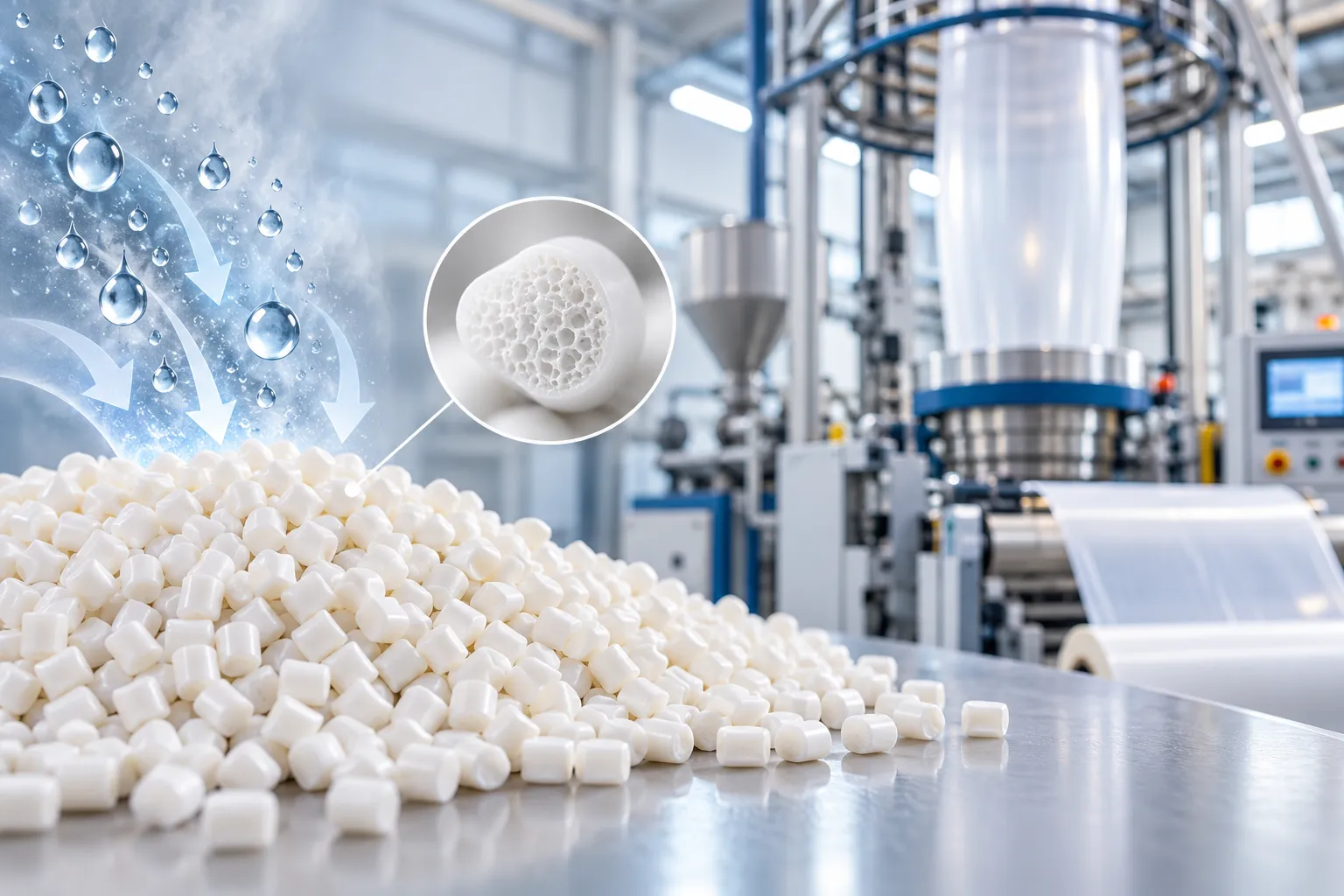
Moisture is a common challenge in plastic manufacturing, especially when processing recycled resins or damp raw materials. Excess moisture can cause bubbles, pinholes, fisheyes, and uneven surface finishes, increasing scrap rates and production costs.
Calcium oxide desiccant masterbatch is a functional plastic additive designed to absorb residual moisture during processing. By incorporating calcium oxide (CaO) into a compatible carrier resin, manufacturers can improve moisture control, reduce visible defects, and achieve more consistent results in suitable PE and PP applications.
This guide explains how calcium oxide desiccant works, its key benefits, recommended applications, and how to select the right grade for your production line.
What Is Calcium Oxide Desiccant Masterbatch?
Calcium oxide desiccant masterbatch, also known as CaO desiccant masterbatch or moisture absorber masterbatch, is a functional additive that uses calcium oxide as its primary moisture-absorbing component.
The active ingredient is dispersed in a compatible carrier resin, typically polyethylene (PE) or polypropylene (PP). This masterbatch format makes the additive easier to dose and incorporate into plastic raw materials during manufacturing.
Unlike conventional color masterbatch, which primarily provides color, calcium oxide desiccant masterbatch focuses on moisture control and reducing moisture-related processing defects.
It is particularly useful for plastic manufacturers working with recycled materials, humid feedstock, and production processes where residual moisture affects product appearance and consistency.
How Does Calcium Oxide Desiccant Work?
Calcium oxide reacts chemically with water to form calcium hydroxide:
CaO + H₂O → Ca(OH)₂
In a properly formulated desiccant masterbatch, the active component helps bind residual moisture that could otherwise vaporize during plastic processing. This helps reduce the formation of bubbles, pinholes, and other moisture-related surface defects.
The effectiveness of a calcium oxide desiccant depends on several factors:
- Moisture content: The amount of residual moisture present in the raw materials.
- Active content: The concentration of calcium oxide in the masterbatch.
- Dispersion: How evenly the additive distributes throughout the polymer.
- Processing conditions: Temperature, residence time, mixing efficiency, and the production method.
A suitable formulation helps manufacturers manage moisture-related defects without unnecessarily changing their established production process.
Key Benefits and Applications of Calcium Oxide Desiccant
1. Reduce Bubbles and Surface Defects
Residual moisture can create bubbles, pinholes, and fisheyes in plastic products. Calcium oxide desiccant masterbatch helps reduce these defects, improving the appearance and consistency of finished products.
2. Improve Production Efficiency
For suitable PE and PP applications, the masterbatch can be mixed directly with raw materials. It may reduce the need for separate pre-drying operations, helping manufacturers simplify material handling and manage energy and labor costs.
Actual savings depend on the material, moisture level, equipment, and production conditions.
3. Support Recycled Plastic Processing
Recycled plastic materials can carry residual moisture from collection, washing, storage, or handling. A CaO-based moisture control masterbatch provides an additional method of managing moisture-related problems in recycled PE and PP production.
4. Wide Application Compatibility
Calcium oxide desiccant masterbatch is commonly used in the following applications:
- Blown film production: Helps reduce bubbles and pinholes in plastic films and bags.
- Packaging and garbage bags: Supports a more consistent surface finish during film production.
- Injection molding: Helps minimize moisture-related surface defects in molded components.
- Plastic extrusion: Supports improved surface quality in sheets, pipes, profiles, and other extruded products.
The appropriate grade should be selected according to the base resin, processing method, and final product requirements.
Calcium Oxide Desiccant Masterbatch Specifications
Nuoxin offers desiccant masterbatch formulations designed for PE and PP processing. The following specifications provide a starting point for evaluating a suitable grade.
| Parameter | Specification |
|---|---|
| Active ingredient | Calcium Oxide (CaO) |
| Active content | 50%–80%, customizable |
| Carrier resin | PE / PP |
| Recommended dosage | 1%–5% |
| Processing temperature | 160°C–280°C |
| Main processes | Blown film, injection molding, extrusion |
| Moisture absorption | Grade-dependent; confirm test data with the supplier |
The recommended dosage is a starting range rather than a universal setting. Actual performance depends on the formulation, raw material condition, and processing environment.
Before bulk production, manufacturers should conduct trials to determine the most effective addition ratio while checking dispersion, surface appearance, and final product properties.
How to Choose the Right Calcium Oxide Desiccant
Choosing a suitable calcium oxide desiccant masterbatch requires more than comparing the active content or purchase price. Consider the following factors before selecting a supplier.
- Confirm resin compatibility
Identify whether your production line uses PE, PP, or another polymer. Do not assume that a grade developed for PE or PP will perform equally well with other resins.
- Evaluate the moisture problem
Describe the raw material condition and the defects you are experiencing, such as bubbles, pinholes, or fisheyes. This helps the supplier recommend an appropriate formulation.
- Check the recommended dosage
Ask for grade-specific dosage guidance and confirm the results through production trials. Excessive or insufficient addition may affect processing performance or finished-product quality.
- Verify processing conditions
Share your processing temperature, equipment type, production speed, and recycled-material percentage. These details help establish whether the proposed grade is suitable for your line.
- Evaluate quality consistency
For repeat orders, check active content, dispersion, batch consistency, technical documentation, and the supplier’s capacity to maintain stable specifications.
A reliable supplier should be able to provide technical guidance and help you evaluate product suitability before large-scale purchasing.
Conclusion
Calcium oxide desiccant masterbatch is a practical moisture-control solution for suitable plastic processing applications. By helping reduce moisture-related defects, it supports more consistent product appearance and can help manufacturers manage scrap and production costs.
The key to achieving reliable results is selecting the right formulation, confirming the dosage, and validating performance on the production line.
Looking for a calcium oxide desiccant masterbatch for your PE or PP production? Visit Nuoxin Desiccant Masterbatch to explore product information and contact our team for application guidance and a customized quotation.
Frequently Asked Questions
1. What is calcium oxide desiccant used for in plastic manufacturing?
Calcium oxide desiccant is used to help control residual moisture during plastic processing. In suitable applications, it reduces moisture-related bubbles, pinholes, fisheyes, and surface defects, particularly when processing recycled or humid PE and PP materials.
2. What is the recommended dosage of calcium oxide desiccant masterbatch?
A common starting range is 1%–5%, depending on the grade, moisture level, polymer, and processing conditions. Manufacturers should verify the appropriate dosage through supplier guidance and production trials.
3. Can calcium oxide desiccant masterbatch replace a drying machine?
Not in every application. It may reduce the need for separate pre-drying in suitable PE and PP processes involving recycled or damp materials. However, it should not be treated as a universal replacement for drying equipment, especially for moisture-sensitive polymers such as PET and PA, which often require controlled pre-drying.
4. Which plastic processing methods can use CaO desiccant masterbatch?
Common applications include blown film production, injection molding, and extrusion. Compatibility depends on the carrier resin, formulation, processing conditions, and finished-product requirements.
5. How do I choose a reliable desiccant masterbatch supplier?
Evaluate resin compatibility, active content, moisture absorption performance, dispersion, batch consistency, and technical support. Request relevant specifications and, where possible, samples for testing under your actual production conditions.