
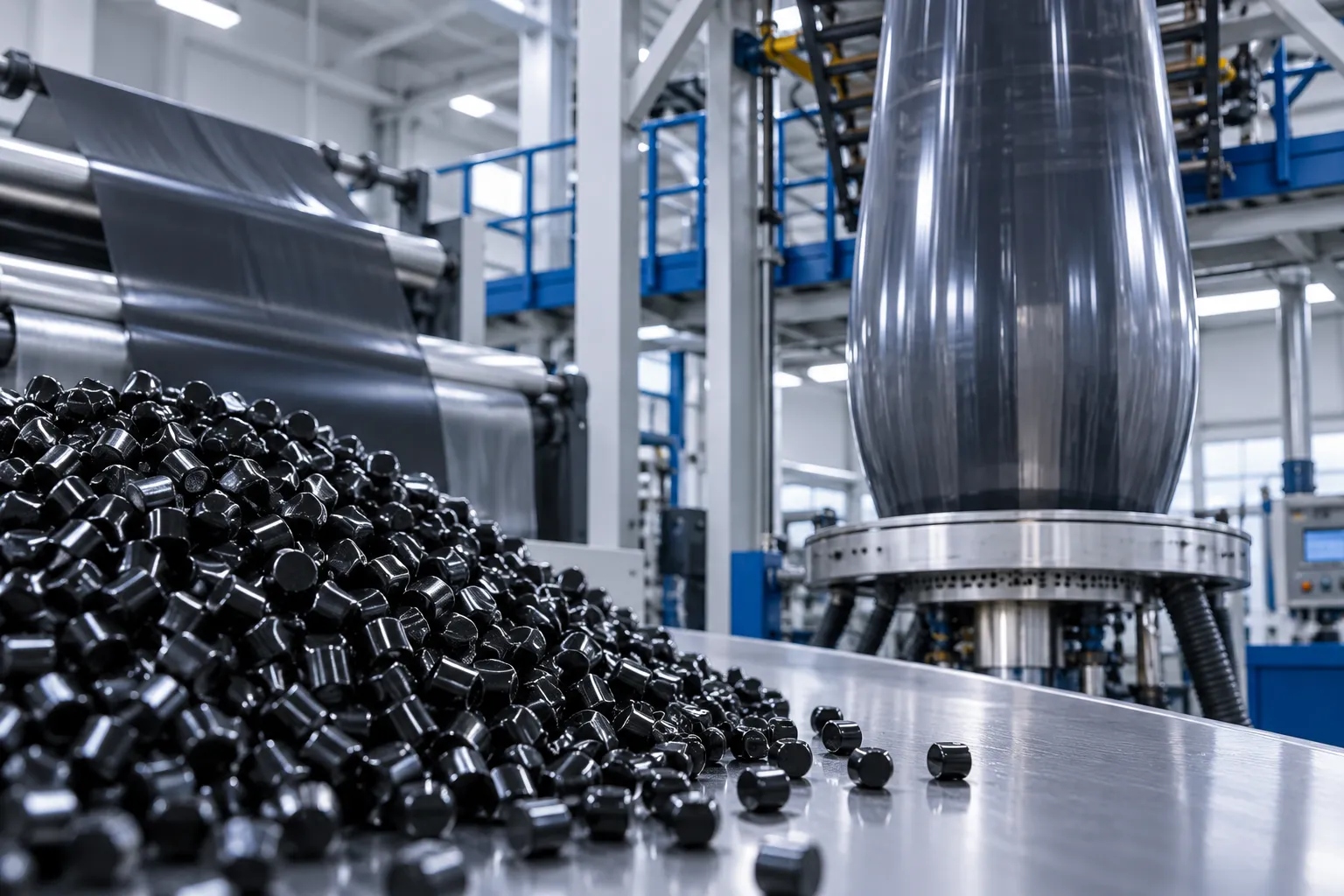
Producing high-quality thin plastic films requires more than achieving the right black color. Film manufacturers must also maintain uniform thickness, smooth surfaces, and stable extrusion performance while controlling material costs.
Plastic black masterbatch plays an important role in this process. It introduces concentrated carbon black into plastic resins, helping manufacturers achieve consistent coloration, reliable opacity, and efficient production.
However, thin films are particularly sensitive to poor pigment dispersion and material incompatibility. Even small carbon black agglomerates can create visible defects or weak points in the finished film.
This guide explains how to select plastic black masterbatch for thin film extrusion, optimize its dosage, and avoid common processing problems.
What Is Plastic Black Masterbatch for Thin Film Extrusion?
Plastic black masterbatch is a concentrated mixture of carbon black pigment, carrier resin, and processing additives. Manufacturers blend it with base polymers during extrusion to produce black plastic films with controlled color and opacity.
In thin film production, polyethylene-based formulations are widely used with LDPE, LLDPE, and HDPE resins.
Unlike thicker plastic products, thin films demand particularly fine pigment dispersion. Poorly dispersed particles can become visible defects as the molten polymer is stretched into a thin layer.
A suitable black masterbatch helps deliver three important results:
- Uniform Black Color: Consistent pigment distribution minimizes visible streaks and uneven shading.
- Smooth Film Surface: Well-dispersed carbon black helps reduce pigment-related specks and surface defects.
- Stable Processing: Compatible carrier resins support consistent melt behavior during extrusion.
For manufacturers producing garbage bags, shopping bags, agricultural films, and industrial packaging, selecting the correct masterbatch formulation is essential for repeatable quality.
Key Factors When Selecting Black Masterbatch for Thin Films
Not every plastic black masterbatch grade is suitable for thin film extrusion. Manufacturers should evaluate dispersion quality, carrier compatibility, carbon black concentration, and processing behavior before starting mass production.
1. Carbon Black Dispersion Quality
Carbon black dispersion is one of the most important factors affecting thin film appearance and performance.
When carbon black particles form agglomerates, they may create black specks, rough surfaces, or localized weak points. These problems become more noticeable as film thickness decreases.
High-quality dispersion helps manufacturers achieve a more uniform black appearance while minimizing pigment-related defects.
During material selection, film producers should examine finished-film samples under consistent processing conditions rather than judging quality from the appearance of the masterbatch pellets alone.
2. Carrier Resin Compatibility
The masterbatch carrier should be compatible with the polymer used in film production.
PE-based black masterbatch is commonly selected for polyethylene films made from LDPE, LLDPE, or HDPE.
A poorly matched carrier can affect melt mixing, film appearance, and processing stability. Melt flow characteristics must also suit the base resin and extrusion conditions.
Before choosing a grade, manufacturers should confirm the polymer type, film extrusion method, and target processing conditions with their masterbatch supplier.
3. Carbon Black Content and Opacity
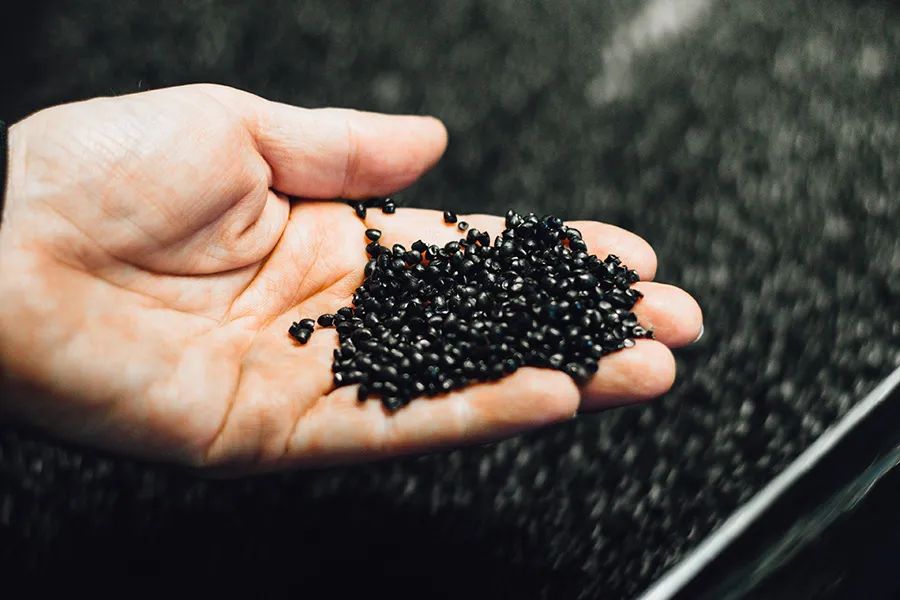
Carbon black concentration influences coloring strength, but a higher concentration does not automatically produce a better thin film.
According to Nuoxin’s published product specifications, its black masterbatch range includes carbon black concentrations of 30–55%, depending on formulation requirements.
However, pigment concentration alone cannot determine the optimal grade. Dispersion, carbon black characteristics, film thickness, and actual addition rate all affect the final result.
For thin film applications, manufacturers should prioritize achieving the required opacity with consistent dispersion and acceptable film properties rather than simply selecting the highest carbon black concentration.
How to Optimize Black Masterbatch Dosage in Film Extrusion
The correct dosage depends on film thickness, resin composition, carbon black concentration, and required opacity.
Nuoxin lists a general recommended addition range of 1–10% across its black masterbatch products. This is a broad product range, not a fixed recommendation for every thin film application.
Film manufacturers should determine the appropriate dosage through production trials using the intended resin and film thickness.
The relationship between masterbatch dosage and final carbon black content can be calculated as follows:
Final Carbon Black Content (%) = Masterbatch Dosage (%) × Carbon Black Concentration (%) ÷ 100
For example, a masterbatch containing 40% carbon black at a 2% addition rate contributes approximately 0.8% carbon black to the total formulation.
This calculation illustrates pigment loading; it does not establish the correct dosage for a particular film.
Excessive masterbatch addition may increase material costs or alter processing and film properties without delivering a proportional improvement in appearance.
The most economical dosage is the lowest validated addition rate that consistently meets the required color, opacity, processing, and finished-film specifications.
Common Thin Film Extrusion Problems and Solutions
Thin film extrusion defects can result from masterbatch quality, resin characteristics, equipment conditions, or processing settings.
Identifying the actual cause is important before changing the formulation.
| Common Problem | Possible Causes | Recommended Action |
|---|---|---|
| Uneven black color | Poor pigment dispersion or inconsistent dosing | Check mixing and dosing accuracy |
| Black specks or streaks | Carbon black agglomerates or contamination | Inspect dispersion and equipment cleanliness |
| Pinholes or film breakage | Contamination, agglomerates, or unstable processing | Inspect film defects, filtration, and extrusion conditions |
| Insufficient opacity | Unsuitable dosage or film thickness | Test opacity at the actual production thickness |
| Unstable film bubble | Incompatible formulation or unstable melt conditions | Check resin compatibility and extrusion settings |
Manufacturers should also monitor screen-pack pressure, film thickness variation, and defect frequency during material trials.
For very thin films, evaluating the finished product at its intended thickness is especially important. A masterbatch that performs well in a thicker film may not deliver the same results when the film is downgauged.
Consistent process conditions allow manufacturers to distinguish material-related problems from equipment or operating issues.
Why Choose Nuoxin Plastic Black Masterbatch?
Choosing a reliable black masterbatch manufacturer helps film producers maintain consistent product quality and a stable material supply.
Nuoxin is a China-based plastic masterbatch manufacturer with over 10 years of manufacturing experience. The company supplies black, color, filler, and desiccant masterbatch for PE and PP processing applications.
Nuoxin’s Black Masterbatch products are developed for uniform coloration, stable dispersion, and processing compatibility across film, molding, and extrusion applications.
For film manufacturers, key benefits include:
- Application-Oriented Formulations: Black masterbatch options for blown film packaging, agricultural films, and other plastic processing applications.
- Adjustable Carbon Black Content: Formulations available with different pigment concentrations to match specific production requirements.
- Consistent Quality Control: Production checks covering carbon black content and dispersion consistency.
- Reliable Factory Supply: Manufacturing capacity and direct technical communication to support ongoing orders.
When selecting a thin-film grade, buyers should share their base resin, target film thickness, required opacity, and processing conditions so the formulation can be evaluated for their specific application.
For more information about suitable solutions, visit Nuoxin’s Blown Film Applications page.
Frequently Asked Questions
What is the best black masterbatch for thin film extrusion?
The best plastic black masterbatch offers fine carbon black dispersion, compatible carrier resin, suitable melt flow characteristics, and adequate opacity at an economical dosage. Its suitability should be verified through trials using the intended production resin and film thickness.
Can PE black masterbatch be used for LLDPE and HDPE films?
Yes. A suitably formulated PE-based black masterbatch can be used in LDPE, LLDPE, and HDPE film applications. However, the carrier formulation and processing characteristics should be evaluated for the specific resin blend.
Does higher carbon black content improve film quality?
Not necessarily. Higher carbon black concentration may increase coloring potential, but film quality also depends on dispersion, resin compatibility, pigment characteristics, and processing conditions.
Can black masterbatch provide UV protection for agricultural films?
Carbon black can contribute to UV protection by absorbing ultraviolet radiation. However, outdoor durability depends on pigment dispersion, concentration, polymer formulation, and service conditions. Agricultural films should use an appropriately specified and tested UV-resistant grade.
How can manufacturers reduce black masterbatch costs?
Manufacturers can improve cost efficiency by selecting a formulation with sufficient coloring strength, optimizing the addition rate, and minimizing film defects and production waste. Total cost per acceptable finished product is more useful than masterbatch price per kilogram alone.
Conclusion
Selecting the right plastic black masterbatch for thin film extrusion requires balancing carbon black dispersion, carrier resin compatibility, opacity, and processing stability.
For thin film manufacturers, consistent dispersion and production performance are often more valuable than high pigment concentration alone.
By evaluating masterbatch performance under actual extrusion conditions, producers can reduce defects, improve film consistency, and control material costs.
Looking for reliable black masterbatch for your thin film production?
Contact Nuoxin New Materials to discuss your resin type, film thickness, and production requirements. Our team can help you identify suitable black masterbatch options for your application.