
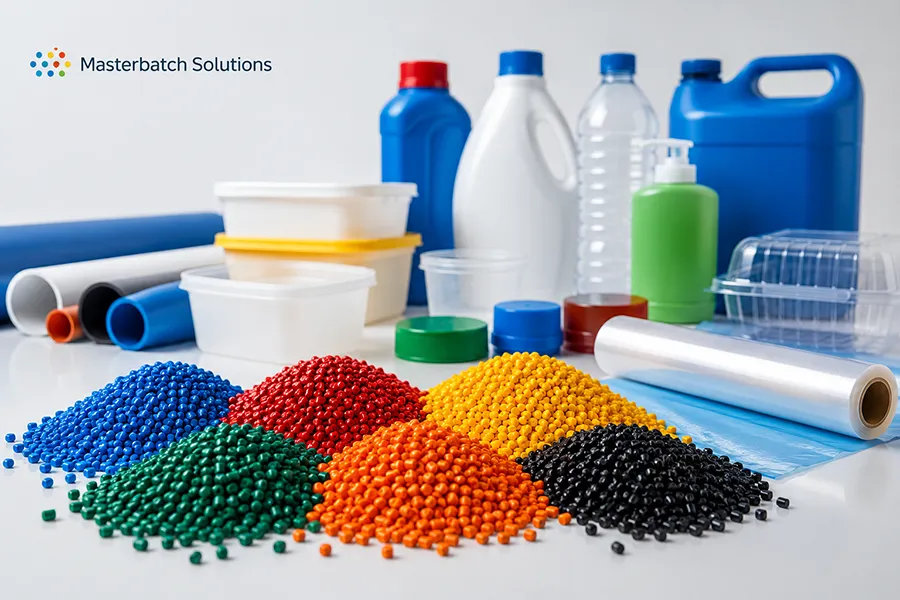
Modern plastic manufacturers need more than basic resin to meet requirements for color, appearance, processing efficiency, mechanical performance, weather resistance, conductivity, flame retardancy, and cost control.
This is where masterbatch solutions for plastic applications play an important role.
Understanding the different types of masterbatch and their applications can therefore help manufacturers select more suitable materials, improve production consistency, and control overall manufacturing costs.
What Are Masterbatch Solutions for Plastic Applications?
Masterbatch solutions for plastic applications are concentrated pigment, filler, or additive formulations designed to modify the color, processing characteristics, appearance, or functional performance of plastic products.
A typical masterbatch consists of three main components:
- Active ingredients – pigments, fillers, additives, or functional materials.
- Carrier resin – such as PE, PP, EVA, PS, PET, or another compatible polymer.
- Dispersing and processing additives – used to improve dispersion and processing stability.
During plastic production, masterbatch is mixed with the base polymer at a specified dosage.
Compared with adding raw pigments or additives directly, masterbatch can provide better dispersion, easier dosing, cleaner processing, and more consistent product quality.
Why Are Masterbatch Solutions Important in Plastic Manufacturing?
Plastic products are used in extremely different environments.
Packaging films must be flexible and visually consistent. Agricultural films require UV resistance. Automotive components may need heat resistance and dimensional stability. Pipes must provide long-term durability, while household products often require accurate color matching and good surface appearance.
A suitable masterbatch helps manufacturers achieve these requirements without significantly changing their existing production process.
The main advantages include:
- Consistent color and appearance
- Better pigment and additive dispersion
- Easier material handling
- Accurate dosing
- Improved production efficiency
- Reduced dust contamination
- Customized functional properties
- Potential reduction in raw material costs
- Better batch-to-batch consistency
For this reason, manufacturers usually choose masterbatch according to the polymer type, processing technology, end-use requirements, dosage, and required performance.
Main Types of Masterbatch Solutions
Different masterbatch categories solve different plastic manufacturing challenges.
1. Color Masterbatch
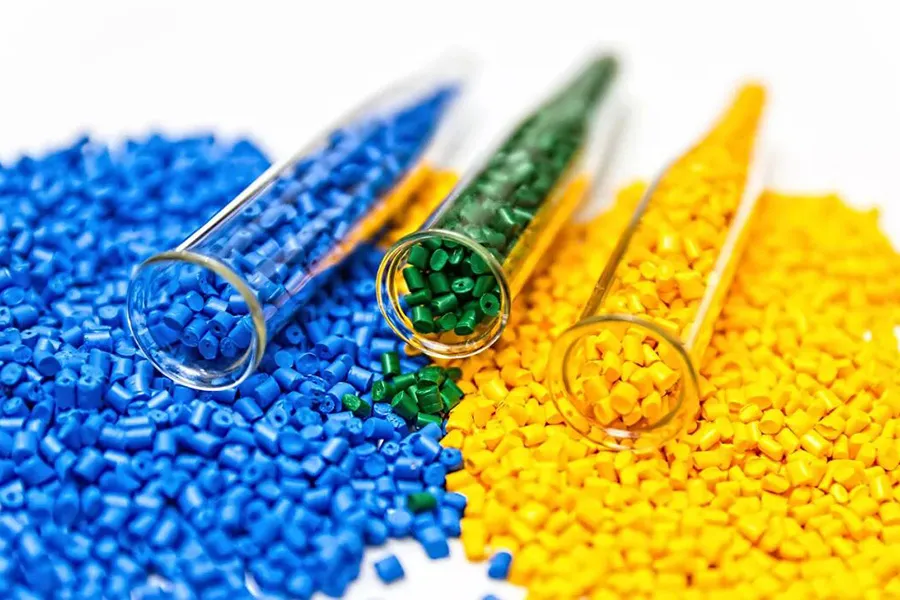
Color masterbatch is used to produce specific colors in plastic products.
It contains concentrated organic or inorganic pigments dispersed in a compatible carrier resin.
Manufacturers can choose standard colors or develop customized formulations based on Pantone, RAL, physical samples, or specific customer requirements.
Typical Applications
Color masterbatch is widely used in:
- Plastic packaging
- Household products
- Toys
- Containers
- Automotive components
- Electrical housings
- Pipes
- Plastic furniture
- Consumer products
Key Benefits
A well-formulated color masterbatch can provide:
- Accurate color reproduction
- Uniform dispersion
- Stable processing performance
- High tinting strength
- Consistent appearance between production batches
For products where visual appearance is particularly important, customized color matching is often preferred.
2. Black Masterbatch
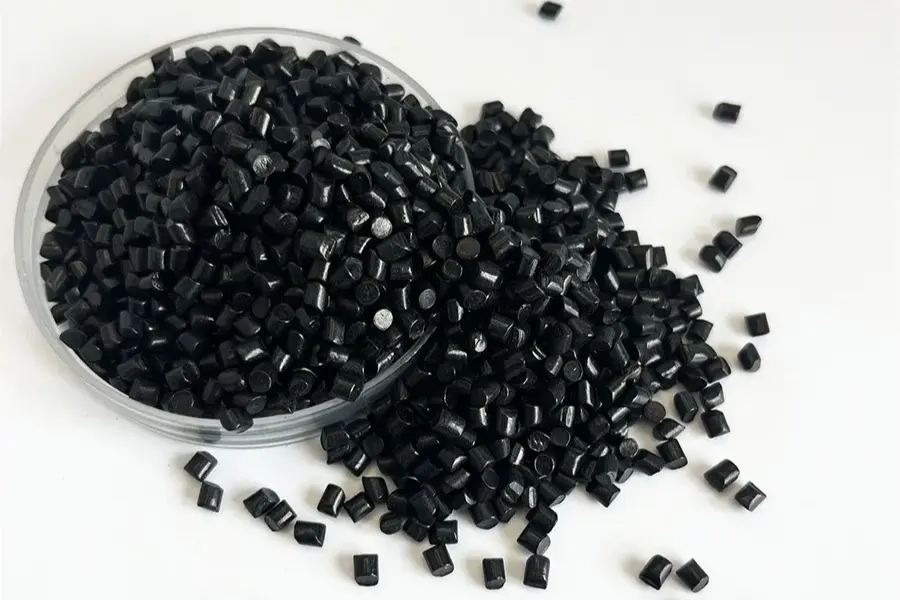
Black masterbatch typically uses carbon black as the primary pigment.
In addition to providing a deep black appearance, certain formulations can also improve UV resistance, opacity, conductivity, or weatherability.
Common Applications
Black masterbatch can be used in:
- PE pipes
- Agricultural films
- Garbage bags
- Automotive parts
- Geomembranes
- Cables
- Injection molded products
- Blow molded containers
- Construction plastics
Important Selection Factors
The performance of black masterbatch depends heavily on:
- Carbon black content
- Carbon black particle size
- Dispersion quality
- Carrier resin
- UV resistance
- Processing temperature
For demanding applications such as pressure pipes or outdoor plastic products, dispersion and carbon black quality are especially important.
3. White Masterbatch
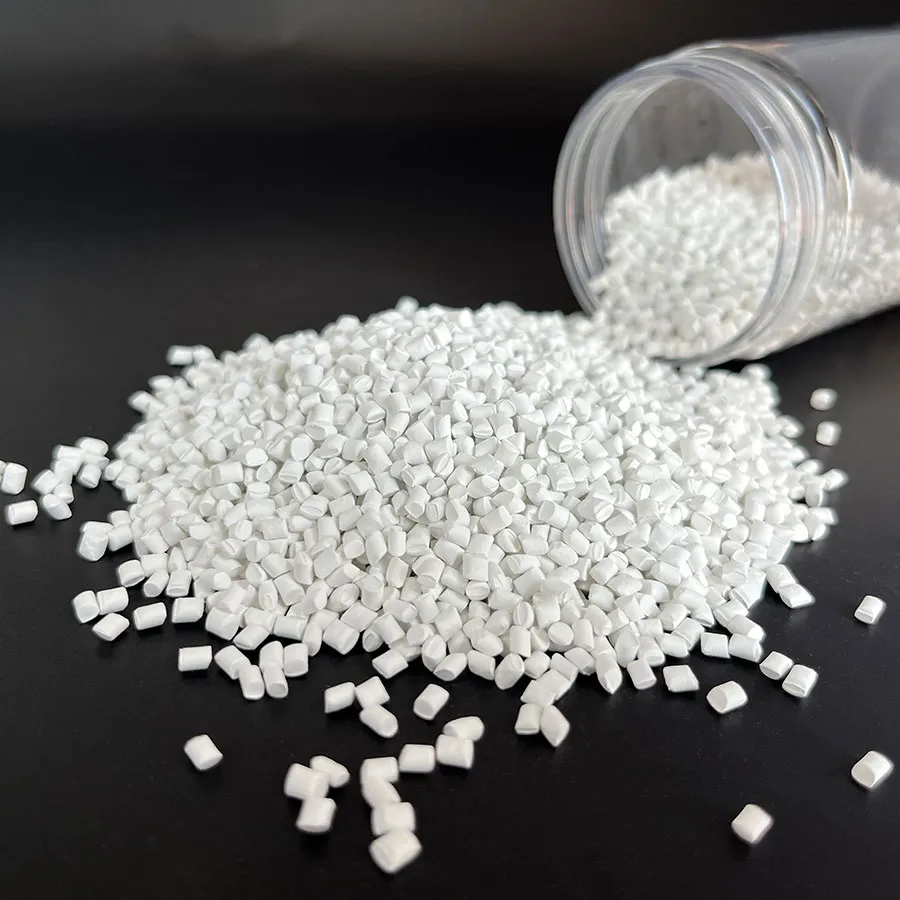
White masterbatch primarily uses titanium dioxide, commonly known as TiO₂, to provide whiteness and opacity.
It is widely used when manufacturers require a bright white appearance or strong covering power.
Typical Applications
White masterbatch is commonly found in:
- Plastic film
- Packaging
- Household products
- Injection molded products
- Blow molded containers
- Pipes
- Sheets
- Consumer goods
Important Performance Characteristics
Key factors include:
- TiO₂ concentration
- Whiteness
- Brightness
- Opacity
- Dispersion
- Heat resistance
- Weather resistance
Higher titanium dioxide loading does not automatically mean better performance. The effectiveness of a white masterbatch also depends on pigment quality, dispersion technology, carrier compatibility, and final dosage.
4. Filler Masterbatch
Filler masterbatch contains mineral fillers such as calcium carbonate or talc dispersed in a polymer carrier.
It is frequently used to optimize material costs and modify certain processing or physical properties.
Calcium Carbonate Masterbatch
Calcium carbonate, or CaCO₃, is one of the most widely used fillers in plastic manufacturing.
Typical applications include:
- Shopping bags
- Garbage bags
- Woven sacks
- Injection molded products
- Blow molding
- Extrusion
- Plastic sheets
- Pipes
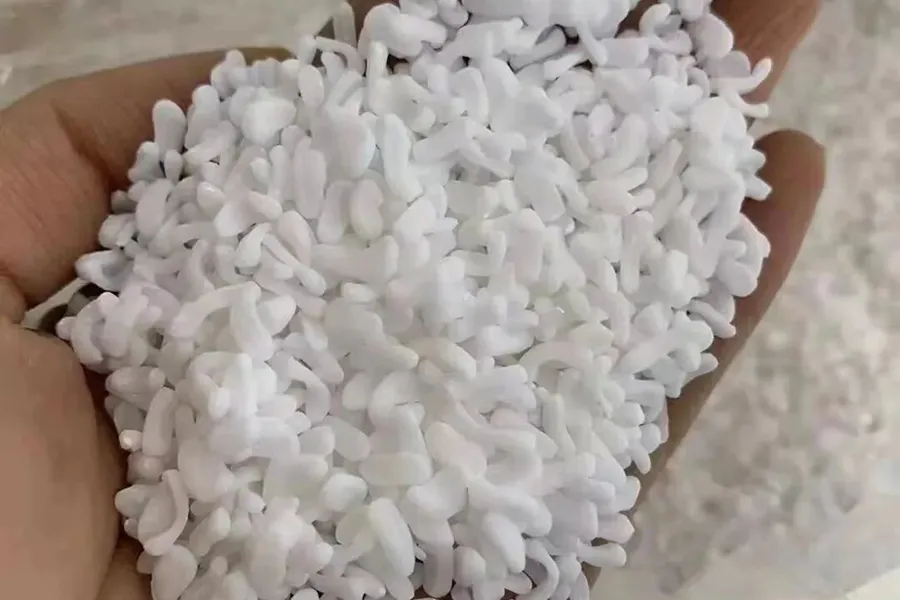
5. Desiccant Masterbatch
Moisture can create serious problems when recycled plastics or moisture-sensitive raw materials are processed.
Possible defects include:
- Bubbles
- Silver streaks
- Surface defects
- Poor mechanical performance
- Unstable extrusion
- Reduced product quality
Desiccant masterbatch contains moisture-absorbing components that help reduce the impact of residual moisture during processing.
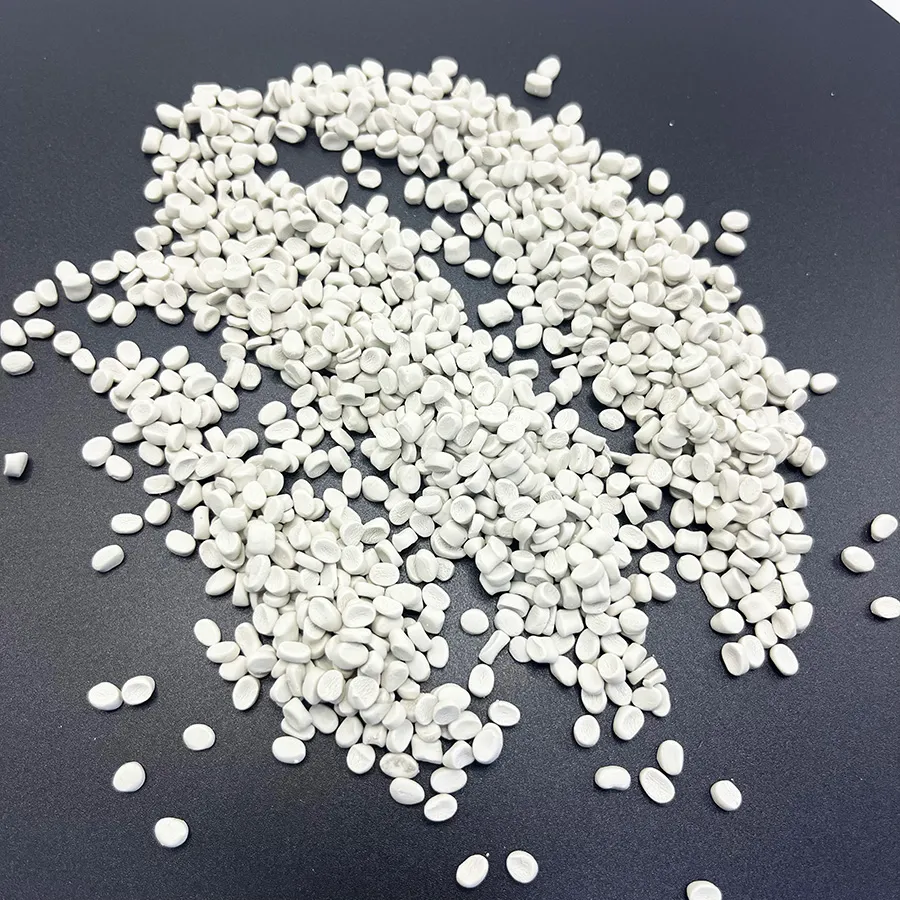
It is commonly used in:
- Recycled PE
- Recycled PP
- Film production
- Injection molding
- Extrusion
- Plastic recycling applications
Desiccant masterbatch can simplify processing in some recycling applications, although it should not be considered a universal substitute for proper material drying.
Masterbatch Solutions by Plastic Processing Method
Choosing the correct masterbatch also depends on the manufacturing process.
Masterbatch for Film Blowing
Blown film applications require excellent dispersion because pigment or filler agglomeration can cause:
- Film breakage
- Uneven color
- Surface defects
- Poor printing performance
- Reduced mechanical strength
Typical masterbatch products used in film production include:
- Color masterbatch
- Black masterbatch
- White masterbatch
- CaCO₃ filler masterbatch
- Slip masterbatch
- Antiblock masterbatch
- UV masterbatch
Carrier compatibility and particle dispersion are especially important for thin films.
Masterbatch for Injection Molding
Injection molding covers an extremely wide range of products, from household goods to automotive components.
Suitable masterbatch may include:
- Color masterbatch
- White masterbatch
- Black masterbatch
- Talc masterbatch
- Flame-retardant masterbatch
- Antistatic masterbatch
- UV masterbatch
Injection molding formulations should provide good heat stability and dispersion while maintaining stable melt flow.
Masterbatch for Blow Molding
Blow molding is frequently used for bottles, containers, drums, and industrial packaging.
Important masterbatch characteristics include:
- Uniform color
- Stable melt behavior
- Good dispersion
- Suitable heat resistance
- Consistent processing
Color, white, black, UV, and filler masterbatch are commonly used in blow molding.
Masterbatch for Extrusion
Extrusion is used to manufacture:
- Pipes
- Profiles
- Sheets
- Cables
- Films
- Plastic boards
Masterbatch used for extrusion must maintain stable dispersion during continuous processing.
Depending on the product, manufacturers may use black, white, color, filler, UV, flame-retardant, or processing aid masterbatch.
Choosing the Right Masterbatch Solution
The most suitable masterbatch cannot be selected only by color or price.
Several technical factors should be evaluated.
1. Base Polymer
The masterbatch carrier should be compatible with the base resin.
Common base polymers include:
- LDPE
- LLDPE
- HDPE
- PP
- PS
- ABS
- PET
- EVA
- PA
Poor carrier compatibility may cause dispersion problems, surface defects, or reduced mechanical performance.
2. Manufacturing Process
Different processing technologies create different shear forces, temperatures, and residence times.
The supplier should therefore understand whether the material will be used for:
- Film blowing
- Injection molding
- Blow molding
- Extrusion
- Rotational molding
- Fiber production
3. Required Dosage
Masterbatch dosage affects both product performance and manufacturing cost.
Typical dosage depends on:
- Pigment concentration
- Target color
- Filler content
- Functional additive concentration
- Polymer type
- Product thickness
- Application requirements
Rather than selecting masterbatch purely by price per kilogram, manufacturers should compare cost per finished product at the required dosage.
4. Dispersion
Good dispersion is one of the most important indicators of masterbatch quality.
Poor dispersion can cause:
- Color spots
- Uneven pigmentation
- Filter blockage
- Surface defects
- Weak points
- Film breakage
Fine and uniform dispersion becomes even more important for thin film, fiber, and high-quality injection molding applications.
5. Processing Temperature
Pigments and additives must remain stable at the processing temperature of the polymer.
A pigment suitable for polyethylene may not necessarily tolerate the higher processing temperatures used with engineering plastics.
Heat resistance should therefore be verified before mass production.
6. End-Use Environment
Manufacturers should also consider where the final plastic product will be used.
Questions include:
- Will the product be used outdoors?
- Will it contact food?
- Will it be exposed to sunlight?
- Is electrical conductivity important?
- Is flame resistance required?
- Will the material experience high temperatures?
- Is recycled plastic being used?
These factors directly influence masterbatch formulation.
Masterbatch Solutions for Recycled Plastics
The use of recycled polymers continues to increase in plastic manufacturing.
However, recycled materials often create additional challenges such as:
- Color inconsistency
- Residual moisture
- Odor
- Contamination
- Variable melt flow
- Reduced mechanical properties
Masterbatch can help processors manage some of these issues.
Common solutions include:
Black Masterbatch
Helps mask color variations in recycled resin.
Color Masterbatch
Helps standardize product appearance.
Desiccant Masterbatch
Helps reduce processing problems associated with residual moisture.
Filler Masterbatch
May help optimize formulation costs.
Functional Additives
May help improve UV resistance, processing stability, or other specific properties.
The exact formulation should still be tested because recycled plastic composition can vary significantly between batches.
What Information Should You Provide to a Masterbatch Supplier?
Providing complete technical information helps the supplier recommend a more suitable formulation.
Before requesting a quotation or sample, provide:
- Base polymer
- Product type
- Processing method
- Processing temperature
- Required color
- Pantone or RAL number if available
- Physical color sample if available
- Required masterbatch dosage
- Functional requirements
- Outdoor or indoor application
- Target annual or monthly consumption
For specialized applications, product samples and production trial information can also improve formulation accuracy.
Conclusion
Effective masterbatch solutions for plastic applications depend on the relationship between the base polymer, processing method, required appearance, functional properties, dosage, and end-use conditions.
For plastic manufacturers, the best approach is therefore not simply to search for the cheapest masterbatch, but to identify a formulation that provides reliable dispersion, compatible processing, consistent performance, and an economical dosage.