
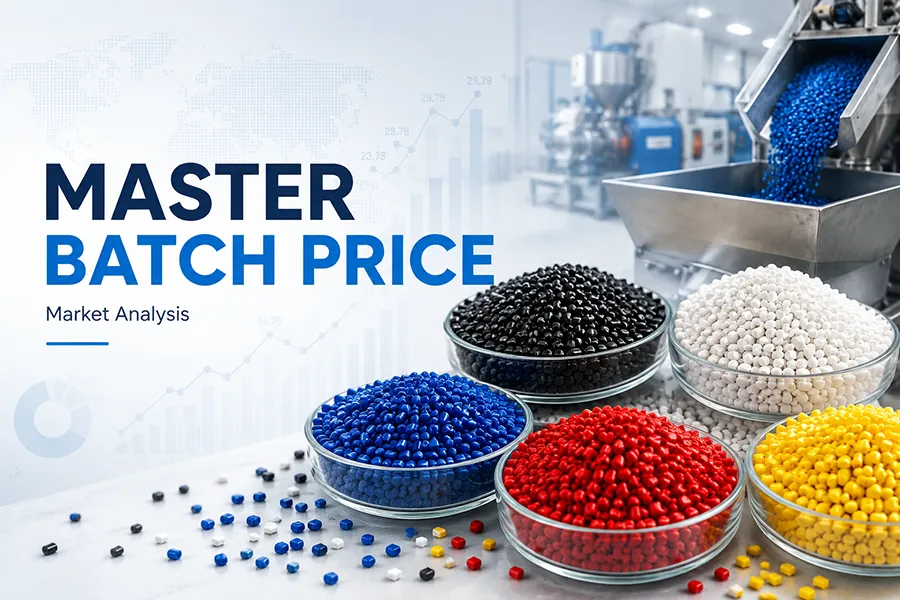
Masterbatch is widely used in plastic manufacturing to add color, improve processing performance, reduce production costs, and introduce specific functional properties. For manufacturers, distributors, and purchasing managers, understanding the майстерна партія price is essential for controlling material expenses and selecting a reliable supplier.
However, comparing masterbatch quotations is not always straightforward. Two products with similar names may contain different pigments, carrier resins, additive concentrations, fillers, and processing aids. They may also perform differently during extrusion, injection molding, film blowing, or blow molding.
For this reason, buyers should not evaluate masterbatch based only on the price per ton. The recommended dosage, dispersion quality, production stability, batch consistency, logistics costs, and technical support should also be included in the purchasing decision.
This guide explains the main factors affecting master batch price, the price differences between common masterbatch types, and practical strategies for reducing total purchasing costs.
Understanding the Masterbatch Market
Demand for masterbatch continues to grow across packaging, automotive components, construction materials, agricultural films, household products, electrical appliances, and consumer goods.
At the same time, plastic manufacturers are asking for more than basic coloring performance. Many applications now require higher color consistency, improved dispersion, better compatibility with recycled plastics, lower dosage rates, and compliance with specific industry regulations.
The market is gradually shifting from simple price competition toward a broader evaluation of product performance and total production cost.
Several trends can influence the master batch price:
- Fluctuations in pigment and resin prices;
- Changes in titanium dioxide and carbon black costs;
- Higher demand for functional masterbatch;
- Increasing use of recycled plastics;
- More customized color requirements;
- Stricter environmental and product compliance standards;
- Changes in international freight and energy costs.
Because raw material prices and customer requirements vary, masterbatch quotations may change over time. Buyers should review both current pricing and long-term supply stability before signing a purchasing agreement.
What Determines Master Batch Price?
The final price of masterbatch is influenced by technical, production, and commercial factors. Understanding these elements makes it easier to compare quotations accurately.
1. Pigment or Functional Additive Type
Pigments and functional additives are often the most important cost components in a masterbatch formulation.
Standard inorganic pigments are usually more economical, while high-performance organic pigments, fluorescent pigments, pearlescent pigments, and heat-resistant pigments can significantly increase the product price.
Functional masterbatch may contain materials such as:
- UV stabilizers;
- Flame retardants;
- Antistatic agents;
- Antibacterial additives;
- Slip agents;
- Antiblock additives;
- Conductive carbon black;
- Processing aids;
- Moisture absorbers;
- Light stabilizers.
The price of functional masterbatch depends on both the additive type and its effective concentration.
For example, a standard black masterbatch and a conductive black masterbatch may look similar, but their formulations and performance are completely different. Conductive products require specialized carbon black and more demanding dispersion technology, which results in a higher price.
When comparing master batch price, buyers should confirm the exact pigment or additive type instead of relying only on the product name.
2. Carrier Resin
The carrier resin helps distribute pigments, fillers, or additives evenly throughout the final plastic material.
Common carrier resins include:
- Polyethylene, or PE;
- Polypropylene, or PP;
- Polyethylene terephthalate, or PET;
- Polyvinyl chloride, or PVC;
- Polystyrene, or PS;
- Acrylonitrile butadiene styrene, or ABS;
- Polyamide, or PA;
- Ethylene-vinyl acetate, or EVA;
- Universal carrier systems.
The selected carrier should be compatible with the customer’s base polymer and processing temperature.
PE- and PP-based masterbatch is generally more economical than products designed for engineering plastics such as PA, PET, PC, or ABS. High-temperature applications may also require specialized carrier resins, increasing the final price.
An incompatible carrier can cause poor dispersion, surface defects, unstable processing, reduced mechanical strength, or pigment migration. Therefore, carrier compatibility is more important than choosing the lowest quotation.
3. Pigment or Active Ingredient Concentration
The concentration of pigment, filler, or functional additive directly affects both the purchase price and the recommended dosage.
A higher-concentration masterbatch may have a higher price per ton, but it may require a lower addition rate. As a result, the actual production cost may be lower.
Наприклад:
- Masterbatch A costs USD 1,100 per ton and requires a 5% dosage;
- Masterbatch B costs USD 1,400 per ton and requires a 2.5% dosage.
The masterbatch cost per ton of finished plastic would be:
- Product A: USD 1,100 × 5% = USD 55;
- Product B: USD 1,400 × 2.5% = USD 35.
Although Product B has a higher purchase price, its actual usage cost is lower.
The correct comparison formula is:
Masterbatch Cost per Ton of Finished Product = Masterbatch Price × Addition Rate
This calculation provides a more accurate basis for comparing masterbatch suppliers.
4. Dispersion Quality
Dispersion quality is one of the most important indicators of masterbatch performance.
Poorly dispersed pigments, fillers, or additives may cause:
- Color spots;
- Black spots;
- Uneven coloring;
- Film breakage;
- Filter blockage;
- Rough surfaces;
- Reduced gloss;
- Lower mechanical strength;
- Increased scrap rates;
- Production interruptions.
High-quality masterbatch normally requires controlled raw material mixing, suitable screw design, stable extrusion temperatures, effective melt compounding, filtration, pelletizing, and batch inspection.
These processes may increase manufacturing costs, but they can reduce waste, equipment cleaning, downtime, and customer complaints.
Трохи вище master batch price may therefore result in a lower total manufacturing cost.
5. Color Matching Requirements
Standard black, white, and commonly used colors are usually more economical because manufacturers can produce them in larger quantities using established formulations.
Customized colors require additional development work, including:
- Sample analysis;
- Pigment selection;
- Laboratory color matching;
- Trial production;
- Color adjustment;
- Тестування застосунків.
The price may increase when customers require:
- Pantone color matching;
- RAL color matching;
- Matching based on a physical sample;
- Very low color tolerance;
- High-gloss or matte effects;
- Stable color under different light sources;
- High-temperature resistance;
- Outdoor weather resistance;
- Compatibility with recycled plastic;
- Food-contact or other regulatory compliance.
Small customized orders are generally more expensive because of setup costs, cleaning requirements, testing, and production losses.
6. Masterbatch Type
Different masterbatch categories have different raw material and production cost structures.
Black Masterbatch Price
Black masterbatch pricing mainly depends on:
- Carbon black content;
- Carbon black grade;
- Jetness;
- Undertone;
- Dispersion;
- UV resistance;
- Carrier resin;
- Conductive or antistatic properties.
Standard black masterbatch for pipes, films, sheets, and injection-molded products is usually more affordable than high-jetness, blue-tone, food-contact, UV-resistant, or conductive black masterbatch.
Some low-priced black masterbatch may contain a high proportion of calcium carbonate or recycled carrier resin. Buyers should confirm the ash content, carbon black content, recommended dosage, and application suitability before placing an order.
White Masterbatch Price
White masterbatch pricing is strongly affected by titanium dioxide type and concentration.
Rutile titanium dioxide generally provides better opacity, weather resistance, and light stability. It is often used in outdoor products, premium packaging, films, and durable plastic parts.
Anatase titanium dioxide may be suitable for some indoor or general-purpose applications but usually provides lower weather resistance.
When comparing white masterbatch, buyers should evaluate:
- Titanium dioxide content;
- Titanium dioxide type;
- Whiteness;
- Непрозорість;
- Dispersion;
- Surface quality;
- Recommended dosage.
A high titanium dioxide percentage does not automatically guarantee better performance. Dispersion and formulation quality also influence the final result.
Color Masterbatch Price
Color masterbatch prices vary widely because different colors require different pigment systems.
Bright red, orange, purple, fluorescent, pearlescent, metallic, and high-temperature colors may require expensive specialty pigments.
The final price is also influenced by:
- Color matching accuracy;
- Order volume;
- Carrier resin;
- Processing temperature;
- Lightfastness;
- Погодостійкість;
- Нормативні вимоги;
- Recycled material compatibility.
Standard colors generally cost less than customized colors because they can be produced in larger batches.
Filler Masterbatch Price
Filler masterbatch is commonly made with calcium carbonate, sodium sulfate, talc, or other mineral fillers.
It may be used to:
- Reduce raw material costs;
- Improve stiffness;
- Adjust shrinkage;
- Improve dimensional stability;
- Modify processing performance.
Ціна залежить від:
- Filler type;
- Filler concentration;
- Particle size;
- Обробка поверхонь;
- Carrier resin;
- Moisture content;
- Whiteness;
- Dispersion quality.
Extremely low-priced filler masterbatch may contain coarse particles, excessive moisture, unstable filler content, or insufficient carrier resin. These problems can reduce product strength, increase film breakage, and cause equipment wear.
Functional Masterbatch Price
Functional masterbatch includes products such as:
- Desiccant masterbatch;
- UV masterbatch;
- Flame-retardant masterbatch;
- Antistatic masterbatch;
- Antibacterial masterbatch;
- Slip masterbatch;
- Antiblock masterbatch;
- Processing aid masterbatch.
The price depends on the functional ingredient, active concentration, performance target, and recommended dosage.
Two functional masterbatches should not be compared only by price per ton. Buyers should also compare active content, test results, dosage, and final product performance.
7. Кількість замовлення
Order volume is an important commercial factor affecting the final quotation.
Large orders may help manufacturers reduce:
- Raw material purchasing costs;
- Equipment setup costs;
- Cleaning costs;
- Packaging costs;
- Average production losses;
- Адміністративні витрати.
Suppliers may offer different pricing levels for:
- Samples;
- Trial orders;
- Standard production batches;
- Full-container orders;
- Annual purchasing contracts.
Standard products normally have lower minimum order quantities than customized color or functional masterbatch.
Buyers with stable demand may obtain a more competitive master batch price by providing quarterly or annual purchasing forecasts.
8. Вимоги до упаковки
Standard masterbatch packaging usually includes 20 kg or 25 kg moisture-resistant bags.
Other packaging options may include:
- Paper-plastic composite bags;
- Vacuum packaging;
- Aluminum-lined bags;
- Ton bags;
- Palletized packaging;
- Customized labels;
- Small bag packaging.
Special packaging increases material and labor costs.
Packaging quality is especially important for desiccant masterbatch and other moisture-sensitive products. Damaged or poorly sealed bags may reduce product performance during storage and transportation.
9. Logistics and Trade Terms
International buyers should compare supplier quotations using the same trade terms.
Common trade terms include:
- EXW;
- FOB;
- CIF;
- DDP.
Остаточна вартість посадки може включати:
- Внутрішнє перевезення;
- Export documentation;
- Морські перевезення вантажів;
- Страхування;
- Port charges;
- Import duties;
- Customs clearance;
- Local delivery;
- Pallets;
- Спеціальна упаковка.
A low EXW quotation may become more expensive than a higher FOB or CIF quotation after transportation and import costs are included.
The most accurate method is to calculate the total cost delivered to the buyer’s factory.
How to Compare Masterbatch Supplier Quotations
Comparing quotations requires more than placing several price lists side by side. Buyers should standardize product specifications and evaluate the total usage cost.
Standardize the Technical Requirements
When requesting quotations from multiple suppliers, provide the same technical information to each company.
Важливі деталі включають:
- Base polymer;
- Processing method;
- Final product;
- Processing temperature;
- Target color;
- Color reference;
- Required function;
- Current dosage;
- Required certifications;
- Order quantity;
- Packaging requirements;
- Пункт призначення доставки.
Without consistent specifications, suppliers may quote products with different concentrations, raw materials, or performance levels.
Request Samples and Production Trials
Sample testing is essential before placing a large order.
Recommended evaluation items include:
- Color accuracy;
- Dispersion;
- Непрозорість;
- Jetness;
- Whiteness;
- Surface quality;
- Melt flow;
- Moisture;
- Heat resistance;
- Погодостійкість;
- Mechanical performance;
- Запах.
Whenever possible, test the masterbatch on the buyer’s actual production equipment and base material.
Laboratory samples may not fully represent performance during film blowing, extrusion, injection molding, or blow molding.
Compare the Actual Dosage
The addition rate directly affects the final production cost.
A cheaper masterbatch that requires a higher dosage may be more expensive in actual use.
Покупцям слід порівняти:
- Price per ton;
- Recommended dosage;
- Cost per ton of finished plastic;
- Scrap rate;
- Cleaning frequency;
- Production stability;
- Final product quality.
A more complete evaluation formula is:
Total Usage Cost = Masterbatch Cost + Scrap Cost + Downtime Cost + Quality Risk
This approach provides a more realistic comparison than evaluating the purchase price alone.
Оцінка узгодженості партії
A successful sample does not guarantee stable future deliveries.
A reliable masterbatch manufacturer should have:
- Incoming raw material inspection;
- Standardized formulation management;
- Production process control;
- Color measurement equipment;
- Melt flow testing;
- Moisture testing;
- Batch traceability;
- Retained samples;
- Final product inspection.
For long-term purchasing, batch consistency is often more valuable than a small difference in price.
Check the Supplier’s Technical Capability
A professional supplier should understand the customer’s resin, processing method, equipment, and final application.
Технічна підтримка може включати:
- Вибір продукту;
- Color matching;
- Dosage optimization;
- Processing troubleshooting;
- Formula adjustment;
- тестування зразків;
- Розробка на замовлення.
A supplier with strong technical capabilities may help reduce dosage, improve production stability, and lower total costs.
Smart Purchasing Strategies for Lower Masterbatch Costs
Build a Purchasing Forecast
Providing quarterly or annual demand forecasts helps suppliers prepare raw materials and production capacity.
This may lead to more stable pricing, shorter delivery times, and lower urgent production costs.
Use Trial Orders Before Bulk Purchases
A trial order allows the buyer to evaluate product performance under real production conditions.
It also reduces the risk of purchasing a large quantity of unsuitable material.
Optimize the Addition Rate
The dosage should be tested according to the required color, opacity, or functional performance.
Excessive dosage increases costs and may affect processing or mechanical properties. Insufficient dosage may cause unstable color or inadequate functionality.
The lowest effective dosage should be determined through production testing.
Consolidate Similar Products
Manufacturers may use several similar colors or formulations across different product lines.
Where possible, standardizing these materials can:
- Increase order volume;
- Simplify inventory management;
- Reduce purchasing complexity;
- Improve bargaining power;
- Reduce the risk of material shortages.
Maintain Reasonable Safety Stock
Masterbatch is formulation-sensitive. Replacing it with an untested product may cause color changes or production problems.
Maintaining reasonable safety stock can prevent production interruptions caused by shipping delays, raw material shortages, or unexpected demand.
However, moisture-sensitive and functional masterbatch should not be stored for excessive periods.
Negotiate Based on Annual Volume
Instead of negotiating each order separately, buyers can discuss pricing based on estimated annual demand.
An annual purchasing agreement may provide:
- Better unit pricing;
- More stable supply;
- Priority production;
- Consistent formulations;
- Improved payment terms;
- Reduced lead times.
The agreement should also include clear quality specifications and procedures for handling nonconforming products.
Побудуйте довгострокові відносини з постачальниками
A stable supplier can provide more than a competitive master batch price.
Long-term cooperation may offer:
- Faster color matching;
- Stable formulations;
- Priority production;
- Customized technical support;
- Improved quality consistency;
- More predictable pricing;
- Better communication.
The lowest-priced supplier is not always the most economical choice. A reliable supplier can reduce waste, downtime, quality complaints, and repeated testing costs.
Common Mistakes When Buying Masterbatch
Comparing Only the Price per Ton
This is one of the most common purchasing mistakes.
A lower-priced masterbatch may require a higher dosage, resulting in a higher cost per finished product.
Ignoring Carrier Compatibility
An unsuitable carrier may cause poor dispersion, surface defects, or reduced mechanical performance.
Skipping Production Testing
A laboratory sample may perform differently on the actual production line.
Focusing Only on Pigment Percentage
A high pigment percentage does not always guarantee better coloring performance. Pigment quality, dispersion, and formulation design are equally important.
Ignoring Moisture and Packaging
Poor packaging may allow the masterbatch to absorb moisture, resulting in bubbles, silver streaks, or surface defects.
Choosing an Unstable Supplier
Frequent formulation changes or inconsistent raw materials may cause color differences and production instability.
What Information Should Be Included in a Masterbatch Inquiry?
To receive an accurate quotation, buyers should provide the following information:
- Plastic resin type;
- Processing method;
- Final application;
- Target color or physical sample;
- Processing temperature;
- Current masterbatch dosage;
- Required functions;
- Performance standards;
- Estimated order quantity;
- Annual demand;
- Packaging requirements;
- Delivery destination;
- Preferred trade terms.
Complete information helps the supplier recommend a suitable formulation and provide an accurate master batch price.
Висновок
Команда master batch price is determined by pigment type, additive concentration, carrier resin, dispersion quality, color requirements, production volume, packaging, logistics, and supplier quality control.
Buyers should avoid making purchasing decisions based only on the quoted price per ton. A more effective approach is to compare actual dosage, cost per finished product, production stability, scrap rate, batch consistency, and technical support.
For standard masterbatch, bulk purchasing and long-term supply agreements may help reduce costs. For customized colors and functional masterbatch, formulation compatibility and production performance should receive greater attention.
The most cost-effective masterbatch is not necessarily the product with the lowest quotation. It is the product that achieves the required color or function at a suitable dosage while reducing waste, downtime, and quality risks.